
A rep opens ChatGPT the night before a renewal call, types "pretend you are a tough buyer," and gets a polite prospect who folds after the first decent answer. The rehearsal feels useful, and then the real buyer says something the AI never tried.
For one rep rehearsing alone, ChatGPT is a cheap and flexible practice partner, and a good prompt makes it far better. For a team or a trainer, a dedicated AI role play platform fits better, because everyone practices the same scenario, the buyer holds its position, and feedback follows the team's own criteria. That is the short answer to AI role play vs ChatGPT, and the rest of this post shows where the line sits.
Updated November 2026. By Julia Georgi, founder of Georgia App.
Georgia wrote this comparison, so we have tried to be fair and to say where other tools fit better.
What is the difference between AI role play and ChatGPT?
ChatGPT is a general assistant that can play almost any character you describe, as long as you write the instructions yourself and keep steering it during the conversation. An AI role play platform is built for one job: it gives people a prepared counterpart with a fixed brief, lets them practice out loud or in text, and scores each attempt against criteria someone set in advance.
Both can talk back in voice and play a skeptical CFO if you set them up well. The difference sits around the conversation: who writes the scenario, whether it stays the same for every rep, how hard the buyer pushes, and what happens after the call ends.
Is ChatGPT good for sales role play?
Yes. It is cheap, always available, and adapts to almost any product or buyer you describe.
Price: ChatGPT has a free plan, and OpenAI's help center lists ChatGPT Plus at $20 a month, billed monthly. For a rep paying from their own pocket, that is hard to beat.
Voice: ChatGPT Voice lets you speak and hear a spoken reply. OpenAI says its Live option can listen and speak at the same time, so turn taking and interruptions feel more natural, and Plus includes 3 hours of Live voice in a rolling 24 hour window, according to the ChatGPT Voice help page.
Flexibility: You can paste your pitch, your pricing page and a real objection from last week, and ask it to play that exact buyer.
Projects: Projects in ChatGPT keep chats, files and instructions together, and project instructions apply to every chat inside that project. A rep can set up one project called "Renewal practice," load the product notes once, and come back to it every week.
One change is worth knowing about. OpenAI's help center says it plans to retire custom GPTs and move creators to plugins, with standard retirement scheduled for December 11, 2026, and new GPTs can no longer be created on personal accounts such as Plus. If your team planned to build a role play GPT, a project is now the safer place to keep the setup.
What are good ChatGPT role play prompts for sales?
A weak prompt gives you a friendly buyer who agrees too fast. A strong prompt sets the buyer's situation, tells the AI what it must not give away easily, and asks for feedback in a fixed format at the end. Here are three you can copy and adapt.
Prompt 1, the price objection: "You are the operations director at a mid-size distributor. You already use a cheaper competitor and you think our price is too high. Stay in character for the whole conversation. Do not agree to a next step unless I ask at least two good questions about your current costs and connect our offer to one of them. Keep your answers short, like a busy person on the phone. When I type STOP, step out of character and give me three things I did well and three things to fix, with one exact sentence I could have said instead."
Prompt 2, the cold call opener: "Play a busy VP of sales who picks up an unknown number between meetings. You have about 30 seconds of patience. Interrupt me if I talk about our product before I say why I called you specifically. Hang up politely if I sound like a script. Start the call by saying 'Yeah, who is this?' and wait for me."
Prompt 3, the stalled renewal: "You are a customer whose contract renews next month. Usage dropped this quarter and your new manager wants to cut tools. Raise budget first, then reveal the real concern only if I ask about results. Push back at least twice before you agree to anything. After the call, score me from 1 to 5 on discovery, handling the objection and asking for a clear next step, and explain each score in one sentence."
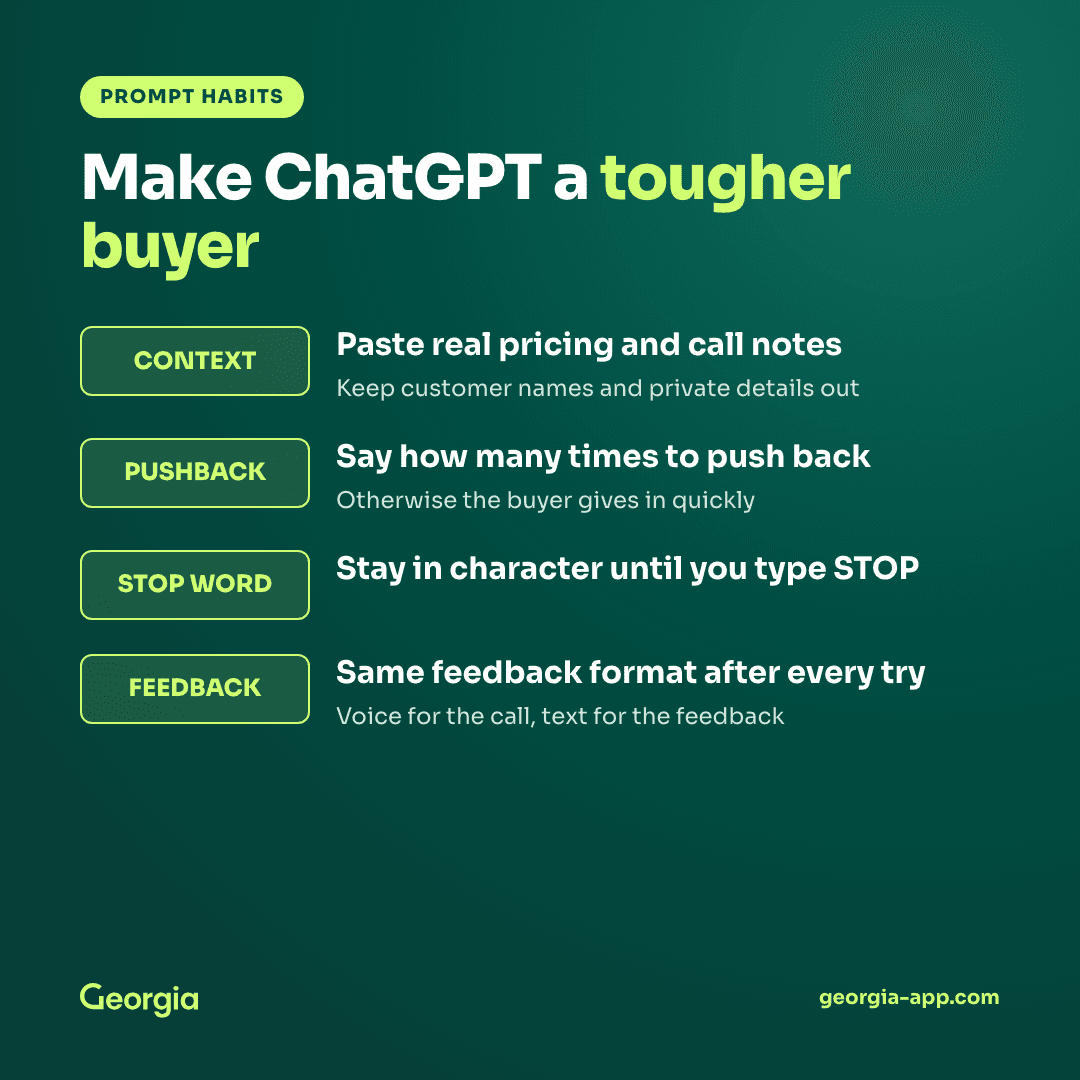
Three habits make any of these better. Paste in real context such as your pricing, a past email or call notes, and keep sensitive customer details out. Tell the AI how many times to push back, since it will otherwise give in quickly. Use voice for the conversation and text for the feedback, so you rehearse speaking and still get something you can reread.
Where does ChatGPT fall short for team sales training?
The gaps show up when a manager or trainer tries to turn ChatGPT into a practice program for a whole team.
Every rep writes their own prompt. One rep asks for a tough buyer, another for a friendly one. After a month you have a dozen different exercises with the same name, and nobody can say whether the team improved at the conversation you care about.
The AI drifts and agrees too easily. General assistants are tuned to be helpful, so a buyer character tends to soften after a few turns, accept a weak answer, or start coaching the rep in the middle of the call. You can fix much of this with careful instructions, and that is exactly the prompt work most reps will skip the night before a call.
There are no shared scenarios and no scoring on your criteria. Plain ChatGPT does not ship with scenarios built from your calls or a rubric based on your sales method. If you ask it to score a call, it will use its own idea of a good call unless you write the criteria in yourself, and each rep's version of those criteria will drift.
A manager can't see who practiced what. In plain ChatGPT, practice lives in each rep's own chat history. OpenAI does offer shared projects, where members can view the project's chats and files, and a Plus owner can invite up to 10 collaborators. That helps a small group share one setup, though a folder of chats is still a long way from knowing who practiced which scenario and how they scored.
Realistic pushback takes prompt skill. The prompts above work because they spell out the buyer's situation and when they give in. Writing that for every scenario and keeping it current is real work, and it usually lands on the busiest person on the team.
ChatGPT is still a strong general tool. Team practice simply needs structure on top of it, and someone has to build and maintain that structure.
How does a dedicated AI role play platform handle these gaps?
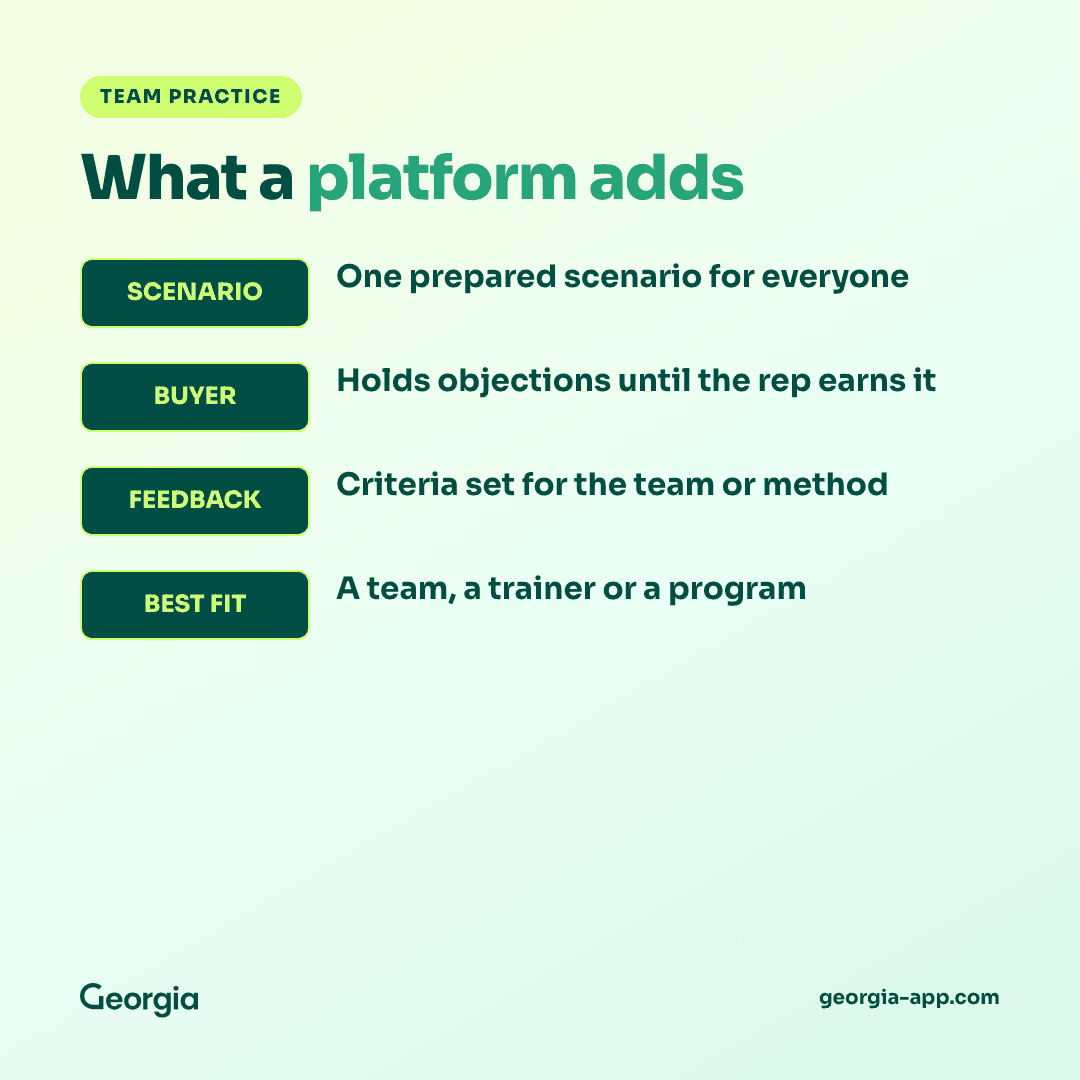
A role play platform moves the setup work from each rep to one place. The scenario, the buyer's behavior and the feedback criteria are written once, tested, and then every person practices the same conversation.
SOLO OR TEAM PRACTICE
ChatGPT prompts or a role play platform
Georgia · georgia-app.com
At Georgia, people practice realistic conversations with an AI buyer, client, employee or investor, out loud or by typing, and get feedback after each attempt before they try again. Teams can practice in any language the team sells in. The Georgia team builds custom modules around a team's real calls, and trainers can bring their own method so the scenarios and the feedback criteria follow it while the method stays theirs. Our co-founder Delphine Voillet has over 25 years of coaching experience, and we work with experienced trainers to build scenarios from real calls.
As our site puts it: "Most AI role play tools let you try their ready-made scenarios. We build yours." If you want to see how several platforms compare on scenarios, feedback and pricing, read our comparison of AI sales role play tools.
When should you use ChatGPT and when a role play platform?
It depends on who is practicing and who needs to see the result.
Use ChatGPT if you are a single rep or a founder preparing for one important call, you are comfortable writing a detailed prompt, and you do not need anyone else to review your practice.
Use a role play platform if you manage a team and want everyone to practice the same conversation, you are a trainer who sells your own method and wants the feedback to follow it, or you need practice for conversations that generic prompts handle poorly, such as industry calls with specific language. Our page for sales trainers explains how this works when the method belongs to you.
Use both if you want reps to keep a quick ChatGPT habit for last minute prep while the team runs structured scenarios on a platform. This mix works well as long as the shared scenarios remain the reference point for what good looks like.
There are cases where Georgia is not the right pick. A large SaaS SDR floor that wants deep CRM driven analytics, a big ready-made scenario library or self-serve scenario building at scale will usually be better served by the larger platforms. Our post on choosing AI sales coaching tools for your team type walks through that choice in more detail.
How can you start practicing this week?
Here is a short plan you can run with ChatGPT now, and it will also tell you what to ask of a platform later.
- Pick one conversation that costs you deals, such as a price objection or a stalled renewal, and write down what a good outcome looks like.
- Copy one of the three prompts above, add real context from a recent call, and remove any customer names or private details.
- Run the role play in voice at least three times, changing one thing in your approach each time.
- Ask for feedback in the same format after every attempt and save the best sentence you found.
- If you lead a team, give everyone the same prompt for one week and compare what each person learned on Friday.
- Note where the AI went easy on you, and decide whether fixing that yourself is worth the time or whether a prepared scenario would save it.
For more on building practice into a small team's week, see our guide to objection handling practice software.
Frequently asked questions
Can I use ChatGPT for sales role play?
Yes. ChatGPT can play a buyer, a customer or a manager if you describe the situation and tell it how to behave. It works best when you set the objections, how often it should push back, and the feedback format you want at the end.
Is an AI role play tool better than ChatGPT?
For one person preparing for one call, ChatGPT is often enough and costs less. For a team or a trainer, a dedicated tool is usually better because everyone practices the same scenario and the feedback follows shared criteria. The right choice depends on whether consistency across people matters to you.
Can ChatGPT do voice role play?
Yes. ChatGPT Voice lets you speak and hear spoken replies, and OpenAI says its Live option can listen and speak at the same time. Usage limits depend on your plan, and OpenAI lists 3 hours of Live voice per rolling 24 hours on Plus.
How do I stop ChatGPT from agreeing too quickly in a role play?
Tell it exactly what the buyer cares about, what they will hide, and how many times they must push back before agreeing to anything. Ask it to stay in character until you type a stop word, and keep the buyer's answers short. If it still softens, restate the instruction and restart the scenario.
Can a sales trainer use ChatGPT to deliver their method?
A trainer can write prompts that reflect the method and keep them in a shared project. Scoring every participant consistently against the method is harder, and a platform built around the trainer's criteria handles that part.
Which should you choose for your team?
If you are rehearsing alone, open ChatGPT tonight and use the prompts above. If you are responsible for how a whole team or a cohort of trainees practices, you will get more from shared scenarios built around your real calls and feedback that follows your criteria.
Georgia offers quote pricing with a free pilot, and teams and programs that qualify as partners get a free custom module built around one of their real calls. If that sounds useful, book a demo of Georgia and bring the call your team finds hardest.
Sources
- OpenAI Help Center, What is ChatGPT Plus?, checked November 19, 2026
- OpenAI, Plans and Pricing, checked November 19, 2026
- OpenAI Help Center, ChatGPT Voice, checked November 19, 2026
- OpenAI Help Center, Creating and editing GPTs, checked November 19, 2026
- OpenAI Help Center, Projects in ChatGPT, checked November 19, 2026