
It is a Tuesday evening, and a new life insurance agent is sitting at a kitchen table with a couple in their early thirties. The baby monitor crackles on the counter, the quote for a 20-year term policy is on the table, and the husband looks at his wife and says they need to think about it.
The agent says the scripted reply from training, the room goes quiet, and she drives home with a follow-up date both sides know will slip.
This post is for life, health, P&C and Medicare agents, and for the managers and trainers who coach them. It covers the insurance sales objections you hear every week, what each one usually means, calm and compliant answers you can practice, the renewal call where a client wants to cancel, and a short drill you can run before Friday.
Why insurance sales objections are so predictable
Most sales trainers will tell you to welcome objections and listen first, and they are right. The trouble is that advice everyone agrees on stays generic, and generic advice falls apart at the kitchen table when a real person goes quiet. What helps more is knowing the specific worry behind each objection in insurance, because the worries are well documented.
Price is guessed, rarely known. LIMRA's 2026 workplace fact sheet, drawn from the 2026 Insurance Barometer Study, reports that 45% of people who need life insurance or more coverage say it is too expensive. In the same fact sheet, 46% of Americans say their estimate of the cost is a "gut feeling" or a "wild guess". The 2025 Barometer found that healthy adults aged 18 to 30 overestimated the median cost of a $250,000, 20-year term policy by about 10 to 12 times.
Workplace cover feels like enough. According to the same LIMRA fact sheet, 27% of insured Americans have workplace life insurance and no individual coverage, while 47% of adults say they would feel the financial impact within six months if a primary wage earner died.
Trust is lukewarm, on both sides of the Atlantic. EIOPA's 2025 Eurobarometer, based on 25,846 interviews across the EU, found that 53% of consumers trust insurers. That leaves a large share of the people you call in Europe starting the conversation with some doubt.
Renewals hurt. J.D. Power's 2026 U.S. Auto Insurance Study found that when customers get an insurer-initiated premium increase, their satisfaction with price falls by 155 points to 486 on a 1,000-point scale.
For a manager, the lesson is that most objections react to missing information or a bad surprise, which is why calm questions work better than clever rebuttals.
Insurance sales objections at a glance: what they mean and a calm answer
Use this table as a starting point for role play. Each answer opens the next question, and none asks the client to decide on the spot.
OBJECTION HANDLING
Six objections, six calm answers
Georgia · georgia-app.com
How to answer the most common insurance sales objections
Each answer below acknowledges what you heard, asks one question that finds the real concern, then gives a short, honest explanation.
"It's too expensive"
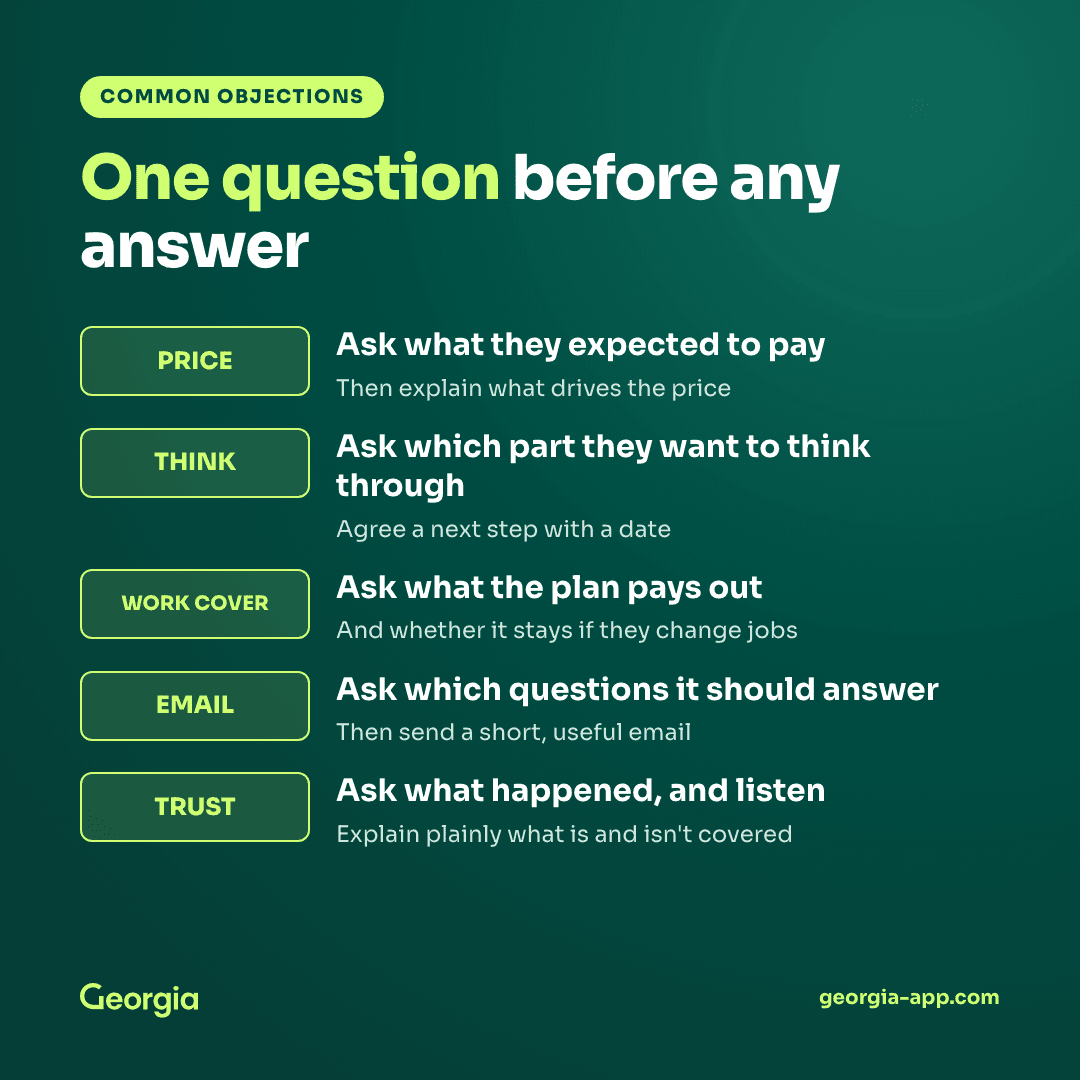
Start by finding out what "expensive" is compared to. Ask what they expected to pay, or what monthly figure would feel comfortable, and listen to the answer without defending the quote. When a client's number is a guess, a plain explanation of what drives the price (term length, coverage amount, health class) often does more than any rebuttal.
If the budget is the real limit, show the options honestly, such as a smaller face amount or a shorter term, with a clear note of what each one gives up.
"I need to think about it" or "I need to talk to my spouse"
This is often the most honest objection you will hear, and it deserves respect. Ask what they want to think through, because the answer usually points to one open question about cost, the amount of cover or the company. If a spouse is missing, offer to set up a short call with both of them, so the second person hears the explanation from you and not as a secondhand summary.
When both people are at the table, as in the opening scene, ask each of them what they would want to know before deciding, then agree a next step with a date.
"I already have coverage through work"
Treat the workplace plan as good news. Ask whether they know what it pays out, whether it would follow them if they changed jobs, and how long the family could manage on that amount. Many people have never looked, so a walk through their own benefits page is more convincing than any statistic, and the decision about whether it is enough stays with them.
"Just send me something by email"
Sometimes this is a polite exit, and sometimes the person genuinely prefers to read. Agree warmly, ask which questions the email should answer and when you could talk it through for ten minutes, and if they will not give a time, send a short, useful email anyway.
"I don't trust insurance companies"
Ask what is behind it and listen to the whole story, because a denied claim in the family is a real experience and arguing with it will lose the conversation. Explain plainly what the policy covers, what it excludes and how a claim works, and offer to put the key points in writing.
The renewal cancellation call: keeping a client who wants to leave
Renewal calls are harder than new business because the client knows you and feels let down. J.D. Power's 2026 study found that 30% of auto customers reported an insurer-initiated premium increase in the past year, and that only 58% say they completely understand their policy and what it covers. A client who calls to cancel often has a higher bill and a vague idea of what it buys.
Shopping has become normal behavior. In J.D. Power's 2025 U.S. Insurance Shopping Study, 57% of auto customers shopped for a new policy year over year, up from 49%, the highest rate in the study's history. The same study found that bundled customers stay an average of 7.0 years with their insurer, compared with 5.5 years for customers who are not bundled.
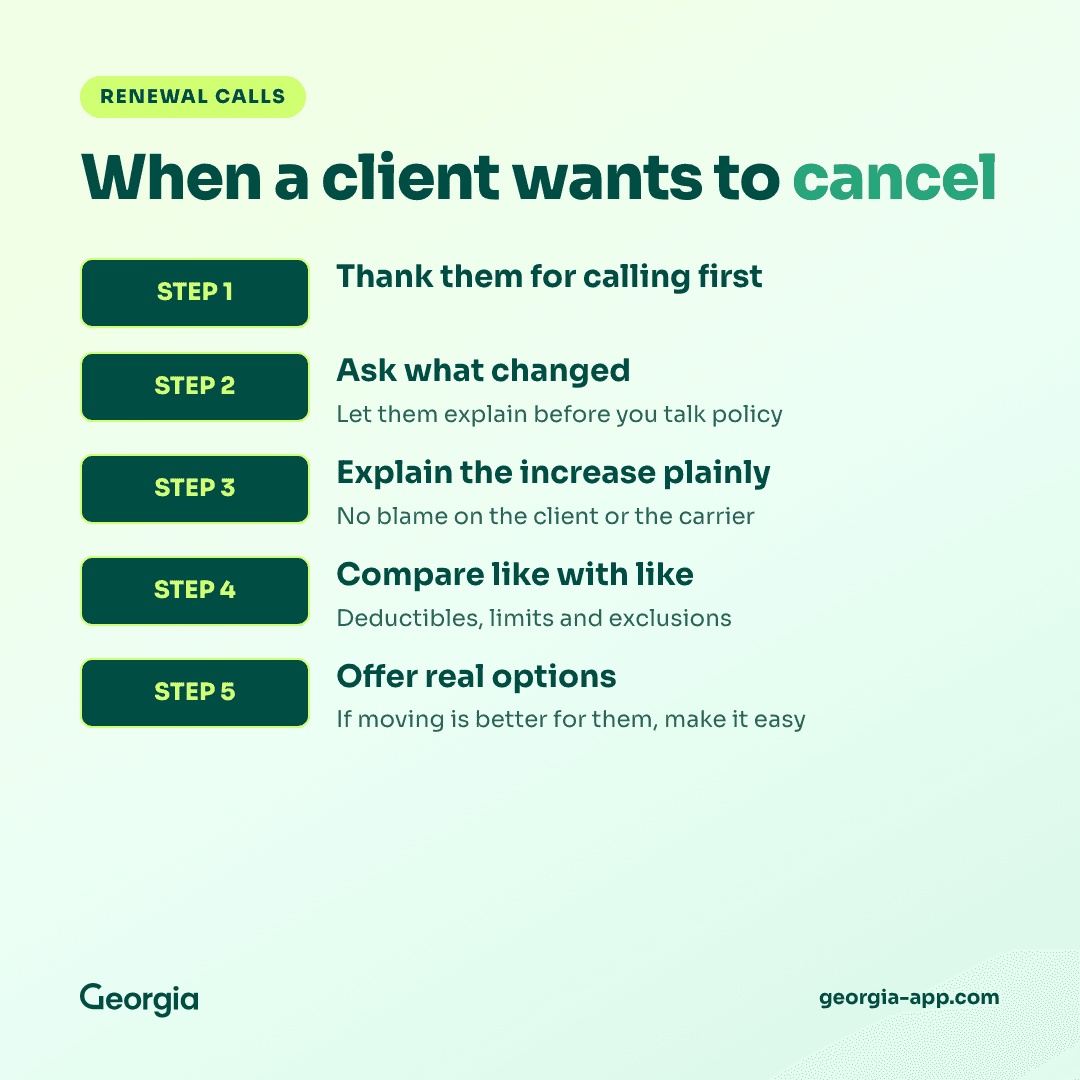
Here is a calm structure for the call:
- Thank them for calling first. Many clients simply switch, so a call is a chance to help them choose well.
- Ask what changed. Let them explain the price shock or the competing quote before you say anything about the policy.
- Explain the increase plainly. Share what you know about why the premium rose, without blaming the client or the carrier.
- Compare like with like. Check deductibles, limits and exclusions on the other quote, so the client sees whether the cheaper option is the same cover.
- Offer real options. A higher deductible, a review of discounts or a bundle may help; if moving is the better choice for them, say so and make it easy.
A client who leaves after an honest call may still come back or refer a friend.
Common mistakes when handling objections in insurance
Answering too fast. Launching into a rebuttal after the first three words tells the client their concern was filed away before they finished.
Using pressure. Talk of prices rising tomorrow may close a sale once, and it brings complaints, cancellations and compliance risk. Keep every answer accurate and give clients time to decide.
Talking about products before needs. If you have not asked about the family, the mortgage or the business, any price will feel high. Our guide on how to sell insurance covers the needs conversation before the quote in more detail.
How to practice insurance objection handling this week
Reading answers is the easy part; staying calm when a real person goes quiet or says something unexpected only improves with repetition. If you want to go deeper on the habit itself, our post on objection handling practice explains why short, frequent rehearsal beats long workshops.
Run this drill with a colleague, a manager or on your own:
- Pick the two objections you hear most often this month and write each one exactly as clients say it.
- For each one, write the single question you will ask before giving any explanation.
- Role play each objection three times, with your partner changing the client's mood each round: friendly, rushed, then annoyed.
- Record one round and listen for how long you let the client talk before you answered.
- Rehearse one renewal cancellation call where the client has a cheaper quote in hand.
- On Friday, note which answer felt natural with a real client and which still needs work.
If finding a practice partner is the problem, Georgia's insurance role play lets you practice realistic calls with an AI client, such as a prospect who says it is too expensive or a family that wants to think about it, get feedback after each attempt and try again. Agencies can build custom scenarios around their own real conversations, so new agents rehearse the calls they will actually take.
Frequently asked questions
What are the most common insurance sales objections?
Agents hear price ("it's too expensive"), delay ("I need to think about it" or "I need to talk to my spouse"), existing cover through work, "send me something by email" and distrust of insurers most often. At renewal, the usual one is a client who wants to cancel after a premium increase.
How do you overcome the price objection in insurance?
Ask what the client expected to pay before you explain anything, because many people are comparing to a guess. LIMRA's 2026 fact sheet found that 46% of Americans base their estimate on a gut feeling or a wild guess. Then explain what drives the price and show honest options that fit the budget, including what each option gives up.
How should an agent respond to "I need to think about it"?
Agree that it is reasonable, then ask which part they would like to think through, because the answer usually reveals one open question you can address now. End with a specific next step and a date.
Is workplace life insurance enough?
That depends on each family's situation, and the agent's job is to help the client find out. Ask what the plan pays, whether it stays if they change employers and how long the family would manage on it. LIMRA reports that 27% of insured Americans rely on workplace life insurance with no individual coverage.
Turn your agents' hardest calls into practice
Objections are predictable, and calm answers are learned by trying, hearing feedback and trying again before the call that counts. If you lead a team of agents, book a demo of Georgia to see how realistic practice calls fit into your onboarding and coaching. Teams and programs that qualify as partners get a free custom module built around one of their real sales calls, such as a renewal call where the client wants to cancel.
Sources
- LIMRA, 2026 Facts About Life Insurance: Workplace Benefits, 2026
- Life Happens and LIMRA, Adults Age 30 and Younger Overestimate Life Insurance Cost by 10 to 12 Times (2025 Insurance Barometer Study), 2025
- EIOPA, Eurobarometer 2025: Consumer Trends in Insurance and Pension Services, 2025
- J.D. Power via InsuranceNewsNet, 2026 U.S. Auto Insurance Study release, 2026
- J.D. Power via InsuranceNewsNet, 2025 U.S. Insurance Shopping Study release, 2025