
It is a Monday morning in January and the new inside sales class has just finished two weeks of training. You are sitting at a desk with a headset, a list of people who bought single game tickets last summer and a manager who has told you twice that the first call is always the hardest.
The first person who picks up says they are busy and hangs up before you finish your name. The second one asks whether the seats along the first base line are in the sun for evening games, and you realize you have no idea. By lunch you understand more about sports sales jobs than any careers page ever told you.
This post is for students weighing a sales job with a team, first-year sellers who want to know what is normal, and the managers who hire them. It covers the main roles, how the pay is built, a working week, what makes people good at it and what research says about who stays.
Most career advisors will tell you that sales is the most common way into a team's front office, and they are right. Advice that everyone agrees on is also generic, though, because it tells you nothing about the work itself. The real question is whether you would enjoy a job built on short conversations with strangers who mostly say no, and whether you can improve fast enough to earn the commission.
How common sports sales jobs are
In the 2019 Sports Industry Jobs Report from the IUPUI Sports Innovation Institute, sales made up 35% of the 7,653 jobs posted on TeamWork Online that year, more than double the next category, marketing, at 15%.
An earlier content analysis of 733 sport sales job ads by Pierce, Petersen, Clavio and Meadows (2012) found that inside sales was the biggest of 12 job types at 32.3%, and that teams or team companies posted 76% of the ads. In May 2025 the Bureau of Labor Statistics counted 13,220 people in sales and related occupations in spectator sports.
For a job seeker, that means more openings in sales than anywhere else in a team's business office, mostly with teams themselves, so start with team career pages and TeamWork Online. To see where those teams cluster, our guide to sports jobs by state ranks the states with the most spectator sports employment.
The main sports sales jobs, from inside sales to premium
Inside sales representative. This is the entry-level seat. The San Diego Padres describe inside sales as a developmental program in which reps sell full and partial season plans, groups, hospitality and suites, and they say plainly that candidates must be comfortable making cold calls.
Account executive. After inside sales, the next step is usually an account executive role with your own book of prospects and a bigger quota. The Washington Nationals say their inside sales program is designed for promoting top talent into account executive positions internally.
Group sales. Group sellers work with schools, churches, youth leagues, companies and clubs that want a block of seats for an outing or a theme night.
Premium and suites. Premium sellers handle club seats, suites and hospitality, usually for businesses. Even here the volume is real: a premium seats manager quoted by Johnson & Wales University described making about 50 to 65 phone calls a day.
Service and renewals. Service reps look after people who already own a plan and work to renew them. The Nationals run a separate Inside Service program focused on renewing plan holders, and the Padres list Membership Services as one of the next steps after inside sales.
SPORTS SALES ROLES
The main sports sales jobs
Georgia · georgia-app.com
How sports sales pay works: base salary, commission and the BLS numbers
Almost every sports sales job pays a base salary plus commission. Popp, Sattler, Pierce and Shreffler (2022) note that sales managers in sport acknowledge base pay is usually below entry-level sales jobs in other industries, and that nearly all sales positions provide commission, which lets top performers earn well above their base. Ohio University lists the average salary of its sport management graduates as "$37k + Commission".
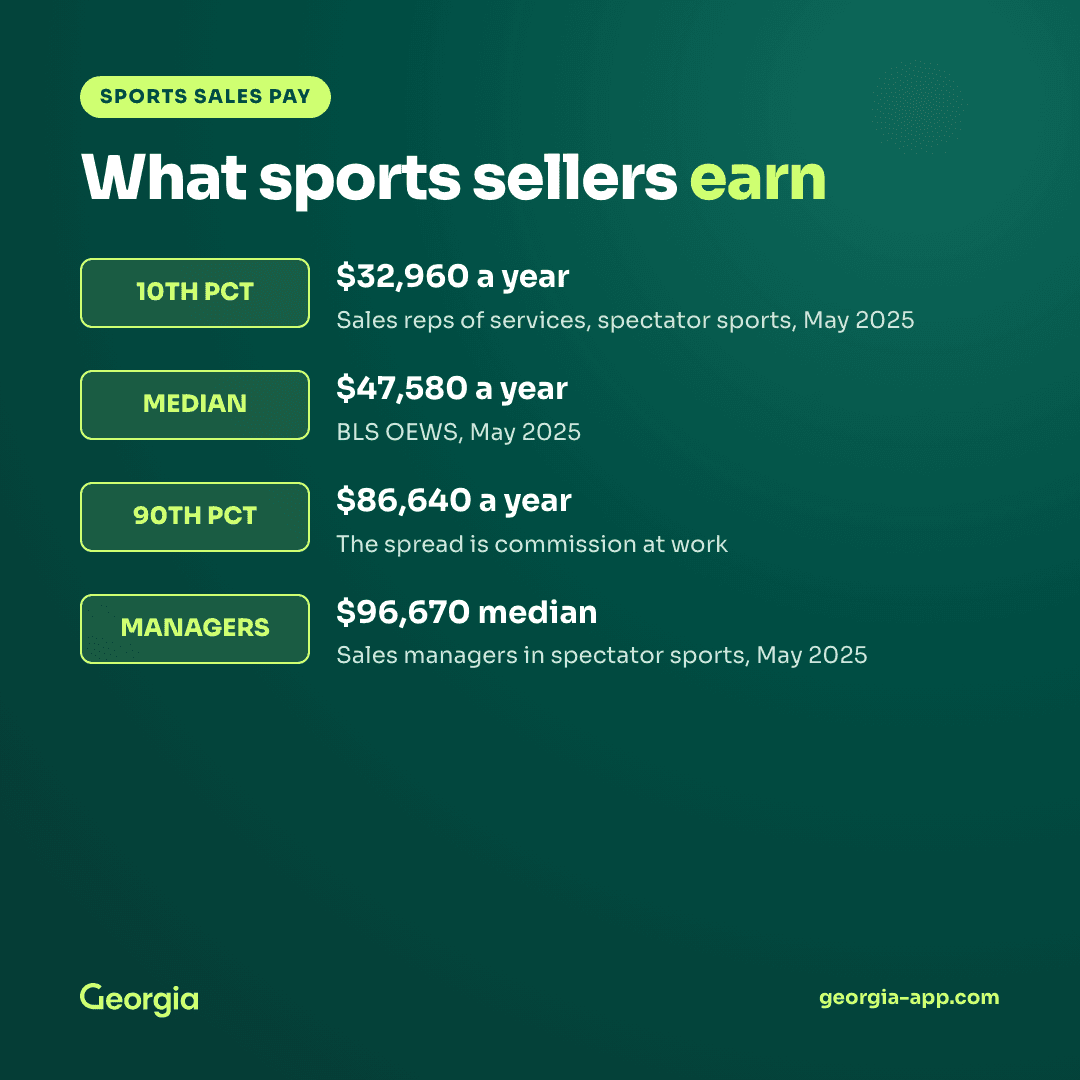
The clearest public benchmark comes from the Bureau of Labor Statistics. For the occupation "sales representatives of services" inside the spectator sports industry, which covers many ticket and sponsorship sellers, the May 2025 figures look like this.
| Measure (spectator sports, May 2025) | Annual pay |
|---|---|
| 10th percentile | $32,960 |
| 25th percentile | $38,550 |
| Median | $47,580 |
| Mean | $55,960 |
| 75th percentile | $61,700 |
| 90th percentile | $86,640 |
Source: BLS Occupational Employment and Wage Statistics, NAICS 711200, occupation 41-3091, May 2025. The category held 3,800 jobs and also includes sellers who are not on a team's ticket staff.
The spread between the 10th and 90th percentile is the commission at work. Two people with the same title can end the year tens of thousands of dollars apart, so when you compare offers, ask how commission is paid, what a typical first-year rep earned in total, and whether the quota changes during the year. Sales managers in spectator sports earned a median of $96,670 in May 2025, which shows where the pay goes if you stay and lead a team.
A week in a ticket sales job
Most of the week is phone time. Your manager gives you a list, often past single game buyers, lapsed plan holders or people who filled in a form at the stadium, and you work through it in blocks, logging every call and booking appointments for anyone who wants to see the seats in person. The Padres train new reps on phone call road maps, timeblocking and face-to-face appointments in the two weeks before their first call.
Volume is high and the hours follow the schedule. Beyond the premium manager's 50 to 65 calls a day, a ticketing vice president in the American Hockey League described a 55 to 60 hour week during the season in the same Johnson & Wales piece. At the hard end, Kirby (2017), cited by Pierce (2018), linked high turnover to entry-level reps being asked to make 100 scripted calls per day in a boiler room setting, so it is worth asking any team how many calls they expect and how much of the script you can adapt.
Hiring often runs in classes: Padres inside sales hires usually start in January and June, so a class trains together and competes on the same leaderboard.
What makes people good at sports sales
When Pierce and colleagues read hundreds of sport sales job ads, the entry-level ones stressed work ethic and cold calling. That matches what you see on the floor: the reps who do well pick up the phone again after a bad call, ask a question before they pitch, and remember what a buyer told them last month.
Training matters a great deal. In the Popp et al. (2022) survey, people who stayed in ticket sales were more likely to credit their success to ability and training and less likely to credit luck. In an earlier study of 140 ticket sales professionals, Popp, Simmons and McEvoy (2017) reported an alarming lack of sales training and found that time spent in certain training methods was related to hitting sales goals. In college athletics, nearly a quarter of sales hires got under 2 hours of training before their first call, according to the same research group.
The specific skills that separate a good seller from an average one are conversational. You need to open a call without sounding like a recording, ask what the buyer actually wants from a night out, handle "the team is losing" or "it is too expensive" without arguing, and close with a clear next step. None of that is learned from a slide deck, and most of it improves only with repetition and honest feedback.
Turnover in sports sales jobs: what the research found
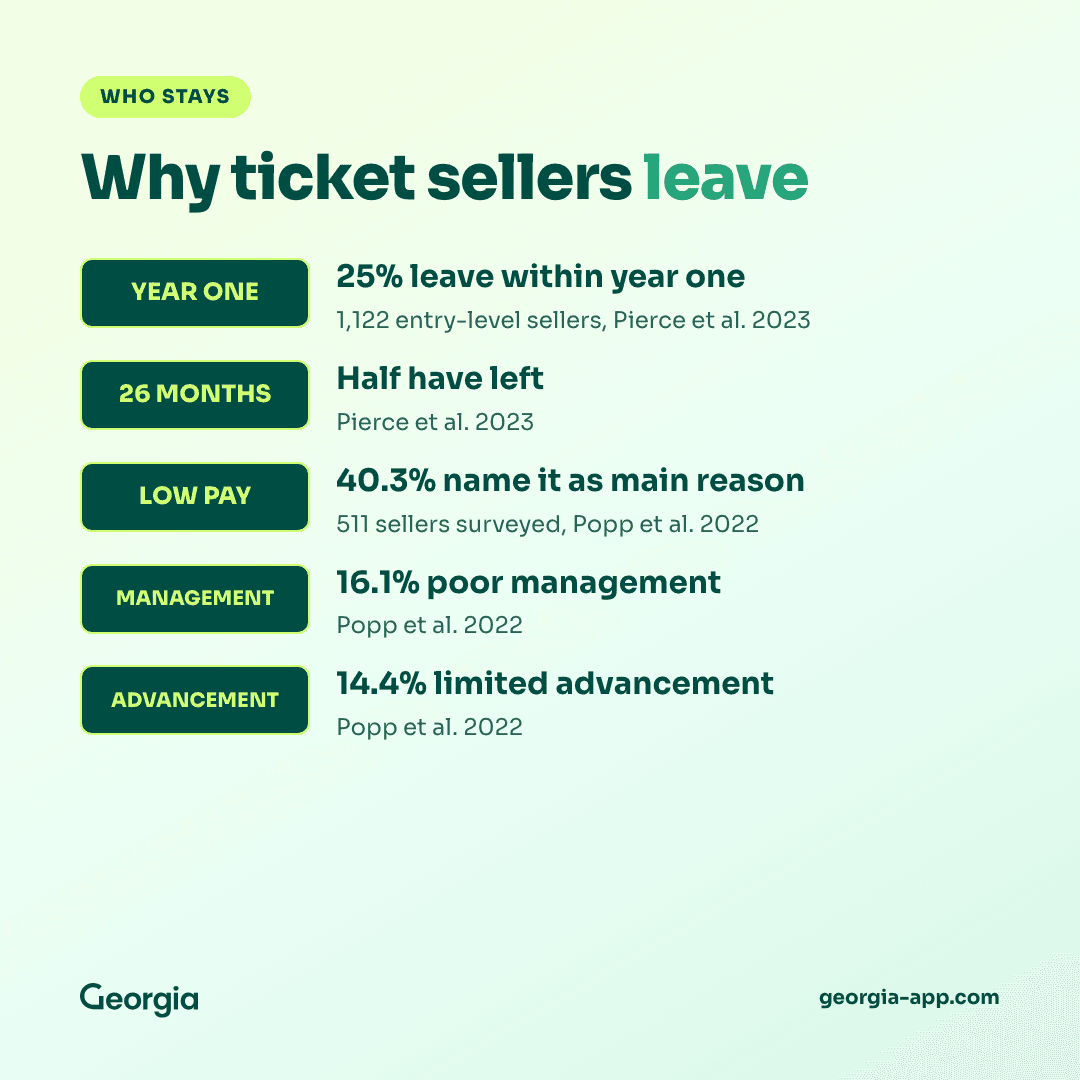
Pierce, Wanless, Popp, Sattler and Shreffler (2023) followed 1,122 entry-level ticket sellers at NBA, MLB, NHL and NFL teams and found that 25% left within their first year and half had left within 26 months.
The Popp et al. (2022) survey of 511 current and former ticket sellers in the four major leagues explains why. The mean age was 27 and median tenure was 2 years 4 months. Asked for the single biggest reason they left, 40.3% named low pay, 16.1% poor management or leadership and 14.4% limited chances to advance. The authors note that these are factors a team can change, while fixed ones such as team results mattered less.
For a manager, that is the useful finding. Clear commission plans, coaching that happens every week and a visible path to account executive are likely to keep more people than a winning record does. Job seekers should ask about all three in the interview. For where people go after the sales floor, our guide on how to get into sports business looks at the honest numbers on moving into other departments.
How to practise sales calls before and during the job
The fastest way to improve is to make more calls and hear what went wrong, which is hard when every real call uses up a lead. Pierce (2018) found that sport sales courses built around real client projects used mock sales calls more often.
You can also practise alone. Record yourself answering the objections you fear most and listen for where you rushed or stopped asking questions. If you want a more realistic counterpart, Georgia lets you practise sales calls with an AI fan or buyer who pushes back, gives you feedback after each attempt and lets you try the same call again straight away. Teams and programs can build custom scenarios around their own situations, such as a season ticket renewal call, a group sales call or a premium seating conversation, so a new class can hear the hard objections before the phones open.
A one-week drill to test whether sports sales suits you
- Pick one team you would like to work for and read its season ticket, group and premium pages until you can explain each plan in two sentences.
- Write a short opening for a call to a past single game buyer and say it out loud until it sounds like you.
- List the objections you expect, such as price, the team's record and parking, and write one question you would ask in response to each.
- Record a practice call every day this week and note one thing to change in the next attempt.
- Ask someone who works in team sales how many calls they make, how commission is paid and who got promoted from their last class.
- At the end of the week, decide honestly whether the calls got easier and whether you enjoyed the improvement.
Frequently asked questions
How much do sports sales jobs pay?
Most entry-level sports sales jobs combine a modest base salary with commission. BLS data for sales representatives of services in spectator sports shows a median of $47,580 in May 2025, with the 10th percentile at $32,960 and the 90th at $86,640. Ohio University reports an average starting salary of "$37k + Commission" for its sport management graduates.
What does an inside sales representative for a sports team do?
An inside sales rep calls past buyers and new leads to sell season plans, partial plans, group outings and sometimes suites. The role is usually the entry level of a team's sales department and includes outbound calls, emails and face-to-face appointments. Strong reps are promoted to account executive or move into group, premium or service roles.
Is a sports sales job a good career?
It can be, especially if you like conversation and want your pay tied to results, since sales managers in spectator sports earned a median of $96,670 in May 2025. It is also demanding, and research on 1,122 entry-level ticket sellers found half had left within 26 months. Ask about training, commission and promotion paths before you accept an offer.
Do you need a sports management degree to work in sports sales?
Entry-level job ads tend to stress work ethic and cold calling more than a specific degree. A program with a real sales course helps, because you get practice calls before your first job. Our guide to sports management colleges with sales programs lists schools that teach it.
Get ready for the phones before your first day
Sports sales jobs reward people who can hold a good conversation with a stranger, take a no and come back to the next call a little better. The pay rises with that skill, and the turnover research points to pay, management and training as what decides who stays. If you run a ticket sales team or teach sport sales, book a demo of Georgia to see how your sellers can practise real calls with an AI buyer. Teams and programs that qualify as partners get a free custom module built around one of their real sales calls, such as a season ticket renewal.
Sources
- IUPUI Sports Innovation Institute, 2019 Sports Industry Jobs Report, 2020
- Emerald, Pierce, Petersen, Clavio and Meadows, Content analysis of sport ticket sales job announcements, 2012
- Bureau of Labor Statistics, Occupational Employment and Wages in Spectator Sports, May 2025
- San Diego Padres, Inside Sales, 2026
- Washington Nationals, Sales and Service Job Opportunities, 2026
- Boston Celtics, Inside Sales Program, 2026
- Ohio University, Sport Management BBA, 2026
- Johnson & Wales University, Sport Leadership: Working in Ticket Sales, 2025
- Illinois State University, Popp, Sattler, Pierce and Shreffler, Why sport ticket salespeople leave their jobs, 2022
- Emerald, Pierce, Wanless, Popp, Sattler and Shreffler, Attrition in entry-level ticket sales positions: a survival analysis, 2023
- Sport Marketing Quarterly, Popp, Simmons and McEvoy, Sport Ticket Sales Training: Perceived Effectiveness and Impact on Ticket Sales Results, 2017
- IUPUI ScholarWorks, Pierce, Using Experiential Client-Based Projects in Sport Sales Courses, 2018