
Your first week on the phones at a building materials distributor starts with a call before the yard gate is even open. A masonry contractor needs block, mortar and rebar on a site across town by mid-morning, and before he gives you the order he wants to know whether it is on the shelf and whether your truck will really be there when his crew is.
You spent onboarding learning product codes, compressive strengths and the price book, so you answer the questions he never asked. He thanks you politely, says he will call back, and phones the yard down the road instead.
By Friday you have noticed a pattern. The calls that turned into orders were the ones where you knew the stock, promised a delivery window you could keep and talked price only once the customer was sure you could supply.
This guide is for sales reps, territory managers and sales leaders at distributors, dealers and cement, ready-mix and aggregates producers, including owners of regional producers who still sell much of the volume themselves. It covers how to sell building materials to each type of buyer, what drives the decision, what the best reps do differently and the mistakes that quietly cost orders.
Who buys building materials and why each buyer needs a different call
Building materials move through a chain, and every link buys for a different reason. The USGS estimates that in 2025, 70% to 75% of US cement sales went to ready-mixed concrete producers, 11% to concrete product manufacturers, 8% to 10% to contractors and 5% to 10% to other customer types. A cement rep spends most of the week with producers, while the ready-mix rep who buys from that cement plant spends most of the week with contractors.
Dealers and distributors sit in the middle, buying from producers and selling to contractors who may never meet the manufacturer's rep. Specifiers such as architects and engineers rarely place an order, yet they decide which products are acceptable long before anyone asks for prices. Each of these buyers listens for something different, so your opening should change with them.
WHO BUYS
Five buyers, five different calls
Georgia · georgia-app.com
What drives the decision: availability and delivery ahead of price
Ask any sales trainer how to sell building materials and you will hear a familiar list: build relationships, know your products, answer quickly and avoid leading with price. Every item on that list is right, and yet advice that everyone agrees on tends to be generic, because it tells you very little about what to say when a contractor says the other plant is cheaper and your truck was late last week.
The more useful angle is that orders are won or lost on whether you can prove availability and delivery inside the conversation, and those conversations happen under pressure. The data on what buyers weigh shows which calls matter most.
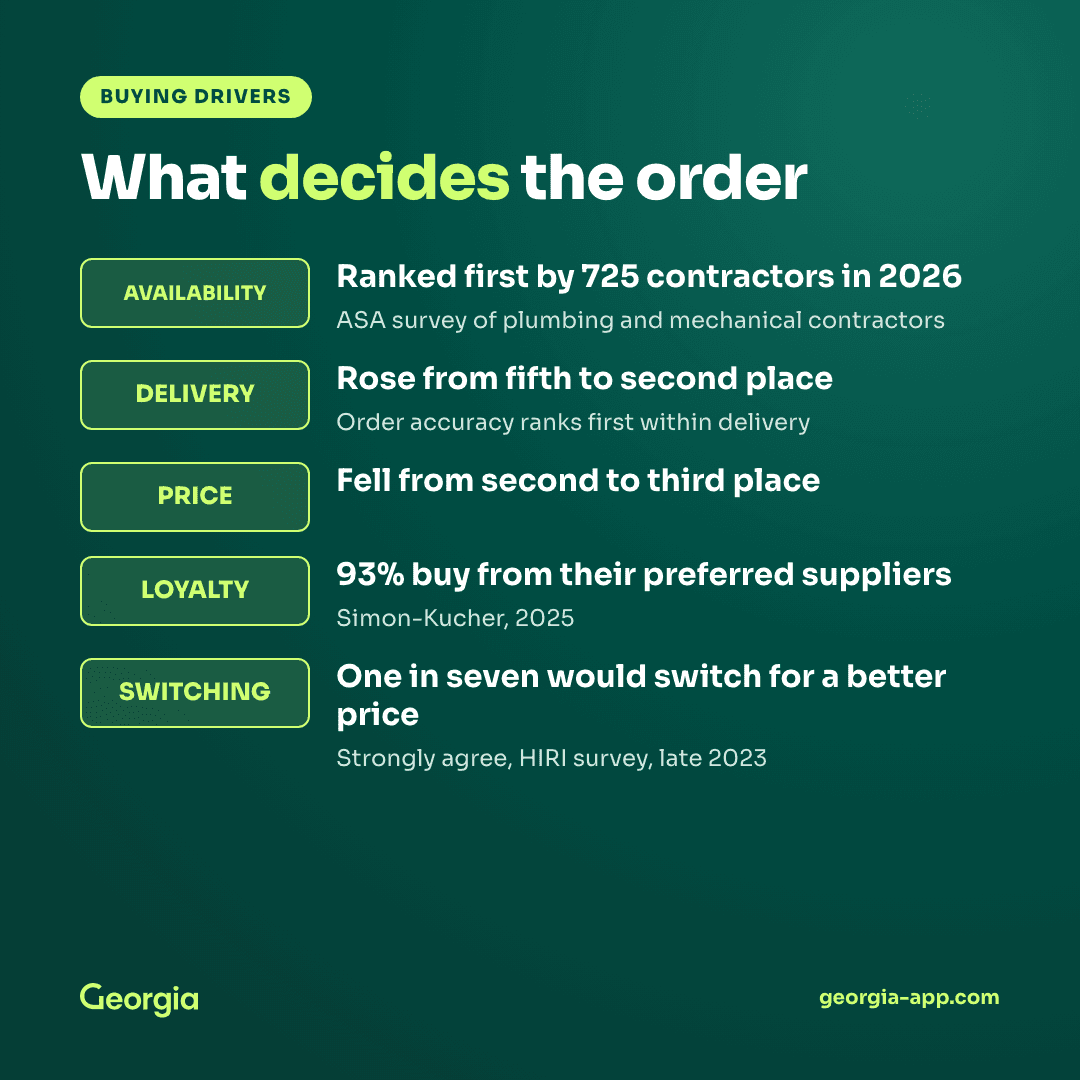
The clearest recent numbers come from a neighboring trade. The American Supply Association asked 725 plumbing and mechanical contractors in May and June 2026 what matters when they choose a distributor, and Distribution Strategy Group published the ranking in November 2026.
| Rank in 2026 | What contractors weigh when choosing a distributor | Rank in 2023 |
|---|---|---|
| 1 | Product availability and inventory | 1 |
| 2 | Delivery service | 5 |
| 3 | Price | 2 |
| 4 | Inside sales service and support | 3 |
| 5 | Counter and will-call | 6 |
| 6 | Outside salesperson presence and relationships | 8 |
| 7 | Convenient locations | 4 |
Within delivery, order accuracy ranked first, followed by consistent on-time delivery windows and then low or no delivery fees. Because the sample covers plumbing and mechanical contractors, treat it as a strong signal for building materials rather than a measurement of concrete or aggregates buyers.
Other studies point the same way. Simon-Kucher's 2025 Construction and Building Materials Study found that 93% of builders and contractors consistently purchase from their preferred suppliers, with loyalty resting on reliability, availability and service as well as price.
Loyalty has limits, though. In a HIRI survey from late 2023, one in seven contractors strongly agreed they would switch brands or suppliers to get a better price, and pros tended to switch suppliers before brands. Principia Consulting's quarterly survey of 150 contractors found that 40% were substituting brands or materials more often in Q4 2024, rising to 61% by Q3 2025, citing price increases, lead times and availability.
On the phone, this means price is usually the reason a contractor starts calling around, while availability and delivery are the reasons they stay with you or leave.
How to sell building materials when the buyer says your price is too high
Price still matters, which is exactly why you should protect it. McKinsey's "The power of pricing" (2003) found that for a typical large company a 1% price rise, with stable volume, would lift operating profit by about 8%. Ready-mix shows how thin the margin is: NRMCA's 2023 benchmarking survey put average revenue at $159.68 per cubic yard and profit before tax at $14.59, so every dollar you give away comes out of that $14.59.
The line you will hear most is some version of "The other plant is 10% cheaper." A calm answer starts with questions, because you rarely know what the other quote includes.
- Compare the full delivered cost. Ask whether the other price includes delivery, minimum load charges and waiting time, and whether it covers the same product.
- Bring it back to their schedule. Ask what a late or short delivery would cost their crew on this job, then say what you can commit to.
- Trade before you move. If you adjust price, ask for something in return, such as more volume or faster payment.
Our post on construction sales objections covers the common lines in detail, and an earlier piece explains how practising objections stops revenue leakage in building materials sales. Concrete sellers will find quotes and pour scheduling in ready-mix concrete sales.
What top building materials reps do differently
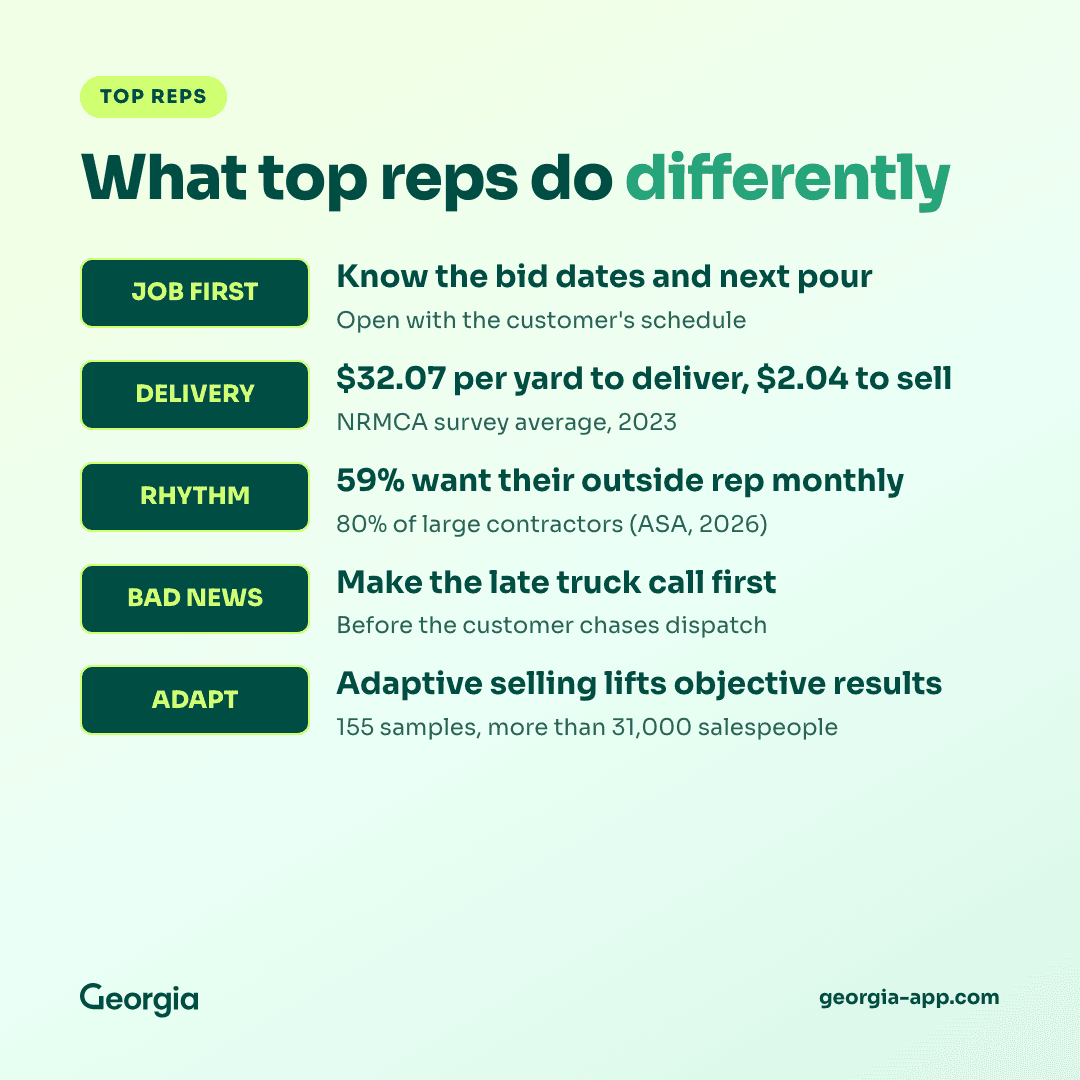
A meta-analysis by Franke and Park (2006) across 155 samples and more than 31,000 salespeople found that adaptive selling, adjusting your approach to each buyer and situation, raised self-rated, manager-rated and objective performance, while customer orientation on its own raised only self-rated performance. In construction, Davis (2008) surveyed 898 construction managers and found that commitment, trust and satisfaction shape supply chain relationships. The reps who earn that trust tend to share a few habits.
- They know the job before they call. Top reps know the project stage, the bid dates and the next pour, so their first question is about the customer's schedule. Our guide to selling to contractors shows how to use the call before the bid.
- They sell the delivery promise their company can keep. In NRMCA's 2023 survey, delivery cost $32.07 per cubic yard and selling cost $2.04, so delivery cost about 16 times as much as selling, and that reliability is what you are really selling.
- They show up on a rhythm. In the ASA survey, 59% of contractors want contact with their distributor's outside salesperson at least monthly, and 80% of large contractors do.
- They make the bad-news call first. When a truck is late or a load is short, the customer hears it from the rep before they have to chase dispatch.
Common mistakes when selling building materials
Most lost orders trace back to habits that feel reasonable in the moment and cost a lot over a season.
- Leading with the price book. Opening with price invites a price comparison, when the buyer's first worry is usually stock and timing.
- Promising a window you cannot keep. Order accuracy ranks first within delivery, so one missed promise can undo months of good visits.
- Treating every buyer the same. A dealer worried about margin and a contractor worried about Thursday's pour need different conversations.
- Disappearing between orders. If most contractors want monthly contact, silence between jobs leaves room for the next supplier.
- Forgetting the inside team. Inside sales and the counter ranked fourth and fifth in the ASA survey, so they are part of the sale you are making.
A one-week drill for building materials reps
Reading about these calls helps less than you would hope, because the moment that matters arrives with a contractor on the line and a crew waiting.
- Label your top twenty accounts with a buyer type from the table above.
- Write one opening question for each buyer type and use it on your next calls with that type.
- Ask dispatch which delivery windows you actually hit last month, so your promises match the record.
- Write down the price lines you hear most often and a calm answer to each that starts with a question.
- Say the price call out loud five times this week, with a colleague playing the buyer or with an AI buyer.
- Make one bad-news call before the customer has to ask, and note how the conversation changes.
For step five, Georgia's building materials scenarios let you practise the call with an AI contractor, dispatcher or purchasing manager, get feedback after each attempt and try again. Teams can also build custom scenarios around their own situations, such as a late delivery complaint.
Frequently asked questions
How do you sell building materials to contractors?
Start with the contractor's schedule and the job in front of them, then show that you have the product and can deliver it accurately and on time. Talk price after that, comparing full delivered cost, and keep in touch between orders, since most contractors in the ASA survey want monthly contact.
Is price the most important factor for building materials buyers?
Price matters, yet recent surveys put it behind availability and delivery. In the 2026 ASA survey of plumbing and mechanical contractors, price fell from second to third place, and Simon-Kucher found that 93% of builders and contractors consistently buy from preferred suppliers.
What skills does a building materials sales rep need?
Product knowledge is the entry ticket, and the skills that separate top reps are adaptive selling, listening and calm handling of price and delivery problems. Research across more than 31,000 salespeople links adaptive selling to better objective results.
How much do building materials sales reps earn?
There is no BLS figure for building materials reps alone. The closest category, sales representatives in wholesale and manufacturing outside technical and scientific products, had a median annual wage of $72,080 and a mean of $82,530 in May 2025, and our building materials industry statistics post covers jobs and pay in more detail.
Win the calls that decide the order
How to sell building materials comes down to a few conversations that repeat every week: the opening with each buyer type, the price call, the late delivery call and the visit between orders. The reps who handle them well have usually rehearsed them, so they sound calm when a contractor is under pressure.
If you lead a building materials sales team and want your reps to practise those calls before they happen on a real job, book a demo of Georgia. Teams and programs that qualify as partners get a free custom module built around one of their real sales calls, for example a contractor asking for a lower price per cubic yard.
Sources
- USGS, Mineral Commodity Summaries 2026: Cement, 2026
- Distribution Strategy Group, Contractors rank delivery ahead of price when choosing distributors (ASA survey), 2026
- Simon-Kucher, Winning in 2025: building material suppliers in a changing market, 2025
- HIRI, Changes in contractor loyalty, 2023 survey
- Principia Consulting, Are contractors breaking up with their favorite brands?, 2025
- McKinsey, The power of pricing, 2003
- NRMCA, Annual Performance Benchmarking Survey and State of the Industry, 2024
- Franke and Park, Salesperson adaptive selling behavior and customer orientation: a meta-analysis, 2006
- Davis, A relationship approach to construction supply chains, 2008
- BLS, Occupational Employment and Wage Statistics, SOC 41-4012, May 2025