
A missed customer concern can stall a quote, delay a decision, and put pipeline value at risk. AI sales coaching software can help teams identify conversation behaviors to improve, but its value depends on how well the coaching fits the sales motion.
A transactional sale and a complex project pursuit place different demands on sales reps. Generic feedback can miss the behavior that matters in a particular conversation.
You’ll learn how AI tools analyze rep behavior, support different B2B sales motions, and help managers reinforce coaching. The focus is practical: connect conversation insights to the right practice and the next coaching action.
Key Takeaways
- Use call transcripts and conversation analytics to spot repeatable behaviors and identify where a rep needs focused practice.
- Match coaching to the sales motion: a short-cycle sale and a complex project pursuit call for different practice scenarios and feedback.
- Turn AI-generated insights into specific manager coaching actions, then reinforce those behaviors in later conversations.
- Compare tools by how they support simulation, in-call guidance, and post-call review, rather than relying on feature counts alone.
- Use role-play to build communication skills before customer conversations, especially when reps need practice handling pressure and objections.
How fast can AI sales coaching deliver measurable results?
Results depend on how quickly teams turn conversation insights into coaching and practice. The three tool categories support reps before, during, or after customer calls.
Real-Time Coaching Tools
Real-time tools guide reps during a live sales call, and managers can intervene when needed. Teams using real-time AI coaching can help new hires reach full productivity 30% to 50% faster.
Post-Call Analytics and Transcripts
Post-call tools analyze transcripts and call patterns for manager review. Manual review covers 5 to 10% of calls per representative, while AI tools can analyze 100% of sales calls.
| Option | Timing | Best use | Manager action |
|---|---|---|---|
| Real-time assistance | During a call | Live guidance | Support an active conversation |
| Post-call analytics | After a call | Transcripts and patterns | Coach a specific behavior |
| Simulation | Before a call | Scenario practice | Assign targeted rehearsal |
Choose based on when your reps need support: before, during, or after a customer conversation.
For measurable outcomes, track ROI separately from win rates. Sales teams typically see measurable ROI within 60 to 90 days of deployment, with strongest ROI signals appearing 3 to 6 months after deployment. Teams using real-time AI coaching report an average 8 to 12% improvement in win rates within the first three months of deployment. Use manager coaching groups to review examples, assign focused practice, and observe later calls.
User ratings offer another way to gauge impact: 78% of users rate real-time coaching tools as very valuable for accelerating ramp time and improving rep confidence. Pair that feedback with observed practice and later-call behavior to assess whether teams are putting live guidance to use.
AI expertise, escalation, and manager reinforcement
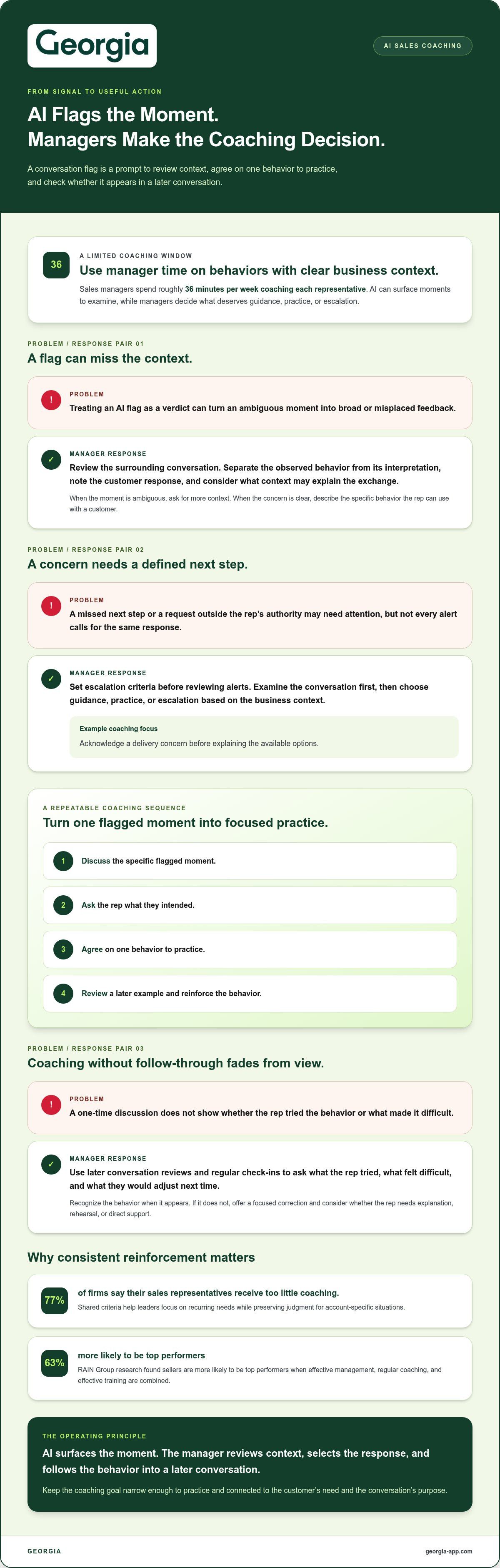
AI can flag patterns, but managers decide what needs action. Sales managers spend roughly 36 minutes per week coaching each representative, so use that time on behaviors with a clear business context.
Set escalation criteria before reviewing alerts. A missed next step or a customer request outside a rep’s authority may warrant a manager’s attention. Review the surrounding conversation first, then decide whether the issue calls for guidance, practice, or escalation.
Use a consistent coaching sequence: discuss the flagged moment, ask the rep what they intended, agree on one behavior to practice, and review a later example. For instance, coach a rep to acknowledge a delivery concern before explaining the available options.
Seventy-seven percent of firms say their sales representatives receive too little coaching. Shared criteria help leaders focus on recurring needs while preserving judgment for account-specific situations. RAIN Group research found sellers are 63% more likely to be top performers when effective management, regular coaching, and effective training are combined.
For a focused rehearsal before customer calls, an AI role-play platform can support practice around objections. Managers can reinforce the chosen behavior in later conversations.
Separate the observed behavior from the interpretation attached to it. A flag should prompt a review, not determine whether a rep acted appropriately. Note what happened, how the customer responded, and what context may explain the exchange. If the concern remains after reviewing the conversation, identify the specific decision or skill that needs attention. This keeps feedback grounded in evidence rather than broad labels, while giving the rep a clear opportunity to explain their intent. When the moment is ambiguous, managers can ask for more context before deciding whether to intervene. When the concern is clear, describe the expected behavior in practical terms the rep can apply in a customer conversation.
Reinforce the behavior through regular manager check-ins and later conversation reviews. Ask the rep what they tried, what felt difficult, and what they would adjust next time. Recognize the behavior when it appears, and offer a focused correction when it does not. Keep the coaching goal narrow enough to practice, while connecting it to the customer’s need and the conversation’s purpose. If a pattern continues, revisit the expectation and consider whether the rep needs more explanation, rehearsal, or direct support. AI can surface moments for review, but managers remain responsible for interpreting context, choosing a response, and keeping coaching relevant to the account. Consistent follow-through makes the behavior easier to revisit and gives managers and reps a shared basis for discussing progress.
AI sales coaching tools compared by team type
Choose a platform that fits your team’s sales motion, coaching gap, and manager workflow. Compare feedback quality, practice scenarios, call analysis, and how managers assign follow-up.
AI Sales Coaching Platforms
An AI coaching platform analyzes sales activity to help managers identify behaviors to coach. A distributed enterprise team may prioritize consistent feedback and shared criteria, while a smaller team may focus on quick setup around its own sales calls. Compare whether each tool supports the moment your reps need help: before, during, or after customer conversations.
Sales Roleplay Platforms
A role-play platform gives reps a place to rehearse conversations before meeting customers. Unlike a call-analysis platform, it starts with a scenario, such as responding to a contractor’s concern about delivery timing, rather than reviewing a completed call. Compare how relevant the scenarios are, how feedback addresses communication skills, and how easily managers can connect practice to real customer situations.
Team type shapes the buying criteria. New hires handling repeatable inbound requests may need guided practice in discovery and qualification. Teams managing longer project pursuits may need scenarios for aligning stakeholders, handling specification changes, and following up across several conversations. Match the platform’s coaching method to the work reps do each week.
For an enterprise team, examine how leaders set shared coaching criteria across managers and locations. For a specialist team, assess whether managers can focus on a specific skill, such as explaining a product substitution clearly. In either case, feedback should identify an observable behavior and a next action, not leave managers with a vague score and no coaching path.
Compare platforms using the same sample scenario. Give each tool a sales situation your reps face, such as a customer questioning a quote or requesting a revised delivery schedule. Check whether the feedback identifies the specific response, explains the coaching opportunity, and offers a useful way to practice. This test reveals more than a feature checklist.
Then map each platform to your team’s workflow. Identify who assigns practice, who reviews progress, and how managers reinforce skills during regular coaching. If a platform generates feedback but gives managers no clear next step, the process can stall. If role-play supports targeted practice, use it to prepare reps for relevant customer conversations.
Prioritize the tool that fits your team’s most costly communication gap. A sales team struggling with call execution may need conversation review; reps who need rehearsal may benefit from role-play. Teams with both needs should assess how the approaches work together. This keeps platform features tied to daily sales work.
AI analysis of sales conversations and rep behavior
AI can analyze conversation patterns and produce insights, feedback, and tailored recommendations. For example, it may highlight whether a rep clarified a contractor’s delivery concern before proposing a solution. That signal gives managers a behavior to examine, while the customer’s account context helps them interpret the conversation.
Set a clear analysis method before using these insights. Choose a behavior, such as confirming the customer’s next step, and define what it sounds like in an actual call. Then compare examples across reps. This keeps conversation intelligence focused on observable actions rather than broad scores that leave managers guessing.
AI role-play adds a practice stage to conversation analysis. A rep can rehearse a scenario, such as responding to a specification change, and receive feedback before facing the customer. Managers can then compare the practice response with a later sales conversation. The difference shows whether the skill carried over from rehearsal to the rep’s actual workflow.
Use role-play and conversation intelligence for different purposes. Role-play creates a controlled scenario for practicing a difficult exchange. Conversation intelligence examines customer interactions and identifies behaviors worth coaching. For example, rehearse acknowledging a price objection, then review later calls to see whether reps recognize the concern before explaining the quote.
CRM data can provide useful context when connected with conversation records. A manager might compare call themes with opportunity stages, then investigate whether unclear next steps appear in stalled deals. Treat that comparison as a coaching prompt, not proof of cause. Account timing, customer needs, and project changes can also affect pipeline movement.
Build the integration workflow around a specific management decision. First, identify the conversation behavior that matters. Next, decide what CRM context helps interpret it, such as the opportunity stage or recorded next step. Then assign a coaching action and review a later example. Each step connects data to a decision instead of adding another dashboard for managers to monitor.
Keep feedback actionable. If analysis flags a rep talking over a customer’s concern, coach them to pause, restate the concern, and confirm their understanding. A manager can use that sequence in practice, then look for it in a later conversation. Specific behaviors are easier to observe and discuss.
Use the insights to refine team workflows. If several reps miss the same discovery step, leaders can update practice scenarios or coaching criteria. If one rep struggles with a particular objection, assign focused rehearsal. This helps teams direct support to the right level instead of applying the same coaching response to every role.
How AI sales coaching software works
AI coaching turns sales conversations into patterns, feedback, and practice priorities. A useful workflow connects what a rep says to a specific behavior managers can reinforce.
In the United States, there is no single price for these tools. Pricing depends on the case and is provided after a quote request, with factors such as user seats, call volume, features, integrations, and support shaping the cost.
Call analysis typically follows three steps: capture a conversation, identify patterns, and generate feedback. For example, a system may flag a sales call where the rep discusses a quote before clarifying the customer’s delivery concern.
AI analyzes calls by examining conversation content and rep behavior, then providing personalized insights, live feedback, and tailored recommendations. A manager can review a flagged moment, check the surrounding exchange, and coach one observable action, such as confirming the customer’s concern before proposing options.
Privacy, consent, and data security risks include recording without clear notice, collecting sensitive customer details, and exposing transcripts to people without a business need. In the US, define a recording-notice process, restrict transcript access, set retention rules, and review how the platform stores and uses conversation data.
For a practical rollout, connect each stage to a sales-team decision:
- Set a coaching objective, such as improving how reps confirm project requirements.
- Capture sales conversations through the team’s approved recording workflow.
- Use analysis to surface examples tied to the objective, rather than relying on a general score.
- Give the rep focused guidance and assign practice for the next customer meeting.
- Review a later conversation to see whether the behavior changed.
This sequence makes enablement specific. If a rep skips agreement on the next step, coaching can focus on summarizing ownership and timing before ending the meeting. The manager can then assess that behavior in a later call, rather than treating revenue movement as proof of coaching quality.
Keep the system’s role clear. AI can organize call evidence and suggest coaching priorities; managers interpret customer context and decide what guidance fits. A CRM record may show an opportunity’s stage, while the conversation explains why the customer delayed a decision. Together, those inputs help a sales team distinguish a communication gap from a changing project requirement.
Choose one sales motion and one coaching behavior for the first workflow. For example, track how reps respond when a buyer changes specifications, then use the call examples to shape practice and manager review. This gives sales teams a clear path from conversation data to a repeatable coaching action.
Georgia: Sales & Commercial Training Modules
Georgia is a practical next step when your sales team has identified a communication skill to strengthen. Its Sales & Commercial Training Modules and AI Role-Play Platform provide personalized, self-paced practice for high-pressure conversations.
Use this approach when reps need to rehearse a specific situation, such as responding to a customer objection, before applying the skill in a live conversation. Managers can connect practice to the behaviors they want to reinforce across the team.
Visit Georgia’s website to learn more.
Put the Next Coaching Decision Into Motion
Choose one sales motion and one communication behavior to strengthen next. Set a clear coaching objective, decide how managers will reinforce it, and give reps an opportunity to practice before their next customer conversation. This focused operational choice gives your team a concrete starting point for evaluating progress.
As you assess AI sales coaching software, connect the tool decision to the behavior you want reps to build. Georgia’s Sales & Commercial Training Modules, Customer Operations Training, and AI Role-Play Platform support practice and development across customer-facing conversations. Consider which area matches your team’s immediate coaching priority.
Bring a specific sales scenario and the skill you want to improve to your next discussion with Georgia. A clear starting point helps you move from selecting a tool to building a coaching routine managers can use.
Take the next step with a focused objective, and give your team a practical path to stronger conversations.
Frequently Asked Questions
Can an AI sales coach adapt to different B2B sales motions?
Yes, if you tailor coaching to the conversations each sales motion requires. A team selling repeat orders may focus on clarifying availability and delivery needs, while a project team may practice handling specification changes and coordinating several stakeholders. Give the tool relevant scenarios and behavior criteria for each group. Review coaching prompts with managers, then adjust examples that do not reflect actual customer situations.
How accurate is an AI sales coach tool at spotting skill gaps?
AI can surface recurring conversation patterns, while managers determine whether they point to a real skill gap. Compare flagged examples with calls managers consider successful and unsuccessful. If a tool repeatedly marks down a behavior that supports your sales method, refine the criteria. This calibration helps distinguish a genuine coaching need from harmless differences in phrasing or customer context.
How does AI coaching improve sales performance over time?
It creates a repeatable cycle: identify a behavior, practice it, observe it in customer interactions, and adjust coaching. For example, if reps struggle to confirm who owns a project’s next step, managers can reinforce that behavior during reviews. Track whether reps apply it consistently and whether the conversation ends with a clear next step. This gives coaching a practical rhythm instead of relying on memory.
How does an AI sales coach help reps close more deals?
It helps reps prepare for difficult exchanges and strengthen behaviors that keep opportunities moving. A rep can practice responding to a contractor concerned about a revised quote, then focus on clarifying the concern before answering. Managers can reinforce the same approach during deal reviews. This supports clearer customer conversations and stronger follow-through, while reps remain responsible for understanding the account and asking for the next commitment.
Is AI sales coaching just rep monitoring or true enablement?
It becomes enablement when analysis leads to useful practice and manager support. Monitoring records activity; enablement helps a rep improve a behavior, such as explaining a product substitution in terms the customer can assess. Set clear team expectations for how conversation data informs coaching. Give reps the opportunity to discuss flagged examples and connect feedback to skills they can apply in upcoming customer conversations.
Which AI sales coach solves your actual problem?
Choose based on where performance breaks down. If reps need preparation before customer meetings, prioritize scenario practice. If managers cannot identify recurring behaviors, prioritize conversation analysis. If inconsistent manager feedback is the problem, focus on shared coaching criteria and review routines. Write down one failure point, one behavior that could address it, and the evidence managers will use to assess progress.
Why Does Sales Coaching Break at Scale?
Coaching can break down at scale when managers use different standards, review too few examples, or fail to follow up after giving feedback. One new rep may hear a particular way to handle a delivery concern, while another manager teaches a conflicting response. Define shared behaviors, create consistent practice scenarios, and schedule review points. These steps reduce variation while preserving room for account-specific judgment.
What is AI sales coaching software and how does it work?
AI sales coaching software uses conversation data and rep behavior to support coaching decisions. A manager might use its feedback to identify where a rep lost clarity during a customer discussion, then assign practice for that situation. The manager reviews the rep’s approach, adds account context, and reinforces an observable skill. Its value comes from connecting analysis to a specific action reps can apply.