
Margin leaks when sales and procurement teams enter negotiations without clear limits, alternatives, or a plan to defend value. Effective B2B negotiation tactics training builds those habits: prepare the case, use your BATNA, and negotiate around outcomes instead of defaulting to price concessions.
A negotiation can shape more than a single deal. It can affect margins, supplier performance, customer relationships, and future conversations. Generic scripts leave your team unprepared for pressure, objections, and competing priorities.
This guide explains which techniques matter, how to apply BATNA and value-based negotiation, and what to compare when evaluating training providers and courses. You’ll learn how to assess practical exercises, role relevance, and opportunities to rehearse difficult conversations before a live deal.
Key Takeaways
- Prepare for negotiations by mapping the other party’s interests, likely objections, your limits, and viable alternatives before the conversation starts.
- Use realistic simulations to rehearse high-pressure discussions and identify where your team needs more practice.
- Define your BATNA before you negotiate so you can assess proposals against a clear alternative and recognize when to walk away.
- Shift price discussions toward business objectives, measurable value, and terms that support the working relationship.
- Compare training courses by their relevance to sales or procurement, the quality of their practice scenarios, and how well they help participants apply techniques on the job.
What are sales and negotiation techniques, and why are they important?
Sales and negotiation techniques help you manage commercial conversations, protect terms, and reach clear agreements. Strong negotiation skills depend on preparation and practice under pressure.
Watch this example of a B2B sales negotiation:
AI-supported simulations let you rehearse specific conversations, such as a late-stage pricing objection. Practise your response, review where you conceded, then try again with a different buyer reaction.
Negotiation Preparation Frameworks
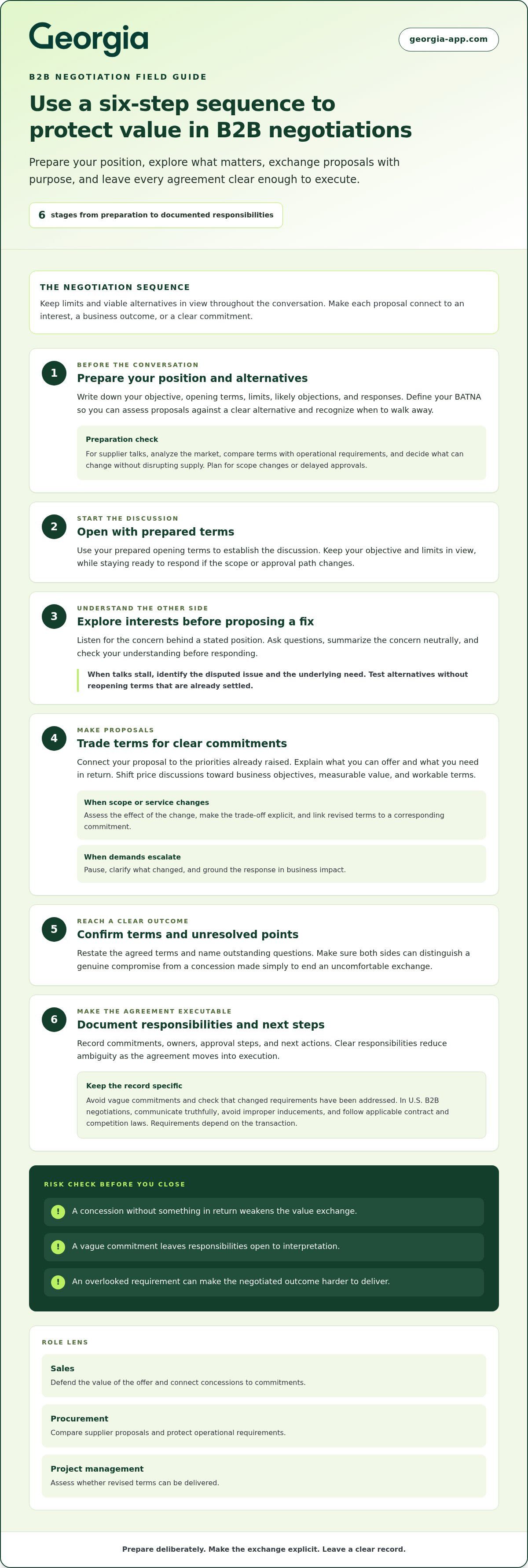
Use a framework to record your objective, opening terms, limits, likely objections, and responses. Prepare for uncertainty by deciding how you’ll respond if scope changes or approval is delayed.
Supplier Negotiation Preparation
Before supplier talks, analyze the market, anticipate objections, and define your limits and alternatives. Compare proposed terms with operational requirements, then decide which terms can change without disrupting supply.
B2B Negotiation Steps and Risks
Follow a clear sequence: prepare, open the discussion, explore interests, exchange proposals, confirm agreement, and document responsibilities. Common risks include conceding without getting something in return, accepting vague commitments, and overlooking changed requirements.
In U.S. B2B negotiations, communicate truthfully, avoid improper inducements, and follow applicable contract and competition laws. The relevant requirements depend on the transaction.
Jordi Quoidbach, Senior Lecturer in Esade’s Department of People Management and Organization, states that 25% of daily conversations contain elements of negotiation. That perspective makes these techniques relevant beyond formal deal-making: whenever people discuss priorities, responsibilities, or expectations, a conversation may involve competing needs and room for agreement. The practical aim is not to turn every exchange into a contest, but to notice what each person needs, ask questions before proposing a solution, and make commitments explicit.
Listen for the concern behind a stated position. Summarize it neutrally and check your understanding before responding. Then connect your proposal to the priorities already raised, explain what you can offer, and state what you need in return. If a point remains unresolved, name it clearly instead of letting silence or ambiguity stand in for agreement. Close by restating the agreed terms, outstanding questions, and who owns the next action. These habits support trust and focus the conversation, helping both sides distinguish a genuine compromise from a concession made just to end an uncomfortable exchange. With preparation and deliberate practice, you can adapt your approach without losing sight of your limits or the relationship. This discipline also makes routine conversations clearer: both sides can see what was heard, what remains open, and what each has agreed to.
B2B negotiation training for sales, procurement, and project management
Training should reflect each role’s commercial decisions and operating pressures. Practice should prepare teams to manage deadlocks, emotional shifts, and changing demands.
Deadlock Management and Agreement Closing
When talks stall, identify the disputed issue and the underlying need. Test alternatives without reopening settled terms. Before closing, record commitments, owners, and approval steps so the agreement can move into execution without ambiguity.
Emotions, Relationships, and Demands
When demands escalate, pause and clarify what has changed. If a customer adds a service requirement late in a deal, for example, assess its effect on scope before discussing revised terms. A calm, specific response protects the working relationship and keeps the decision grounded in business impact.
Sales and Procurement Tactics
Sales teams defend the value of their offer and connect concessions to commitments. Procurement teams compare supplier proposals and protect operational requirements. Project managers assess whether revised terms can be delivered. Top-performing sellers are 70% more likely to manage buyer negotiation tactics, making practice with the other party’s likely perspective valuable for both sides.
For sales teams, a proposed figure is a point to examine, not a reason to concede without understanding the exchange. Clarify what the client expects at that level, then check whether the package and its commitments match those expectations. If the discussion shifts to a different scope or service requirement, make the trade-off explicit and link any change in terms to a corresponding commitment. This keeps the conversation focused on the value exchanged, rather than treating one figure as the whole agreement. Practice can include explaining the basis for an offer, asking what matters most to the other party, and distinguishing a genuine constraint from a preference without assuming either in advance.
Procurement teams can apply the same discipline when comparing proposals: make the criteria visible, test whether each offer meets operational requirements, and explain why a requested change matters. Project managers can assess the practical effect of proposed terms before making a commitment, keeping the negotiated outcome workable for delivery. Use relevant objective data, standards, or norms to support fair decisions. Identify the evidence that applies to the disputed point, use the same standard to assess each option, and state where uncertainty remains. This gives participants a shared basis for discussing price, scope, or responsibilities while leaving room to explore alternatives. Training should help each role explain its priorities and respond to others’ constraints, rather than treating negotiation as a contest over who yields first. Close by checking that everyone understands the terms in the same way and separating unresolved issues from what has already been agreed.
BATNA and knowing when to walk away
BATNA means the best alternative to a negotiated agreement. Define yours before talks begin, then compare each offer with that alternative and your commercial limits.
BATNA and Alternative Options
Your BATNA is the practical option available if negotiations fail. List credible alternatives, then assess their cost, timing, operational impact, and effect on margins. A supplier’s terms may look attractive but create delivery risk; another supplier or a revised project schedule may lead to a stronger outcome.
In an illustrative supplier negotiation, the buyer can pay up to €10,000, while the supplier needs at least €8,000. That creates a possible agreement range between those limits. The figures only help if both sides understand their actual constraints. Identify what each alternative requires, who approves it, and how quickly it can be used.
Separate a real alternative from a threat. A backup source that cannot meet specifications may not protect your operation. Test each option against the requirements that matter, such as supply continuity, quality, and delivery commitments. Top-performing sellers are 105% more likely to know when to walk away from a sales negotiation. That decision depends on comparing the proposal with a credible alternative, not on winning the exchange.
Walkaway-Point Analysis
Set your walkaway point before the meeting, based on the minimum acceptable outcome and the value of your BATNA. Buyers should assess the full supplier terms, including delivery conditions and operational exposure. Sellers should account for margin and the resources needed to serve the account. A headline price alone can conceal a costly agreement.
Then define the ZOPA, or zone of possible agreement: the overlap between each party’s acceptable terms. In the €8,000 to €10,000 example, the buyer’s maximum and supplier’s minimum create a potential range. If new requirements push the supplier’s minimum above the buyer’s limit, the overlap disappears unless another term changes.
Use a simple decision sequence: compare the proposal with your BATNA, identify the remaining overlap, and test whether a trade can close the gap. Revised delivery timing, for example, may affect the supplier’s costs and the buyer’s operational value. Record the condition behind each concession. If no workable overlap remains, pause or walk away rather than eroding margins to secure an agreement.
Review your decision when material facts change. A new project deadline, supply constraint, or approval limit can alter your alternatives and acceptable terms. Update your walkaway point before making another offer, then communicate your revised position clearly. This keeps outcomes aligned with current operating needs rather than pressure in the meeting.
Negotiating on objectives and value rather than price
Price-only bargaining narrows the deal and can squeeze margins. Start with the business objective, then shape terms around value both parties can use.
To protect profit margins, link each concession to a commitment or scope change. When responding to objections or counteroffers, clarify the concern, test its basis, and make a conditional proposal tied to the buyer’s priorities.
Objectives and Value Creation
Identify the outcome behind each stated position. A customer asking for faster delivery may need reliable supply for a project sequence, while a supplier may need predictable scheduling. Build options around those interests, such as phased deliveries or a revised order schedule. According to RAIN Sales Negotiation, sellers should focus negotiations on value rather than price. That shift can strengthen a relationship and create a more useful dynamic.
For strategic customers, align the offer with their objectives and long-term relationship needs. Ask which operating result matters most, then connect proposed terms to that result. If the buyer values continuity, discuss supply planning alongside price. If flexibility matters, explore scheduling or scope changes. Each option should solve a defined problem, not add features without a business reason.
Value Anchoring and Claiming
Anchor the discussion in relevant outcomes before exchanging numbers. Explain what the proposed terms support, using objective data, standards, or agreed criteria where available. For example, a seller discussing a project supply agreement can connect delivery reliability to the customer’s work sequence. An anchor should clarify value, not inflate claims.
Creating value means finding options that improve the combined deal. Claiming value means securing terms that protect your own priorities. Treat both as deliberate steps: identify a shared gain, then agree how its benefits and responsibilities will be divided. Top-performing sellers are 81% more likely to overcome price pressure and maintain margins. That advantage depends on defending value with relevant terms and evidence.
Concession Exchanges
Never concede without asking for something in return. State the exchange clearly: “If we adjust the delivery schedule, can you confirm the order volume?” This links a concession to a commitment and gives both sides a reason to accept the change. Buyers can use the same approach when offering forecast visibility in return for improved supply terms.
A creative example replaces a proposed €1,000 penalty per day of delay with €3,000 and a bonus arrangement. The proposal includes a €500-per-day early-delivery bonus. It turns a one-sided penalty demand into a structure that rewards timely performance. In your own negotiation, define the trigger, responsibility, and commercial effect before agreeing. Then test whether the exchange supports the intended outcome and preserves your margin.
Comparing negotiation training providers and courses
Compare training by what participants practise, how they receive feedback, and whether skills transfer to live deals. A course title tells you little; its scenarios and assessment reveal its practical value.
Start with your team’s negotiation gap. A sales group facing discount pressure needs different practice from procurement staff managing supplier changes. Match course scenarios to actual calls, bid reviews, and project discussions. If a program relies on generic examples, participants may struggle to apply its techniques to real commercial decisions.
Compare the learning format with your team’s work patterns. Instructor-led workshops can support group discussion, while self-paced simulations let participants rehearse individual conversations. Check whether the format includes realistic objections, chances to retry, and feedback on specific responses. For example, participants should practise exchanging a concession for a commitment, then review where their response protected or weakened the deal.
- Compare scenario relevance, such as customer discount requests or supplier delivery changes.
- Check whether learners practise opening terms, objections, counteroffers, and agreement confirmation.
- Look for feedback that identifies specific wording or decisions to improve.
- Assess whether participants can repeat practice and apply lessons to current deals.
- Match the course format to scheduling needs and the team’s preferred practice method.
Also compare how a course covers preparation and follow-through. Participants should leave with a method for recording objectives, limits, and next steps. A procurement learner might practise documenting a supplier commitment, while a sales learner rehearses responding to a late price objection. These outputs help connect training to routine work.
Measure return by setting a baseline before training, then tracking comparable deals afterward. Review indicators such as discount levels, margin retention, agreement terms, deal progression, and repeat customer outcomes. Compare like with like, because product mix, market conditions, and deal complexity can affect results. Training ROI is more useful when managers connect observed changes to the specific skills participants practised.
Use a decision matrix to compare each course with your priorities. Assess scenario relevance, practice quality, feedback, accessibility, and how well workplace application can be measured. Then identify the strongest fit for your team’s actual negotiation tasks. The right course addresses a visible performance gap and gives participants structured opportunities to practise improving it.
Explore negotiation practice options
Georgia: Sales & Commercial Training Modules
Georgia helps sales teams practise high-pressure conversations through Sales & Commercial Training Modules and its AI Role-Play Platform. Teams can rehearse buyer objections, price pressure, and concession exchanges in personalized, self-paced simulations, then identify where their responses need work.
Consider this approach when negotiation gaps appear in live customer conversations, such as unplanned discounts or unclear commitments. Customer Operations Training and Leadership Development Practice address related communication needs across customer-facing and leadership roles. The focus is practical conversation practice, not technical skills instruction.
Visit Georgia’s website to learn more.
Make Negotiation Practice Part of the Operating Rhythm
Choose an upcoming customer or supplier negotiation and set a clear practice objective. You might focus on holding a margin boundary, responding to a scope change, or securing a firm commitment before offering a concession. Make that objective clear before the conversation starts.
After the meeting, compare the result with the objective. Identify which response helped, where the discussion lost direction, and what your team will try next time. This turns B2B negotiation tactics training into an ongoing performance discipline rather than a one-off learning event.
Build the habit into deal reviews and team development. Consistent practice gives managers a clearer view of negotiation behaviors and practitioners a practical target for improvement.
Approach your next negotiation with a defined objective and a deliberate plan. Your team can make every conversation more disciplined.
Frequently Asked Questions
What is the best business negotiation training program?
The best program fits the negotiations your team actually handles. For B2B negotiation tactics training, compare how well the exercises reflect your customers, suppliers, and approval process. Check whether participants receive feedback on specific decisions and can practise again after making mistakes. A useful program should also help managers connect workplace behavior with deal outcomes, rather than relying on course completion as proof of performance.
What are the most effective B2B negotiation tactics?
Effective tactics clarify proposals and keep discussions focused on decisions. Set an agenda, ask questions that reveal decision criteria, and summarize the other party’s priorities before responding. When priorities differ, present more than one workable proposal, then ask which option best meets their needs. This lets both sides compare trade-offs without turning every disagreement into a price concession.
What skills should B2B negotiation training cover?
Training should strengthen listening, clear questioning, commercial judgment, and composure under pressure. Participants also need to explain proposals plainly, recognize when an objection signals a missing stakeholder, and adapt their communication. For example, a sales representative may need to restate technical delivery constraints for a finance approver. Practice should cover internal handoffs too, so negotiated commitments reach the teams responsible for fulfilling them.
How do you prepare for a B2B sales negotiation?
Before a sales negotiation, map the customer’s decision process and identify who influences approval. Review the account’s stated requirements, likely alternatives, and the evidence supporting your proposal. For a construction materials bid, clarify specifications, delivery dependencies, and which terms need internal approval. Prepare concise responses to likely objections, and decide who will lead each topic if colleagues join the discussion.
What B2B negotiation training courses are available in the United States?
U.S. teams can find courses focused on sales negotiations, procurement and sourcing, contract discussions, and project-based commercial decisions. Training may be self-paced digital learning, live instruction, or scenario-based practice. Choose the subject based on role and recurring deal challenges. A sales team handling customer objections needs different exercises from a procurement team reviewing supplier terms or project leads managing scope changes.