
Key Takeaways
- A startup value proposition is never really finished. Julia Georgi calls it "a floating feature", because it moves every time you learn something new about the people you sell to.
- When your offer moves, the way you talk about it has to move with it, which means your conversation skills need to keep up too.
- The advice everyone agrees on, like "nail your positioning", gives you a good sentence, but it rarely prepares you for the buyer who wants to talk about something else.
- Every time the offer changes, practise the new conversation out loud, in short sessions, before a real buyer hears it.
A buyer you met at a conference finally agrees to a call. You open with the value proposition you rewrote last month, the one your advisor liked so much, and she listens politely, nods, and then says: "Interesting. We tried something similar. What we actually struggle with is getting the team to use anything." Your carefully polished sentence has no answer to that, so you say it again, just a little louder.
Most founders treat their startup value proposition a bit like a slide: you write it once, polish it until it shines, and present it whenever someone asks. Then the real conversations begin, and every single one of them tests it from an angle you did not expect.
What Is a Startup Value Proposition?
A startup value proposition is the short answer to three questions every buyer asks, out loud or in their head: who is this for, what problem does it solve, and why should I choose you over simply doing nothing? For a young company it usually fits in one or two sentences, and it quietly shapes your homepage, your pitch and the way you open your first sales calls.
Every guide will give you a template for it, with a slot for the customer, the pain, the outcome and what makes you different. The templates are perfectly fine. The trouble starts once you have filled one in and decide that the work is done.
Why Your Value Proposition Is Never Finished
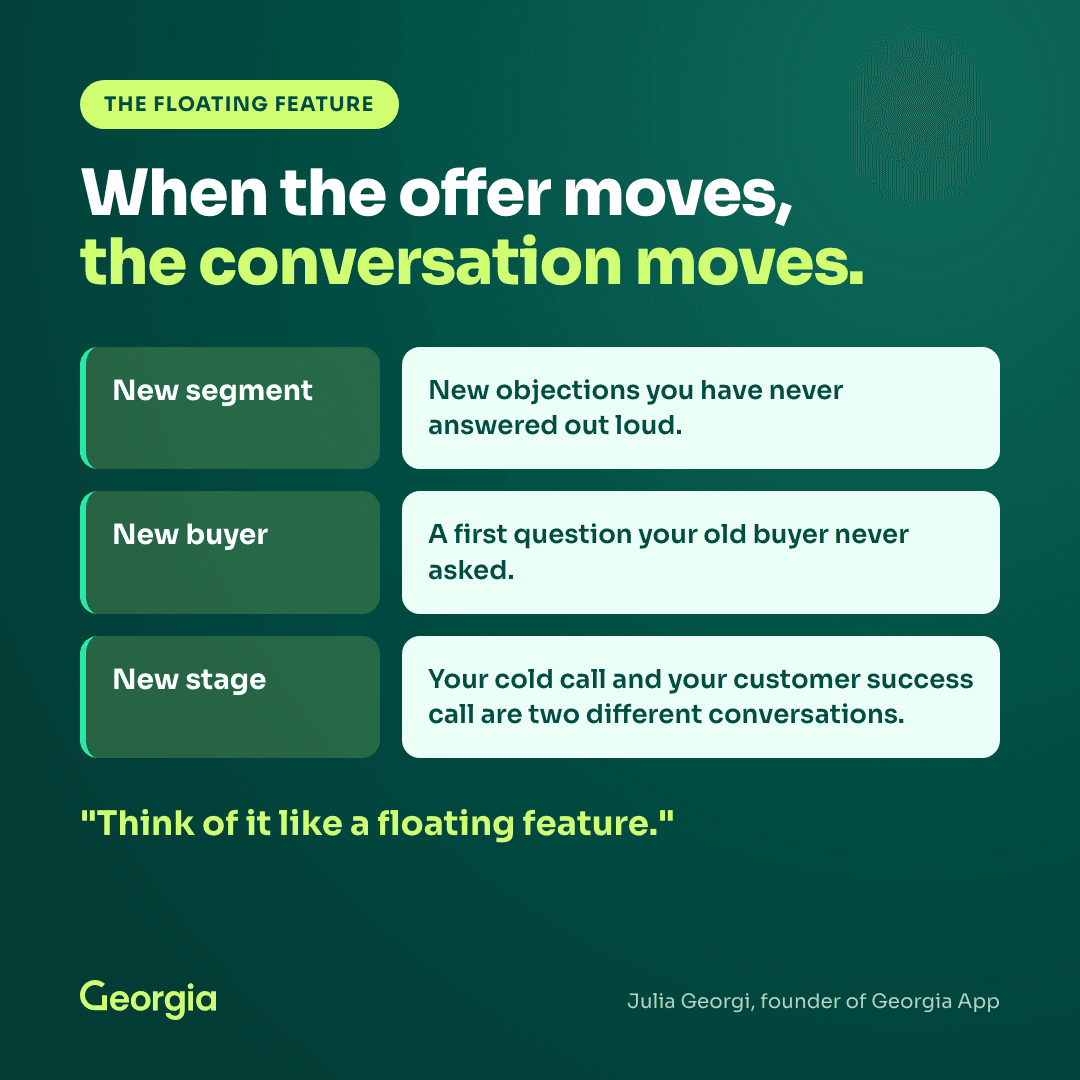
Julia Georgi, founder of Georgia App, put it very simply in a recent conversation with Justin DeMarchi. When she works with founders, she often sees them treat their offer as a product, almost like a finished feature they can ship and forget. Her advice goes the other way: "Think of it like a floating feature."
Understanding your ideal customer is only the first step. After that you interview people, you sell, you lose a few deals and you sell again, and each of those conversations teaches you something about how the offer should sound. "There is no stop. That's the business," she said. In other words, your job as a founder is to keep figuring out how to bring your product to market, again and again, for as long as the company exists.
Julia's own path shows how far an offer can travel. Georgia started with HR in mind, but she soon found HR almost impossible to sell into, so she turned to sales trainers, who already had budgets and a clear reason to buy. In an earlier startup she had learned a similar lesson the hard way: big companies kept saying no, while smaller ones said yes, mostly because they let her talk directly to the person who makes the decision. It was the same product with a different buyer, and it needed a different way of talking about it.
She is refreshingly honest about how this feels from the inside: "It's always work in progress." She admits she does not like her own website and that everything feels a little outdated in her head, because the vision keeps moving and the words always have to catch up.
Everyone says
"Nail your value proposition before you sell"
Georgia · georgia-app.com
When the Offer Floats, Your Skills Float Too
This is the part most positioning advice leaves out. If your value proposition keeps moving, the conversations around it keep moving as well: a new segment brings objections you have never heard, a new buyer opens with a question you did not prepare for, and every stage of the sale asks for a slightly different kind of talk.
Julia makes the point when she talks about the sales trainers Georgia works with: "your cold call will not be the same as, let's say, your customer success call." The trainers she chooses never hand out a script. Instead, they teach techniques and a way of reading the situation, because a script only works for the offer you had on the day you wrote it.
You probably know this from your own week:
- You refined your pitch for operations leads, and then a CFO joins the call, asks about payback, and all your best lines turn out to be about workflow.
- You moved from enterprise deals to smaller companies, so now you are talking directly to a founder who wants a decision today and has no interest in your procurement slides.
- You added the feature customers kept asking for, yet you still describe the product the way you did six months ago, simply because that is the version you know by heart.
In each case you know the content perfectly well. What you have not done is practise the new conversation, so the offer moved on while your skills stayed exactly where they were.
Founders who sell well tend to treat both as moving parts. They update the words, and then they rehearse the conversation those new words are going to start. That is the thinking behind Georgia's practice for founders: you rehearse the conversation you are about to have, with the offer you actually have today.
Advisors Are Right, and That Is the Problem
Ask any advisor and you will hear the same list: know your ideal customer profile, lead with the pain, keep it short and, of course, test it with real buyers. They are right, and that is exactly why every founder in your cohort has heard the same advice.
When everyone agrees on a piece of advice, it usually stops at the content. It tells you what to say on a calm day, but it says very little about the moment a buyer answers with something your value proposition never saw coming, and you have about three seconds to decide what to do with it.
That moment is a skill, and like any other skill it gets better with practice. Knowing your value proposition is one thing; being able to adapt it live, with a real person looking at you and waiting for an answer, is something else entirely.
How to Test and Practise a Value Proposition That Keeps Changing
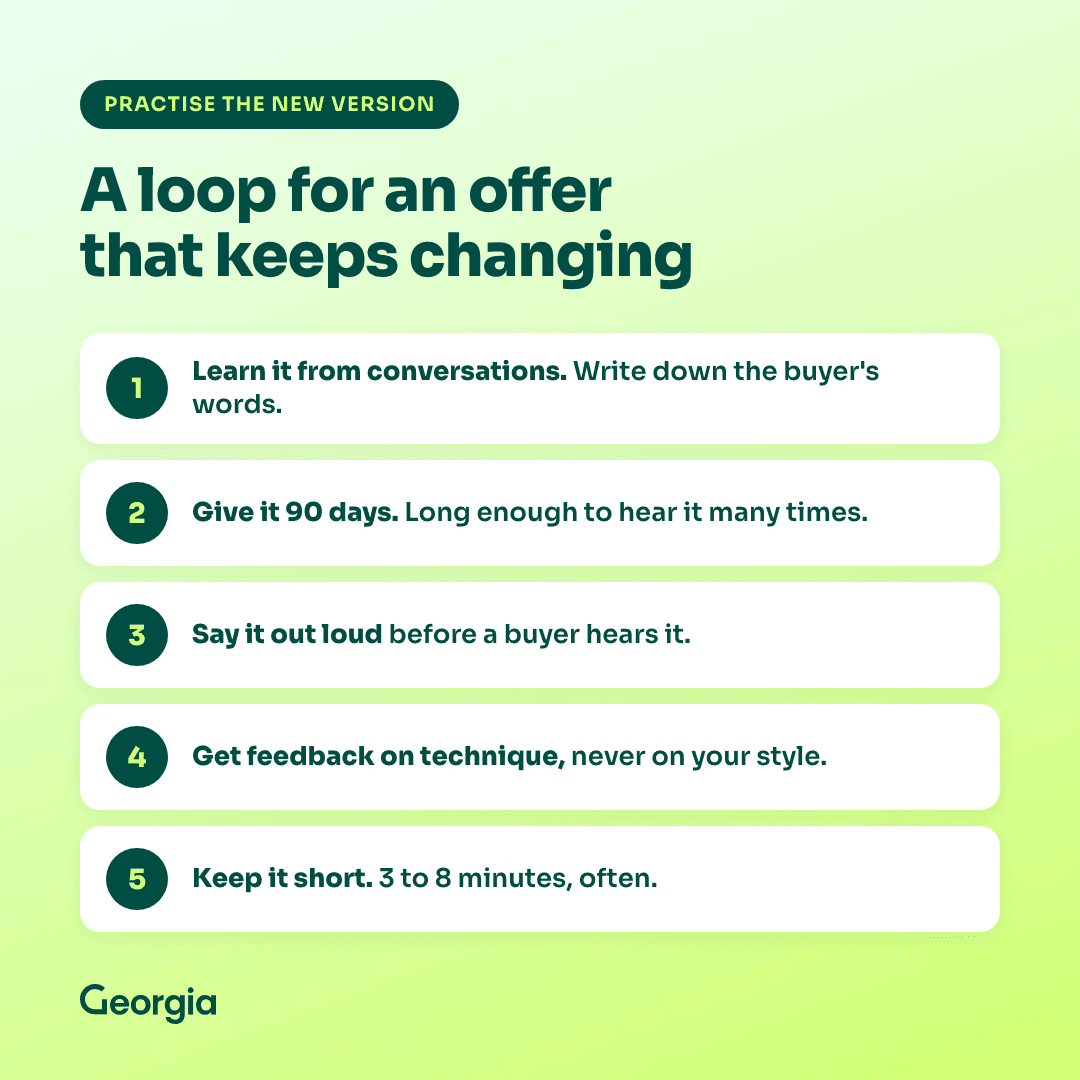
You do not need a big programme for this. What you need is a simple loop that runs every time the offer moves.
1. Learn it from conversations first
Julia found her first proof of concept client on LinkedIn, simply by messaging people she already knew. Her marketing mentor's rule was to reach out to at least 20 people, on the assumption that two of them would give real feedback. Treat those replies as interviews, write down the exact words buyers use to describe their problem, and you will find that those words make the best raw material for your next value proposition.
2. Give each change a fixed test period
Julia works with one simple rule: "If I start something, I try to do it for 90 days." Give each new version of your offer a similar window, long enough to hear it in many real conversations and short enough that you do not end up defending a version that is clearly not working.
3. Say the new version out loud before a buyer hears it
A value proposition you have only typed is still a draft. Say it to a colleague, to your phone's recorder or to an AI role-play partner, and let them answer the way a real buyer would, ideally with a question you did not plan for. Then answer that question, and do the whole thing again with a different type of buyer in mind.
4. Ask for feedback on technique
Useful feedback is specific. Julia uses Georgia herself and openly admits that on some products she gets "horrible grades." The feedback she values is technical, something like "you sound very clear, but you pitch early." It is never about personality, or as Julia puts it, "We will never judge your style." Feedback like that gives you one concrete thing to change on your very next call.
5. Keep the sessions short and frequent
Realistically, you are not going to block a whole day for practice every time your offer changes, but you can find three minutes before a call, and that is enough as long as you do it often. Georgia sessions take 3 to 8 minutes, with a listener who changes every session and a score for how relevant your words were for that particular listener.
Julia's advice to founders in the same interview was generous, too: if you do not want to try Georgia, try another tool, even a general AI chat. "Methodology is the core of any training," she said. What matters is that the practice happens before the real conversation does.
Julia talked all of this through with Justin DeMarchi, who interviews founders and executives, and you can watch the full 25-minute conversation on Justin's DUO page.
Tonight, in Five Minutes
Pick the one that best matches where your offer is this week.
- Your offer just changed: say the new value proposition out loud three times, starting each time with a different first word, until it sounds like you.
- You have a new segment: write down the first question this buyer will ask you that your old buyer never did, and answer it out loud.
- You are stuck on one version: read your last three call notes, underline the words buyers used for their problem, and rewrite your sentence using their language.
- You have a call tomorrow: spend five minutes practising the first two minutes of it with someone, or something, that pushes back.
Frequently Asked Questions
What is a startup value proposition?
It is the short answer to who you help, with which problem, and why they should choose you. For an early stage startup it usually fits in one or two sentences and shapes your website, your pitch and your first sales calls.
How often should a startup change its value proposition?
Whenever your conversations tell you something new about the buyer. A simple approach is to give each version a fixed test window, such as 90 days, and then keep it, adjust it or drop it based on what buyers actually said.
How do you test a value proposition?
Use it in real conversations and pay attention to the reaction: the questions it raises, the words buyers use back to you, and the point where the call starts to stall. Reaching out directly to 20 people you already know is an easy way to begin.
How can founders practise talking about their offer?
Say it out loud before buyers hear it, whether to a colleague, a recording or an AI role-play tool that answers like a buyer would. Short, frequent sessions work better than one long workshop, and you can book a Georgia demo to see how founders practise with it.