
Key Takeaways
- Founders prepare their investor pitch deck as content. Few prepare for the real conversation in the meeting, where the investor interrupts, jumps ahead and asks what the slides never answered.
- Your deck and your spoken pitch must tell the same story. Investors notice the moment they drift apart.
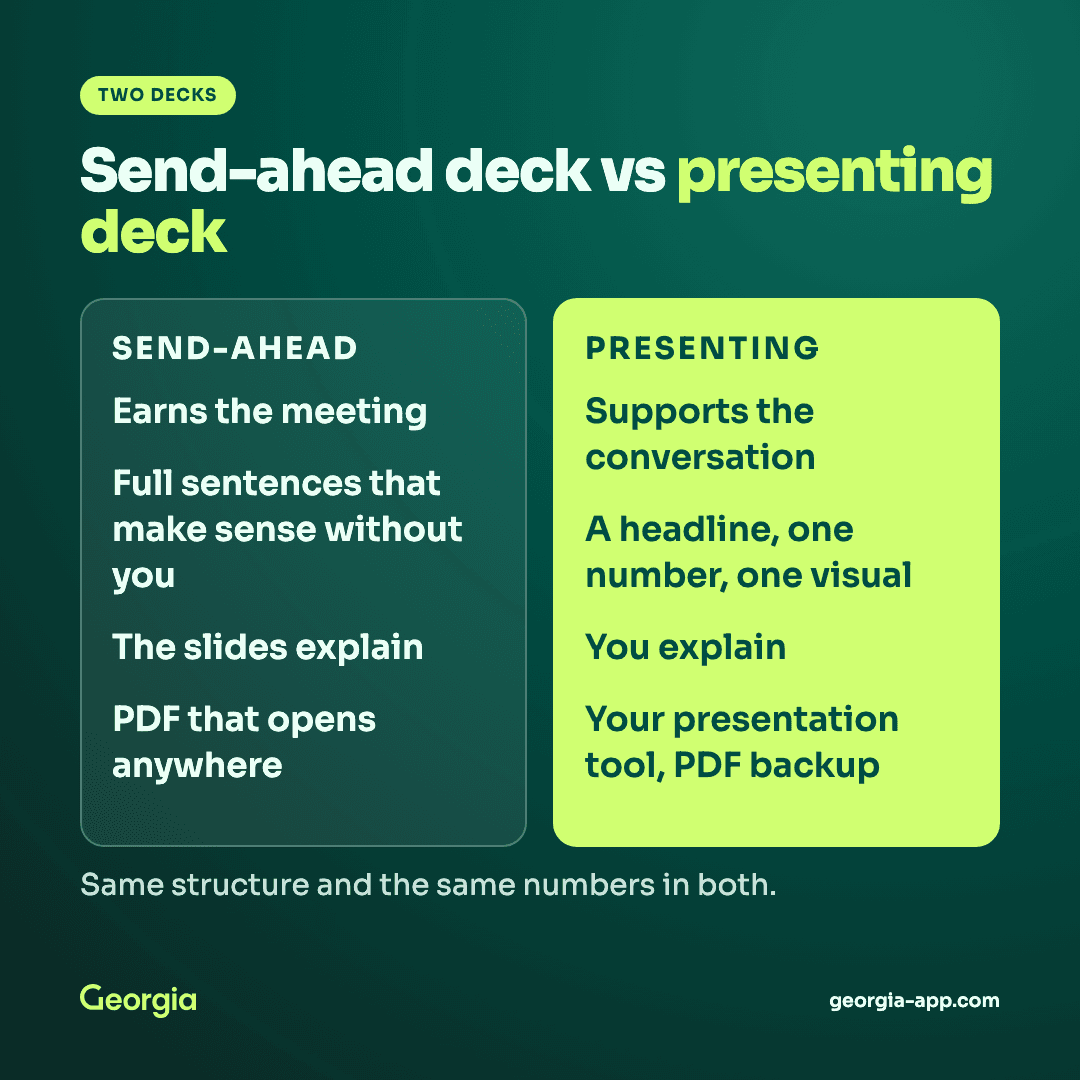
- Build two versions: a send-ahead deck that reads on its own, and a presenting deck with minimal text that supports the conversation.
- Plan each slide around one investor question and the one point you need to make. Know the point cold and let the words change.
- When the investor leads, reflect the question, ask what is behind it, answer with one claim and one proof, and hand back the floor. That is Georgia's Adaptive Conversation method.
- Ask your co-founder separately who your buyer is. If the answers differ, fix that before you fix the slides.
An investor pitch deck is the slide presentation founders use to explain their company to potential investors: the problem, the solution, the market, the business model, the traction, the team and the ask. Most founders spend weeks on the slides and an hour on what they will say. Investors meet your deck twice, once on their screen and once in the room, and the deal often turns on whether those two versions agree.
Underneath that sits a bigger gap. People prepare for content. They do not prepare for a real conversation. The conventional advice tells you to perfect the slides and rehearse the voice-over, and the slide advice is sound. But there is nothing worse than following a script while an investor is trying to talk to you. Investors know that. You know it. The trick is to be prepared for every topic in the deck and confident enough to bring any of them into a discussion between two humans. Yes, investors are humans.
Julia Georgi, founder of Georgia App, tells a story about a founder whose deck said enterprise. Ninety seconds into the live pitch, he said: "usually it is one ops manager who finds us." Asked who else was in the room at the buying decision, he did not know, and the deck was asking for sixty million. His co-founder, asked separately, answered differently. The slides looked fine. The story underneath them had a gap, and the spoken pitch exposed it.
This guide shows how to make your deck and your spoken pitch work together: what to put on each slide, what to say while it is on screen, how a send-ahead deck differs from a presenting deck, and how to run the meeting itself as a conversation, before Slush or any other investor event.
What an Investor Pitch Deck Is For
An investor pitch deck has one job: to get you to the next conversation and, eventually, help you secure funding. Very few investors write a cheque because of slides alone. They use the deck to decide whether a meeting is worth their limited time, and then to check whether what you say in the meeting holds together.
That gives every investor pitch deck two audiences:
- The reader. An associate or partner skimming your deck alone, often on a phone, often between meetings.
- The listener. The same person, later, watching you present and asking questions.
A business plan explains everything in detail. An elevator pitch fits into 30 seconds. The deck sits in between: enough key information to generate interest, short enough to read in a few minutes.
What "send me a deck" means
When an investor says "send me a deck", they want to read your pitch deck without you in the room. It is a screening step. Your deck has to answer their first questions on its own: what you do, for whom, why now, why you, and how much money you are raising. If it needs you to explain it, it will lose the reader.
Send-Ahead Deck vs Presenting Deck
Most startup founders use one pitch deck file for both jobs. That usually means a deck that is too dense to present and too thin to read. Build two versions from the same structure.
Two decks, two jobs
Send-ahead deck and presenting deck
Georgia · georgia-app.com
The structure and the numbers must be identical in both. If your send-ahead deck says one market size and your spoken pitch uses another, the investor will ask which one is true.
A simple test for the send-ahead deck
Send it to someone outside your industry who has never heard you pitch. Ask them to tell you, in their own words, who the customer is and what the company sells. If their answer is far from yours, the deck depends on you being there to explain it.
How to Create an Investor Pitch Deck Step by Step
Before you open a pitch deck template, write the story. Startup founders who create the slides first usually end up with a pretty presentation and a vague plan. Use this order instead:
- Write your one-sentence story. Who has the problem, what it costs them, and how your company fixes it. This becomes your unique value proposition.
- Name one buyer. One person, one job, one problem. Focus beats breadth in the early stages.
- Gather your evidence. Customer conversations, market research, traction, and the business model numbers you can defend.
- Decide the ask. How much money you are raising, what the investment pays for, and what milestones it reaches. Investors invest in a plan, so make it specific.
- Draft the slides. One investor question per slide, in the order below.
- Say it out loud. Talk a friend through the draft, let them interrupt, and note where you had to explain something the slide did not cover.
- Tailor it. Adjust emphasis for a specific investor: a lead investor in your industry may want more on the market opportunity; a generalist venture capital fund may want more on growth potential.
Everything investors do not need for a second meeting goes in the appendix or the data room.
Pitch Deck Slides: What to Show and What to Say
This is the content you need to know cold. A good pitch deck answers one investor question per slide. For each slide below you get what goes on screen and the point you need to make, with an example of how it might sound. The examples come from one fictional logistics company. Treat them as a topic map, never a script: say each point in your own words, and expect the investor to ask for slide seven while you are on slide two.
1. Title and one-line summary
On screen: company name, a one-line value proposition, the round you are raising. Your point, for example: "We help mid-sized logistics firms plan routes in minutes. We're raising a seed round to grow in the Nordics."
2. Problem
On screen: the pain point in one sentence and one concrete example. Your point, for example: "Every morning, a planner at a 40-truck carrier spends two hours rebuilding routes by hand. When a driver calls in sick, they start over."
3. Solution and product or service
On screen: what the product does, ideally a single screenshot. Your point, for example: "Our software rebuilds the plan in under a minute and sends it to drivers' phones."
4. Why now
On screen: the shift that makes this possible or urgent today. Your point, for example: "Carriers now have live data from every truck. Until recently, nobody could use it fast enough."
5. Market size and target market
On screen: your target market first, then the bigger market opportunity. Investors often expect TAM, SAM and SOM: total demand, the segment you can serve, and the share you can realistically win soon. Your point, for example: "We start with carriers between 20 and 200 trucks in the Nordics. That is the market we can win in the next two years."
6. Business model
On screen: who pays, how much, how often. Keep revenue models simple. Your point, for example: "Carriers pay per truck per month. The ops manager finds us; the CFO signs."
7. Traction and key metrics
On screen: the few numbers that show people want this: revenue, pilots, retention, growth trajectory. Your point, for example: "Three paying carriers, two pilots converting this quarter, nobody has left."
8. Go to market strategy
On screen: one buyer, one channel, one message. Your point, for example: "We sell to the head of operations through freight associations. Our first three customers came from one association event."
9. Competition and competitive advantage
On screen: who else solves the same problem and why you win. Your point, for example: "Large planning suites exist, but they take six months to roll out. We go live in a week."
10. Team slide
On screen: the team's background as it relates to this problem. Your point, for example: "I ran dispatch for a carrier for twelve years. My co-founder built routing systems for a delivery company."
11. Financial projections
On screen: a realistic three to five year view and the assumptions behind it. Your point, for example: "These projections assume we keep converting pilots at today's pace and add one new region a year."
12. The ask
On screen: how much you are raising and what it pays for. Your point, for example: "We're raising this amount to hire two engineers and our first sales lead, which gets us to the next set of milestones."
Notice the pattern. The slide carries the evidence; your voice carries the story. When you put the whole story on the slide, investors read ahead and stop listening. When you put nothing on the slide, they can't remember it later. And because you know each point, you can make it from any slide, in any order the conversation takes.
Make the Deck and the Spoken Pitch Tell One Story
A compelling narrative runs through the whole deck: this person has this problem, it costs them this much, here is how we fix it, here is proof, here is why we will win. Every slide is a step in that story.
The trouble starts when the deck and the founder tell different stories. In the pitch case above, the slides said enterprise; the founder's own words said one ops manager. Both may be partly true. Investors can't tell which, and they rarely ask twice. They just move on.
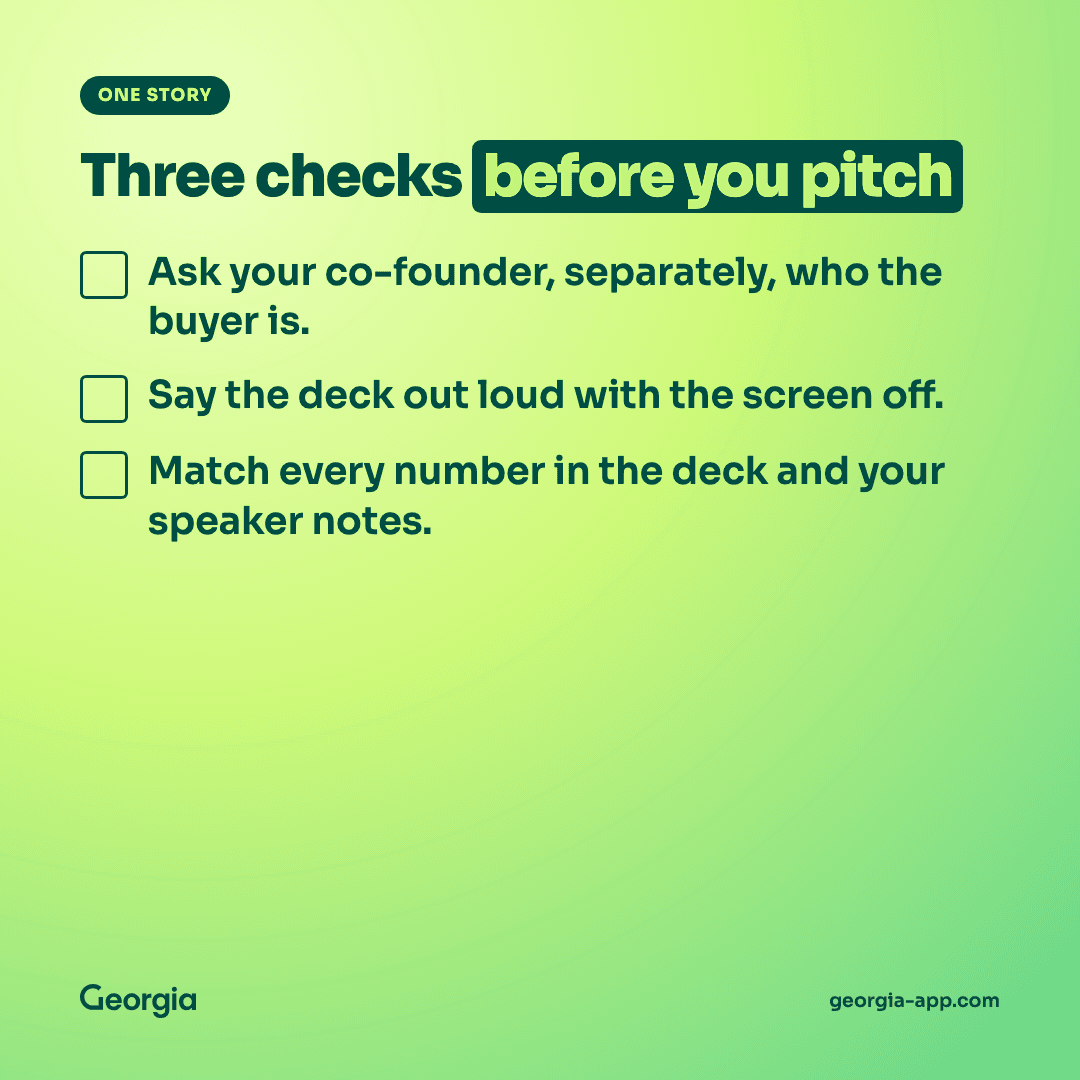
Three checks before you pitch
- Ask your co-founder separately. Without discussing it first, each of you writes down who the buyer is, who else is in the room at the buying decision, and why they buy now. Compare answers. Julia Georgi suggests this exact check, and it often reveals more than any slide review.
- Say the deck without the slides. Present your pitch out loud with the screen off. If you can't tell the story without looking, the slides are doing your thinking for you.
- Match every number. Read the deck and your speaker notes side by side. Market size, revenue, customer count and the amount you are raising should be the same everywhere.
When the answer is two minutes of nothing
Julia hears this from founders often: "An investor asked who my customer was. I talked for two minutes and said nothing." That usually happens when the deck has a market slide and no buyer. Write one sentence that names the buyer, their job and their problem, and make sure it appears on your problem slide and in your opening line.
Julia Georgi's Startup Witch video "You're (Probably) Killing Your Startup" is a useful companion to this section.
How to Present a Pitch Deck
A pitch deck presentation is a conversation with visual support, and the conversation comes first. It is also different from a sales pitch: a buyer asks whether your product or service solves their problem, while an investor asks whether your company can grow into a big business. A few habits make a big difference.
- Keep it short. Canva's pitch deck guide recommends 10 to 15 slides, and J.P. Morgan describes decks of 10 to 20 slides. Fewer is easier to remember.
- One idea per slide. A headline that states the point, one visual, and minimal text.
- Lead with the headline. Say the slide's point in the first sentence, then give the detail. Investors who drift for a moment can catch up.
- Use simple language. Explain complex information the way you would to a smart friend outside your industry. Industry experts in the room will still follow you; generalists will thank you.
- Welcome the interruption. Many investors interrupt. Treat it as a good sign: the conversation has started. Follow their question, even if it means jumping five slides ahead.
- Know your appendix. Keep detailed financials, cohort data and product screenshots in backup slides you can jump to.
Meeting investors at Slush
If you are pitching at Slush 2026 in Helsinki on November 18 to 19, expect short meetings booked through the Slush Meeting Tool, Investor Office Hours and plenty of conversations in corridors and at side events. Slush describes "one VC for every two founders". Many of those conversations will happen with no screen at all. Your spoken pitch has to work on its own, and your send-ahead deck has to be ready in your inbox for the follow-up.
When the Investor Takes Over the Deck
Most meetings leave the planned order within a few minutes. The investor asks about churn on the title slide, or skips straight to the team. That is where founders who prepared only content get lost. Georgia's Adaptive Conversation method has five moves for it. In a deck meeting, they look like this.
When they lead: reflect, then answer
Reflect: play it back until you get "that's right". Before you answer, check what they are really asking. "So the question is less the market size and more whether carriers this small will pay. Have I got that right?" If they say "that's right", you understood their meaning. If they say "you're right", you probably only repeated their words. Reflect again, or ask what is behind the question.
Make a claim: permission, one claim, one proof, hand back the floor. "Can I show you the traction slide for that?" Then one claim and one proof: "Three paying carriers, and nobody has left." Then hand back the floor: "Does that answer it, or is the worry somewhere else?" Never end on your own sentence. The deck follows you; you follow them.
When you lead: start with their agenda
Engage: they set the agenda. Before slide one, ask what they know about you and why they took the meeting. "What made you want to talk today? Had you looked at the deck I sent?" Whatever they name becomes the agenda. If they say "I want to understand the go-to-market", open the deck there.
Explore: their story, not their opinion. Ask about their thesis and their last similar investment. "What was the last logistics company you backed, and what made it a yes?" A real past episode tells you what this investor weighs. Resist the urge to answer with a slide. Ask one more question.
Evoke and relate: they make the argument. "How big a risk is distribution for you here, on a scale of one to ten? Why that number and not a three?" Their answer tells you which slide matters most and which words to use when you show it.
The roots: motivational interviewing (William Miller and Stephen Rollnick) holds that people are persuaded by their own arguments. The deck stays the same. The order and the words follow the person in front of you.
Pitch Deck Templates and Pitch Deck Examples From the Most Successful Startups
A pitch deck template gives you a sensible order of slides, which saves time in the early stages. Most startup pitch deck template files follow the same structure as the list above. Use a pitch deck template for structure and layout, then replace every generic line with your own. If a template has a slide that does not fit your business, delete it.
What to look for in a pitch deck template
- A clear slot for one buyer and one problem on the problem slide.
- Room for a single key number per slide.
- A business model slide that shows who pays and how often.
- A team slide focused on the team's background for this problem.
- Speaker notes with the key point and number per slide, so your presenting deck and your spoken pitch stay aligned.
Pitch deck examples from the most successful startups can also help. Slidebean's collection describes Airbnb's early deck as a classic 10-slide format. Study how famous decks order their story. What made them work was a clear problem, a clear buyer and founders who could explain both, in conversation.
Visually appealing design helps: consistent fonts, readable charts and clean layouts. Fix the story first, though.
Rehearse the Spoken Pitch Until It Matches
Most founders rehearse by clicking through slides alone at a desk, or by reading the same voice-over until they can recite it. Both train you to perform the deck. Practise the way investors will meet you instead:
- Out loud, standing up, with a timer.
- Without slides, as if you met the investor at a coffee stand.
- Out of order. Ask someone to call out a random slide and make its point from there.
- With interruptions. Ask someone to stop you at slide three with "Who exactly is the buyer?"
- With the hard questions: "Why hasn't a bigger company done this?", "What happens if your best customer leaves?", "Why is this the right team?"
An AI counterpart is useful here because it is available every evening. Georgia's Adaptive Conversation module, part of Georgia for founders, works in two parts. An AI coach helps you structure your thinking and write your questions. Then you practise in a live role play with a listener who changes every session, an investor one day and a prospect the next. Georgia scores how relevant your words are for that particular listener. Run your pitch as a conversation with an AI investor in Georgia before the real meeting. For more on preparing for pressure, read our guide on building confidence for difficult conversations through practice.
When the deck, the spoken pitch and your co-founder's answer all tell the same story, you are ready. If you want to test that with a listener who changes every session before Slush, book a Georgia demo.
Frequently Asked Questions
What is a pitch deck for investors?
A pitch deck for investors is a short slide presentation that explains your startup: the problem, your solution, the market, the business model, traction, team and how much money you are raising. Its goal is to secure a meeting and support the conversation in it.
How many slides is a pitch deck?
Most guides suggest about 10 to 15 slides, with some allowing up to 20. Put extra detail in an appendix.
What slides should a pitch deck have?
Title, problem, solution, why now, market size, business model, traction, go to market strategy, competition, team, financial projections and the ask. Adjust the order to tell your story best.
What is the 10/20/30 rule for a pitch deck?
It is a popular rule of thumb: 10 slides, 20 minutes, and no font smaller than 30 points. It is a useful reminder to keep the deck short and the text minimal.
Should I memorise what to say on each slide?
Know the one point and the key number for each slide cold, and let the words change. A memorised voice-over breaks the moment the investor jumps ahead or interrupts. Practise making each point from any slide, in any order, with someone who asks questions.
What not to say to investors?
Avoid claims you can't back up, vague answers about who your customer is, and numbers that differ from your deck. If you don't know an answer, say so and offer to follow up. If you are not sure what they are asking, reflect the question back first.