
Key Takeaways
- Networking for founders is a learnable skill. You can get good at it by practising a few repeatable moves.
- The "they look busy" freeze is normal. A prepared opener and a clear reason to talk make it much easier to walk up.
- Join groups of three or more, stand in the gap, listen first, then add one useful line.
- Have an exit line ready. Leaving well is as important as starting well.
- Introverts and expert founders can network well by planning fewer, deeper conversations and treating their experience as the asset it is.
- Rehearse your openers and your one-line intro out loud before big events like Slush, so they come out naturally under pressure.
You built a product people need. You can talk about it for an hour with a customer on a call. Then you walk into a startup event, see a room full of people already deep in conversation, and your feet stop moving. Everyone looks busy. You check your phone. You get a coffee you don't want. These networking tips for founders are for exactly that moment. You don't need to be in Silicon Valley or be a natural extrovert to build a strong network. You need a plan and some practice.
Most founders who "hate networking" don't hate people. They hate the first ten seconds: walking up uninvited, finding the first sentence, and not knowing how to leave. The product usually works. The conversation is where things go wrong. The good news is that those ten seconds are learnable, and they get easier every time you practise them.
This guide covers the freeze, what to say first, how to join a group, how to exit, and how introverted founders can network without burning out. It uses Slush 2026 as a running example, but it works for any startup event, meetup or conference.
Why Founders Freeze at Networking Events
Picture a turtle pulling its head into its shell. That is what a lot of founders do at networking events. You see two people laughing near the coffee station and your brain says: they look busy, don't interrupt. So you wait. And wait. Twenty minutes later you have spoken to nobody.
The freeze usually comes from three things:
- No reason to approach. If you don't know why you are talking to someone, every approach feels like an intrusion.
- No first sentence. Your mind goes blank because you are trying to invent an opener on the spot.
- No exit. You worry you will get stuck, so you avoid starting at all.
Most people feel some version of this, even the ones who look relaxed. Fix those three and most of the fear goes away. Not all of it. A little nervousness is fine. It means you care.
Reframe what networking is for
Networking at a startup event is a long-term strategy for building meaningful relationships. Collecting business cards or pitching every person you meet misses the point. In practice, that means having a handful of real conversations that might lead to a second one: a meeting, an intro, a customer call, a hire. You are finding out whether there is a reason to talk again. That is how meaningful connections start, and how a founder's network quietly turns into customers, hires and career opportunities for the people around them.
That reframe matters, and it is the first rule of in person networking for founders. "I need to pitch 30 investors today" is terrifying. "I want three good conversations and two follow-ups" is doable.
Networking Tips for Founders Before the Event
Good networking starts before you arrive. Preparation turns a room of strangers into a room with a few people you already want to meet.
Set one clear goal
Pick one main goal per event. You will meet investors, potential clients, partners and future hires, so be specific. For example: meet two seed investors who back B2B SaaS in the Nordics, find three potential design partners, or meet founders who have hired their first sales rep. One goal tells you who to approach and what to ask.
Build a short target list
Most events publish speakers, partners or attendee lists. At Slush, tickets include access to the Slush Meeting Tool, so you can find people and request meetings before you land in Helsinki. Pick 10 to 20 names. Note one thing about each: a recent investment, a talk they gave, a product they launched. That one detail becomes your opener and shows genuine interest. If your startup sells into a particular industry, prioritise people from that industry over big names.
Write and rehearse your one-line intro
You will introduce yourself dozens of times. Make it short, clear and easy to say out loud. Your value proposition should fit in well under 30 seconds: who you help, with what, and one relevant proof point.
- "I'm Anna, co-founder of a tool that helps small logistics firms plan routes. We're working with a few carriers in Finland and Sweden."
- "I'm Ben. We build software that lets clinics fill last-minute cancellations. I'm here to meet people who have sold to healthcare."
Say it out loud ten times. Then say it to a friend, or practise it with an AI counterpart. A line that looks fine on paper often sounds stiff when spoken. For more on this, see our guide on building confidence for difficult conversations through practice.
Use Your Existing Network and Community First
The easiest stranger to meet is one who has already heard your name. Before you walk into any event, use the connections you already have.
- Ask for warm introductions. Look at who is attending, then ask an investor, advisor or friend who knows them: "Would you be comfortable introducing me to Maria? I'd like to discuss how her portfolio companies handle founder-led sales." Existing connections can introduce you to new, credible contacts much faster than a cold approach.
- Post before the event. A short LinkedIn post saying you're attending, what you're building and who you want to meet gives people a reason to reach out. Comment thoughtfully on posts from speakers and investors you plan to meet, so your name is familiar.
- Join a niche community. A Slack group, founder circle or local meetup for your particular industry gives you peers facing the same problems. These are often the people who later invite you to the useful dinners.
- Give before you ask. Share a helpful article, a customer story or an intro. Founders who create value for others get remembered and get help when they need it.
This is how you start building a network before you need it, instead of only reaching out when you want something.
What to Say First: Openers That Work
The best openers are simple, honest and based on the shared situation. A bit of small talk is fine. It is how two strangers check that the other person is friendly. You don't need to be clever. You need to be friendly and clear.
| Situation | Opener you can say |
|---|---|
| Someone alone at a coffee station | "Is this the good coffee or the backup coffee? I'm Sami, by the way." |
| After a talk | "What did you think of that panel? I'm still chewing on the point about pricing." |
| Someone you targeted in advance | "Hi, are you Maria? I saw your post about founder-led sales. Do you have two minutes?" |
| In a queue | "First time at this event? I'm trying to work out where everyone goes after this." |
| At a side event | "How do you know the hosts?" |
Then introduce yourself and ask a question about them. Let them talk first. People remember the person who was interested in them far longer than the person who pitched them. Listen actively: nod, ask about what they just said, and repeat a key word back. That is what makes you memorable.
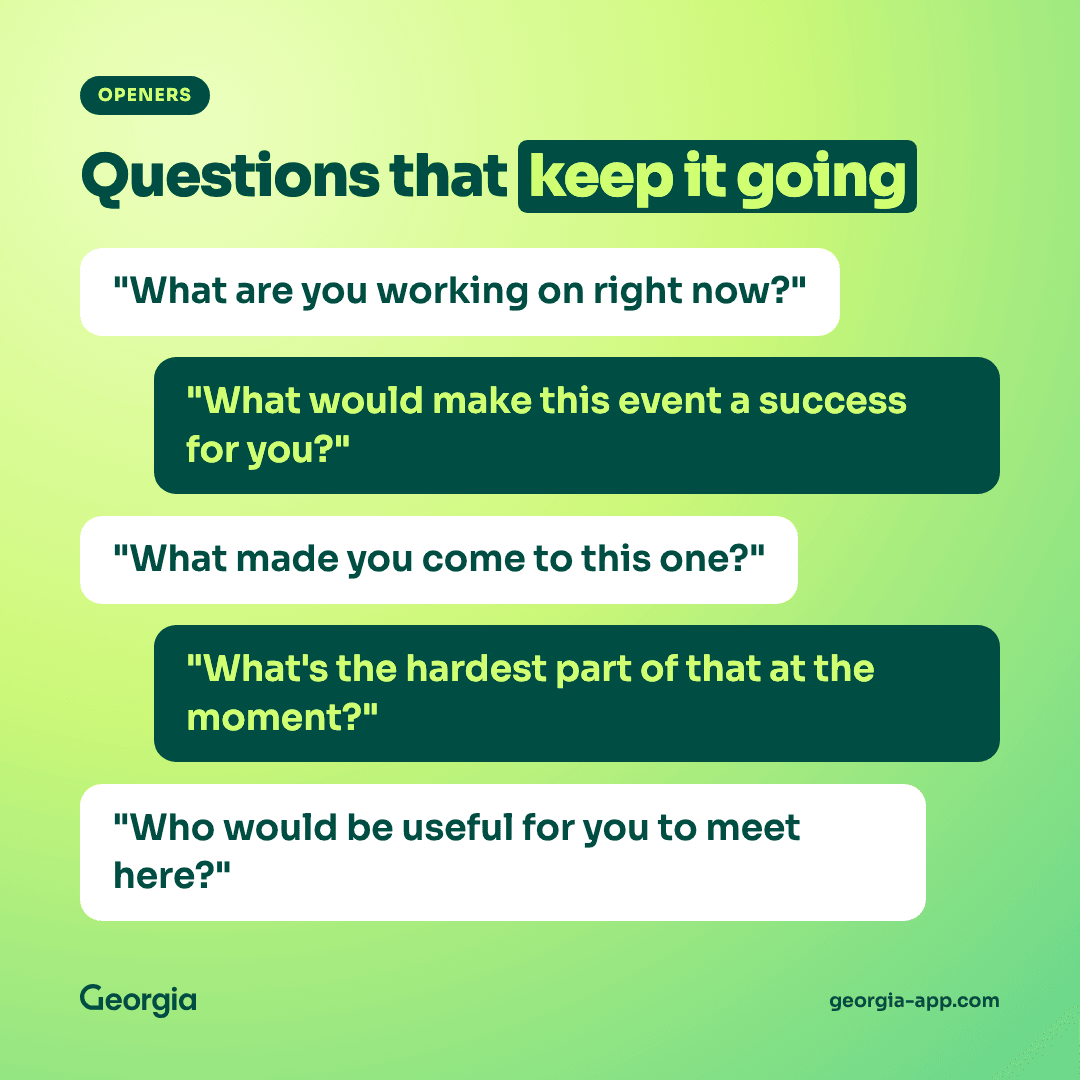
Follow-up questions that keep it going
- "What are you working on right now?"
- "What would make this event a success for you?"
- "What made you come to this one?"
- "What's the hardest part of that at the moment?"
- "Who would be useful for you to meet here?"
The last question turns you into someone who helps, and people often return the favour.
If you are a technical founder who would rather hide behind the product than talk to people, Julia Georgi's Startup Witch video "SOS for Tech Founders Who Hide From Sales" is for you.
In Person Networking: How to Join a Group Conversation
Groups feel scarier than individuals, but they are often easier. Nobody has to carry the conversation alone, and you can listen before you speak.
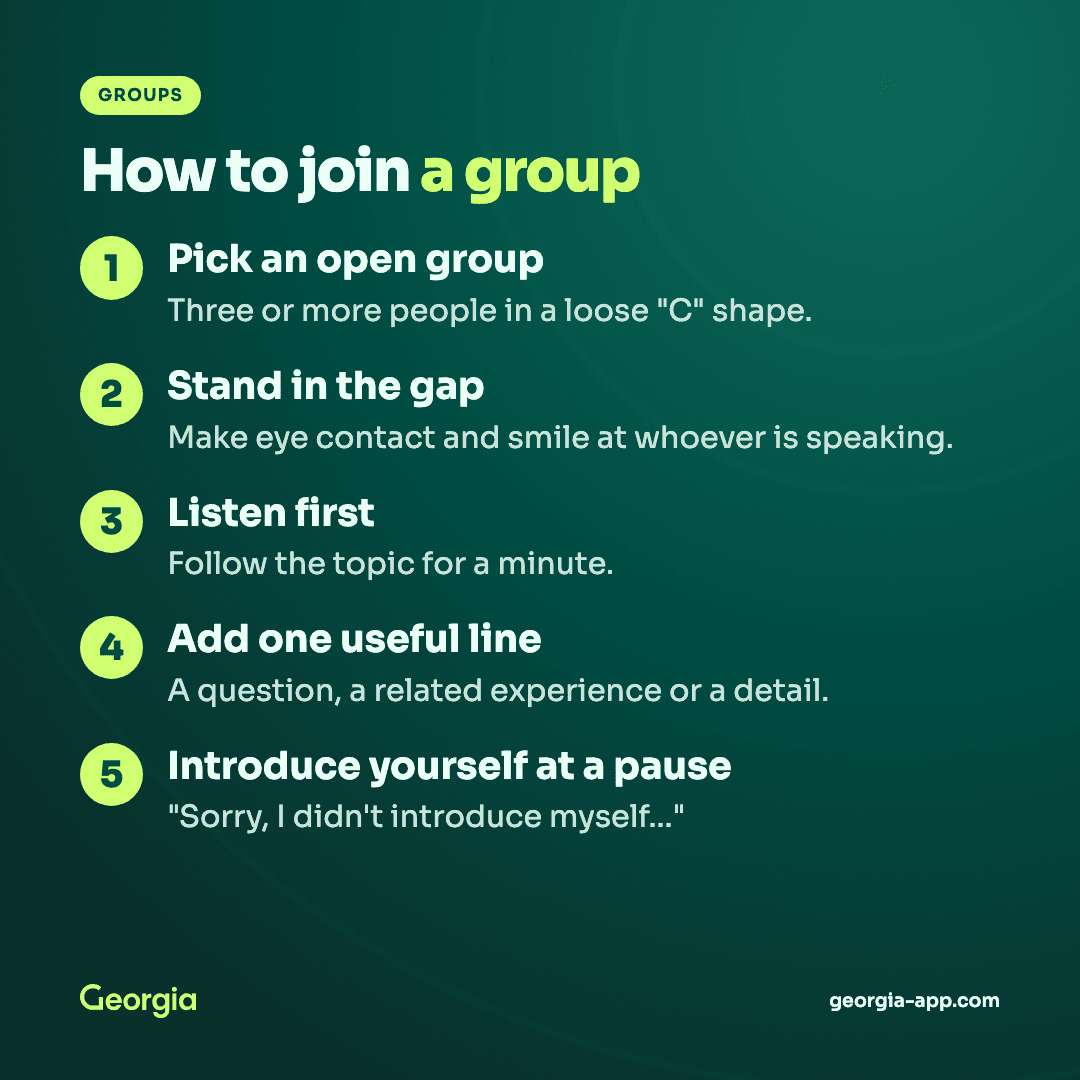
- Pick an open group. Look for three or more people standing in a loose "C" or horseshoe shape with a gap. Two people facing each other closely are probably in a private chat. Leave them.
- Stand in the gap and make eye contact. Smile at whoever is speaking. Most groups will open up a little.
- Listen first. Acknowledge the speaker and follow the topic for a minute. Don't jump in with your pitch.
- Add one useful line. A question, a related experience, or agreement with a detail. "We ran into the same thing with procurement in Germany."
- Introduce yourself when there's a natural pause. "Sorry, I didn't introduce myself. I'm Lena, I run a small HR tech startup."
If the group closes up or the conversation is clearly private, that's fine. Nod, smile and move on. It is just timing.
How to Exit a Conversation Gracefully
Many founders avoid starting conversations because they don't know how to end them. Have two or three exit lines ready before you arrive:
- "It was great to meet you. I'm going to say hello to a few more people before the next session. Can I send you a note tomorrow?"
- "I don't want to keep you all evening. Let's connect on LinkedIn and pick this up next week."
- "I promised myself I'd meet a few investors today, so I'll keep moving. Who else should I talk to here?"
- "I'm going to grab some food. Really enjoyed this."
A good exit includes three parts: thanks, a reason, and a next step if there is one. If there is no next step, that's fine too. Not every conversation needs to go anywhere.
Introduce people before you leave
The most generous exit is an introduction. "Have you met Jonas? He just raised for a similar product. Jonas, this is Priya." Then step away. You leave both people with something useful, and you become the founder who connects people.
When You Feel Like the Oldest Person in the Room
Some founders freeze because they feel out of place. Julia Georgi, founder of Georgia App, hears versions of this line often: "I am 41. Everyone in this world is 26 and posting about their seed round."
If you spent 15 or 20 years in an industry before starting a company, that feeling can hit hard at a startup event. You were the expert in every room for two decades. The moment you say "my startup", you feel like a beginner again.
As Julia Georgi puts it, your expertise is the asset. One founder Julia worked with had 28 years in construction and a real product, yet no first customer. His years of knowing where projects bleed money were the thing buyers cared about. The code only delivered it. The same is true when you network: the person who knows an industry from the inside is exactly who investors and buyers want to talk to.
So lead with it. Try an intro like this:
- "I spent 20 years running logistics for retailers. Now I'm building the planning tool I always wanted."
- "I was a CTO in fintech for a decade. I'm here to meet people who sell to banks."
That one sentence answers the question everyone is silently asking: why you? It also gives the other person something specific to ask about, which makes the next five minutes much easier.
Networking for Introverted Founders
Networking for introverts mostly comes down to choosing the right formats. Many great founders are introverts. They listen well, ask good questions and remember details. Those are networking strengths, and introverts often do their best work in one-to-one or small group settings. The real challenge is energy.
- Plan fewer, deeper conversations. Aim for quality. Five real conversations beat thirty handshakes.
- Arrive early. Rooms are quieter at the start. It is easier to talk to people before the crowd builds. Scout for a quieter corner where you can have one-to-one conversations.
- Use structured formats. Booked meetings, office hours and small roundtables are easier than open mingling. At Slush, the Meeting Area, Mentoring and Investor Office Hours give you structured time with people.
- Schedule recovery time. Block 20 to 30 minutes of quiet between busy sessions. Walk outside. Eat something.
- Bring a wingman. A co-founder or friend can open groups for you, and you can do the same for them.
- Pick side events that fit you. A breakfast for 15 people may suit you better than a party for 500. Accept the invite that matches your interests, and it's fine to stay home from the rest.
Plan your goal, rehearse your intro and openers, and give yourself permission to leave when your energy runs out.
Startup Networking at Big Networking Events Like Slush
Large conferences feel overwhelming because there is so much happening. Slush describes a crowd of 12,000+ people and 20,000+ meetings, with "one VC for every two founders" (slush.org). Slush 2026 runs in Helsinki on November 18 to 19, with Day 0 for founders the day before and many side events around the city during Slush Week.
At that scale, random wandering wastes your time. A simple plan helps:
- Book meetings in advance through the Slush Meeting Tool, so part of your day is already structured.
- Use the gaps between meetings for short, opportunistic conversations near talks, queues and coffee.
- Use Day 0 and side events to meet other founders when everyone is a bit more relaxed.
- Write notes after every conversation: name, company, what they need, what you promised.
- Follow up every evening while the conversation is still fresh.
None of this is Slush-specific. The same plan works for any conference or startup week, and it helps you turn a crowd into a few real networking opportunities.
If you want to walk into your next event with your intro and openers already sounding natural, rehearse your Slush conversations with Georgia. You practise with an AI counterpart by voice or chat and get feedback before the real thing.
The Follow-Up Email After Networking Events
The follow-up nobody sends is one of the most common networking failures. A great conversation that ends with "let's stay in touch" and then silence is a wasted conversation.
- Send your follow up email the next day at the latest. Mention one specific thing you talked about so they remember you.
- Make the next step easy. Suggest a time, share the link you promised, or make the intro you offered.
- Keep it short. Three to five sentences is enough.
Example follow up email: "Hi Maria, great to meet you at the Slush coffee stand yesterday. You mentioned you're looking at founder-led sales tools for your portfolio. Here's the one-pager I mentioned. Would 20 minutes next Thursday work?"
Business cards, LinkedIn and notes
Swapping business cards or LinkedIn profiles is only the start. Don't forget to log each contact somewhere you will actually check, with a note on what you promised. A strong network is just a long list of follow-ups you actually sent. Then stay in touch when you don't need anything: congratulate people on news, share something relevant, or ask how a project went. Relationships built that way are the ones that help you when demand for your time, and theirs, is highest.
Build a Strong Network by Practising Like Any Other Skill
You would never pitch an investor without rehearsing. Networking deserves the same respect. Most founders realize this only after an event where they froze, mumbled their intro or forgot to ask for the next step. The openers, the one-line intro, the group join, the exit and the follow-up are all small, repeatable skills.
A simple weekly routine before a big event:
- Say your one-line intro out loud every day for a week.
- Practise three openers and two exit lines until they feel like your own words.
- Role-play a conversation with a busy investor who gives you 60 seconds, then a curious founder who wants to chat.
- Practise answering the question you hope nobody asks, like "Why hasn't anyone done this before?"
Practice beats theory. The more reps you do before the event, the less you freeze during it. Book a Georgia demo to see how AI role-play can help you practise these conversations on your own schedule.
Frequently Asked Questions
How do you network at an event when you don't know anyone?
Arrive early, pick one goal, and start with people who are alone or in open groups of three or more. Use a simple opener about the shared situation, like "What brought you here?", then ask about them before talking about your startup. Have an exit line ready so you can move on comfortably.
Is networking hard for introverts?
It can feel draining, but introverts often network well because they listen and ask good questions. The hard part is usually energy. Plan fewer, deeper conversations and schedule quiet breaks. Most introverts also prefer meaningful conversations to small talk, which is exactly what good networking needs.
How do you network if you are an introvert?
Prepare your one-line intro and a few openers in advance, use structured formats like booked meetings and office hours, choose smaller events, and bring a co-founder or friend who can help open conversations.
What are the most important networking skills for founders?
Opening a conversation, introducing yourself clearly, asking good questions, listening actively, joining groups, exiting gracefully and following up. All of them improve with practice, and you can rehearse them before an event.
How do I leave a networking conversation without being rude?
Thank them, give a short reason, and suggest a next step if there is one: "Great to meet you. I'm going to catch a few more people. Can I send you a note tomorrow?"