
Key Takeaways
- Soft skills for sales decide most small B2B SaaS deals. The product usually works; the conversation is where deals stall.
- Small teams should train seven skills first: active listening, curious questioning, clear explanation, reading the buyer, objection handling, relationship building and resilience.
- Your expertise can work against you. The deeper you know your field, the more steps you skip when you explain it.
- Silence after a call is an answer too. It usually means the message reached the wrong person.
- A tiny team can practise every week in 45 minutes with role play, short reviews and one skill at a time.
- Learn enough sales to judge the work before you hire someone to do it.
Soft skills for sales are the human skills that turn a good product into a signed deal: listening, asking the right questions, explaining clearly, reading the buyer and handling pushback without getting defensive. If you run a small B2B SaaS team of two to five people, often with a founder still doing most of the selling, these skills matter more than any new tool or script. You can't hide a weak conversation behind a big brand or a large pipeline.
Here is the line Julia Georgi, founder of Georgia App, hears again and again from founders: "Every call went well. Nobody signed." The demo landed. The buyer nodded. Then nothing. In her experience, the product is almost never the problem. The symptom is rarely where the problem lives, and in small SaaS teams it usually lives inside the sales conversation.
This guide covers which sales soft skills to train first, how they show up in a real B2B SaaS deal, and how a tiny team can practise them every week without a big sales training budget. It is written for founders and small sales teams, with practical tips and phrases you can use on your next call.
What Are Soft Skills for Sales?
Soft skills in sales are the interpersonal skills and personal attributes that shape how a buyer experiences you: how well you listen, how you ask questions, how clearly you explain complex ideas, how you respond under pressure and how you build trust over several conversations. Hard skills are the technical side: product knowledge, technical knowledge of the buyer's stack, pricing, CRM hygiene and the steps of your sales process.
Both matter. A sales rep with strong product knowledge and weak listening will pitch features nobody asked about. A rep with great rapport and no technical know how will lose credibility the moment the buyer asks a detailed question. In a small SaaS team, the hard skills usually exist already, because the founders built the product. The gap sits in the soft skills. Strong soft skills are what turn professional knowledge into a sales approach the buyer trusts, and they are the most important skills for long term success in the sales profession.
Why small B2B SaaS teams feel the gap first
- Every deal counts. With a short list of potential customers, one lost deal is a real share of the quarter.
- Buyers are experts too. You sell to a procurement lead, a head of ops or a CTO who has heard every pitch.
- Multiple stakeholders. Even small deals involve a user, a budget owner and someone who can say no.
- No sales manager to catch mistakes. Without sales managers or a coaching layer, bad habits repeat on every call.
Essential Sales Skills for Sales Professionals in Small SaaS Teams
Lists of sales soft skills for sales professionals often run to 15 or 20 items. A team of three can't train 20 things. Other soft skills, like presentation or networking, can wait until these selling skills are steady. Start with these seven, in roughly this order. Each one builds on the one before.
| Soft skill | What it looks like on a call | What goes wrong without it |
|---|---|---|
| Active listening | You confirm what the buyer said before you answer | You pitch features nobody asked about |
| Curious questioning and critical thinking | You find the root cause behind the request | You solve the wrong problem |
| Clear explanation | The buyer can repeat your value in their own words | The buyer nods and never calls back |
| Emotional intelligence | You notice hesitation and ask about it | You talk through the moment the deal turns |
| Objection handling | You treat pushback as information | You discount or argue |
| Relationship building | Every call ends with a clear next step | Deals go quiet after a good demo |
| Resilience and time management | You recover from a lost deal and protect selling time | Selling slips behind building, week after week |
Active Listening: The Best Soft Skill to Start With
If you only train one skill this month, train active listening. Salespeople who actively listen uncover the buyer's real challenges and can tailor what they say next. It is also the skill most founders think they already have.
Active listening means you confirm understanding and ask follow-up questions before you respond. In practice:
- Let the buyer finish. Count two seconds of silence before you speak.
- Play it back. "So the reporting works, and the real pain is that finance gets it three days late. Did I get that right?"
- Ask one more question. "What happens on your side when it's late?"
Here is a quick self-check Julia Georgi suggests: look at your last ten sales conversations and count how many started with your product and how many started with their problem. No score needed. The count alone tells you where to work.
For exercises your whole team can run, see our guide to active listening exercises for sales teams.
Curious Questioning, Critical Thinking and Problem Solving
Strong sales professionals dig until they find the root cause. Curiosity drives the questions; critical thinking separates facts from assumptions. Problem solving in sales starts with knowing which problem you are solving. Good questions surface the buyer's pain points early, so you can offer tailored solutions instead of a generic demo.
Questions that work in B2B SaaS discovery:
- "Walk me through the last time this went wrong."
- "Who else feels this problem, and who would notice if it disappeared?"
- "What have you already tried?"
- "If we did nothing, what would this cost you by the end of the quarter?"
- "Who signs off on something like this?"
Questions also tell you where the buyer is in the buyer's journey: still defining the problem, comparing options, or ready to decide. Critical thinking also means questioning your own read of the deal. When the buyer says "this looks great", ask what exactly looks great and what would stop them from moving forward. Many deals that "went well" never had a buyer with the power or reason to buy.
Effective Communication and Communication Style: Explain It Without Skipping Steps
Effective communication is the foundation of every sale. Clear communication turns complex ideas into something the buyer can understand, repeat and sell internally. For technical founders, this is where things quietly break.
As Julia Georgi puts it, your expertise lights the room and casts the shadow. The deeper you know your field, the more you assume your buyer knows it too. So you skip three steps when explaining, and the deal dies in that gap. Eighteen months inside your own product is exactly what makes the blind spot invisible.
How to close the gap
- Start from their world. Describe the problem in the buyer's words before you describe your product.
- Use one example. "Last month a customer's ops lead spent two days reconciling this by hand."
- Check understanding. "How would you explain this to your CFO?" If they can't, you skipped a step.
- Adapt your communication style. A CTO wants architecture; a head of finance wants risk and cost. Same product, different conversation.
Verbal communication is only part of it. On video calls, body language and maintaining eye contact with the camera still send signals. Notice yours, and notice theirs.
Emotional Intelligence: Read the Buyer
Emotional intelligence helps salespeople read buyer emotions and adjust their approach based on cues. It covers self-awareness (noticing your own frustration or nerves) and relationship management (responding well to theirs).
In a small SaaS deal, emotional intelligence sounds like this:
- "You went quiet when I mentioned the migration. What's on your mind?"
- "It sounds like you've been burned by a tool like this before. What happened?"
- "I'm hearing some hesitation. Is it timing, budget or something else?"
Put yourself in the buyer's shoes. Your champion may be excited, but they also carry the risk of recommending you. Empathy for that pressure builds trust faster than any feature. Emotional intelligence also enables salespeople to respond effectively when a call turns tense, instead of getting defensive.
For a founder's take on this skill, watch Julia Georgi's Startup Witch video "You Don't Need Charisma to Sell. You Need to Read Buyers."
Objection Handling and Negotiation Skills
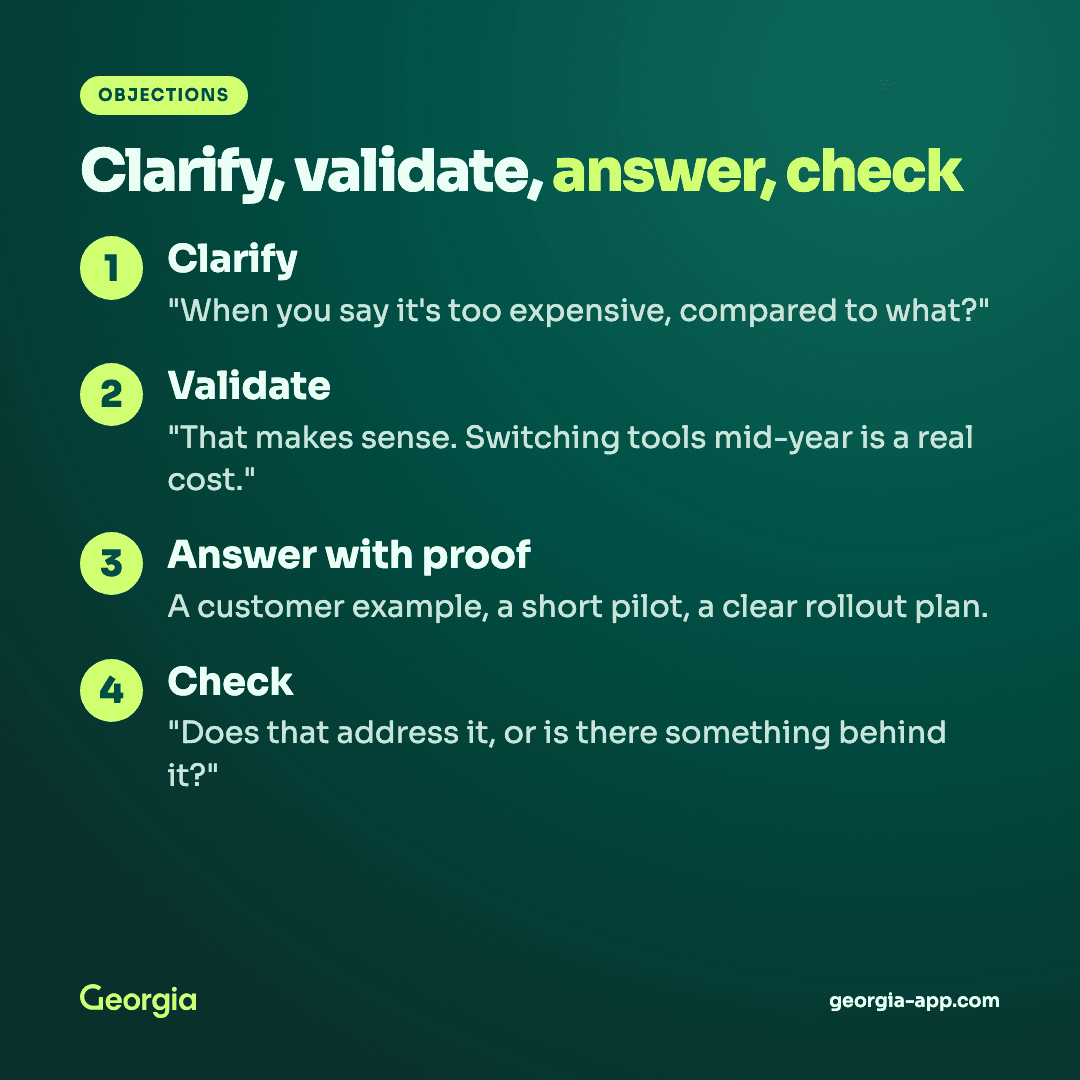
Effective objection handling treats resistance as a clue. When a buyer pushes back, they are telling you what matters to them. Your job is to clarify the concern, validate it and answer with useful proof.
- Clarify. "When you say it's too expensive, compared to what?"
- Validate. "That makes sense. Switching tools mid-year is a real cost."
- Answer with proof. A customer example, a short pilot, a clear rollout plan.
- Check. "Does that address it, or is there something behind it?"
Common sales objections in small SaaS deals: "We're building this in-house", "Not this quarter", "We need to check with IT", "Your competitor is cheaper". Write down your top five and the best answer your team has found for each.
Negotiation skills sit right next to objection handling. Good negotiators clarify value before they touch price, and look for mutually beneficial solutions: a longer term for a lower rate, a smaller first rollout, a case study in exchange for a discount. A small team that discounts by reflex gives away margin it can't afford. Our guide to objection handling practice has more ways to rehearse this.
Relationship Building: Building Relationships Through Follow Ups
Trust drives every buying decision, and building relationships happens across many touchpoints, mostly after the first call. Long-term relationships lead to renewals, expansion and referrals, which drives revenue growth over time. That matters even more when your list of potential customers is small.
Practical habits for relationship building:
- End every call with a next step and a date. "Shall we put 30 minutes in next Tuesday with your finance lead?"
- Send a recap within a day. Three bullets: what you heard, what you agreed, what happens next.
- Make follow up conversations useful. Share a relevant example or answer the question they asked last time.
- Map the buying group. Know who else is involved in the purchasing decisions and how to reach them.
Silence is an answer too
When a promising deal goes quiet, the instinct is to chase harder or blame the product. Julia Georgi's view: silence is an answer too, and it usually means the message reached the wrong person. Before your fourth follow-up, ask who else should hear this, and whether you have been talking to a user with no budget or a budget owner with no pain.
Resilience, Time Management and a Growth Mindset
Resilience helps sales reps recover after rejection or a lost deal and keep their performance steady. In a small team, the founder often feels each loss personally. A growth mindset turns that loss into a lesson: what did we hear, where did it stall, what will we try next time?
Time management is the less glamorous half. In a small SaaS company, product work feels productive every day, so selling time quietly shrinks. Proper time management means protecting it on purpose and tying it to clear sales goals.
- Block fixed selling hours in the calendar, the same way you protect focus time for code.
- Prioritise high-value tasks: calls with qualified buyers first, admin last.
- Run a short self reflection after every lost deal. Seek feedback from the buyer when you can.
- Seek feedback from your teammates too, and spend a little time each month on industry trends in your buyers' market.
A positive attitude helps, and it tends to follow good habits. Some teams also practise mindfulness techniques before big calls to stay calm. Use whatever keeps you steady.
How to Practise Sales Soft Skills Every Week With a Tiny Team
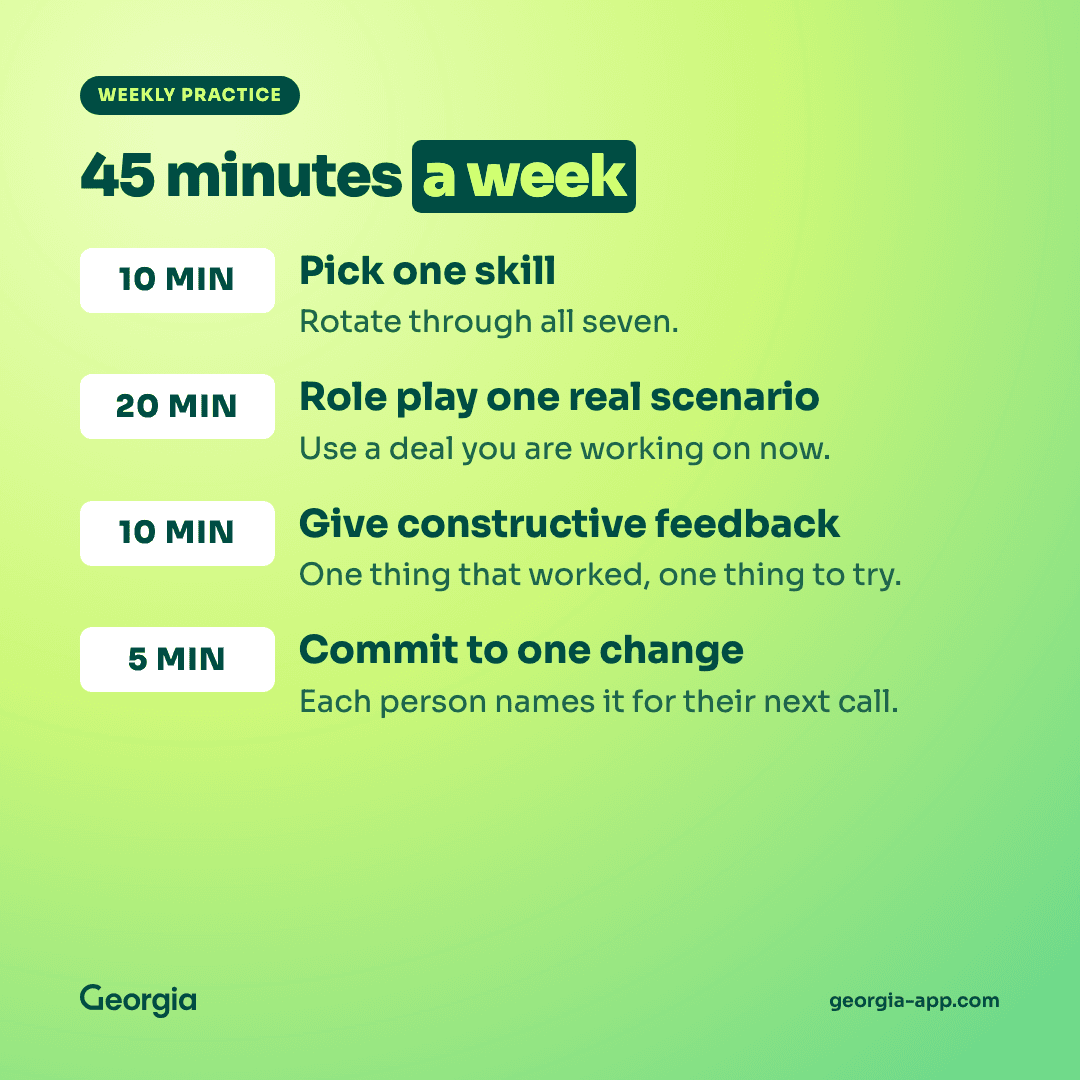
Soft skills training for sales teams works when it is frequent, short and specific. A one-day workshop fades. A 45-minute weekly habit compounds. Here is a role play routine a team of two to five sales reps can run without a sales manager:
- Pick one skill per week (10 minutes). Rotate through the seven above.
- Role play one real scenario (20 minutes). Use a deal you are working on now. One person plays the buyer, one sells, one observes. Swap.
- Give constructive feedback (10 minutes). One thing that worked, one thing to try next time. Keep it about behaviour you can see or hear.
- Commit to one change (5 minutes). Each person names one thing they will do differently on their next real call.
Between sessions, each person can practise alone. AI role play is useful here because there is no colleague to schedule and no embarrassment when you stumble. With Georgia, your team can rehearse sales conversations with an AI counterpart by voice or chat and get feedback, self-paced and personalised for each person. Personalized soft skills practice like this fills the gap that manager coaching usually covers in larger sales teams, and it helps each rep navigate challenges before they meet them on a live call.
Use your real calls as training material
Ongoing learning gets easier when you review real calls. Once a month, listen to one recorded call together. Look for the moment the buyer's energy changed and ask what happened just before it. You read a funnel like a stack trace, as Julia puts it: find where it stops, then look one layer above.
Hire in the Right Order: Learn to Judge the Work First
Many founders hope a first sales hire will fix the gap. Julia Georgi's advice is about order: a sales co-founder or first sales hire solves nothing until you can tell a good one from a bad one. Learn enough of these sales skills to judge the work, then delegate it.
The goal for the founder is modest: be able to listen to a call and tell whether the rep found the pain, explained the value clearly and secured a next step. Those are the same soft skills this guide covers. Practise them yourself first, and you will hire better sales professionals and coach them faster. Many sales leaders treat this as continuous coaching and professional development for the whole team, and it supports the career success of every rep you hire.
If your team wants a low-pressure way to build these habits, book a Georgia demo and see how AI role play fits into a weekly routine.
Frequently Asked Questions
What skills are needed for B2B sales?
B2B sales needs a mix of hard skills and soft skills. The hard skills are product knowledge, industry knowledge and a clear sales process. The soft skills are active listening, discovery questions, clear communication, emotional intelligence, objection handling and relationship building across multiple stakeholders.
What are B2B SaaS sales?
B2B SaaS sales is selling software subscriptions to other businesses. Deals usually involve several people, a trial or pilot, and an ongoing relationship after signature, because the customer renews every month or year. That makes trust and follow-up especially important.
What are the top 5 skills in sales?
For small SaaS teams, start with active listening, curious questioning, clear explanation, objection handling and relationship building. Add emotional intelligence and resilience once those are steady.
What are the 7 major soft skills?
Lists vary. For sales, a useful seven are active listening, critical thinking, effective communication, emotional intelligence, objection handling, relationship building and resilience with good time management.
What is the best soft skill for sales?
Active listening. It improves every other skill: better questions, clearer answers, earlier warning of objections and stronger relationships.
How can a small sales team improve soft skills on a budget?
Run a short weekly practice session, role play real deals, review one recorded call a month, and let each person rehearse alone with an AI role play tool between sessions.