
Key Takeaways
- Founders prepare a startup elevator pitch as content. Very few prepare for the conversation that follows it, and that conversation is where the next meeting is won.
- The conventional formula still matters: who you help, the problem, your solution, one proof point and a clear next step, in roughly 75 to 85 words for 30 seconds.
- Treat the formula as a topic map. Know every part cold, then let the words change with the person in front of you.
- Lead with one specific customer and their problem. Your expertise is the asset, but too much of it makes you skip steps your listener needs.
- Practise with different listeners and practise being interrupted. Georgia's Adaptive Conversation method gives you five moves for turning 30 seconds into a real two-way exchange.
A startup elevator pitch is the 30-second answer to "So, what do you do?" You will say it dozens of times at Slush, in investor meetings and at dinner. Most founders prepare it as content: a polished paragraph they can deliver on cue. Very few prepare for what happens next, when the other person interrupts, asks something sideways, or simply looks blank.
That is the real gap. People prepare for content. They do not prepare for a real conversation. And there is nothing worse than a founder reciting a script at someone who asked a simple question. The listener can hear it within a sentence.
This guide gives you the content you need to know cold: a simple formula, adaptable elevator pitch examples for B2B SaaS, deep tech and marketplace startups, and a practice routine. Then it shows you how to use all of it inside a live conversation, with Georgia's Adaptive Conversation method. It is written for founders from pre-seed to Series A, many of whom are heading to Slush 2026 in Helsinki on November 18 and 19.
Julia Georgi's Startup Witch video "The TRUTH About Smart People in Startups (Nobody Tells You This!)" is a good companion to this guide, especially if you are an expert founder. Find more on Startup Witch on YouTube.
What Is a Startup Elevator Pitch?
An elevator pitch, sometimes called an elevator speech, is a brief introduction to you and your company that fits into a short elevator ride. For a founder, it explains what your company does, for whom, and why it matters, in a way that makes the listener want to ask a question.
Most guides agree on the length. An elevator pitch should last 30 to 60 seconds, according to Indeed's guide to giving an elevator pitch, which also suggests around 75 to 85 words. That is about five or six spoken sentences.
Why is an elevator pitch important for founders?
Your elevator pitch is often the first impression an investor, customer or future hire gets of your company. At a large event, it decides whether a conversation continues or ends politely. A memorable first impression comes from a clear focus on one problem the listener recognises. Clever wording rarely does the job. A strong elevator pitch does three things:
- It makes the listener understand what you do without effort.
- It makes them curious enough to ask a follow-up question.
- It gives them a reason to remember you after the networking event.
Its job is to start a conversation. It earns you the next five minutes, and those five minutes are a dialogue.
The Startup Elevator Pitch Formula
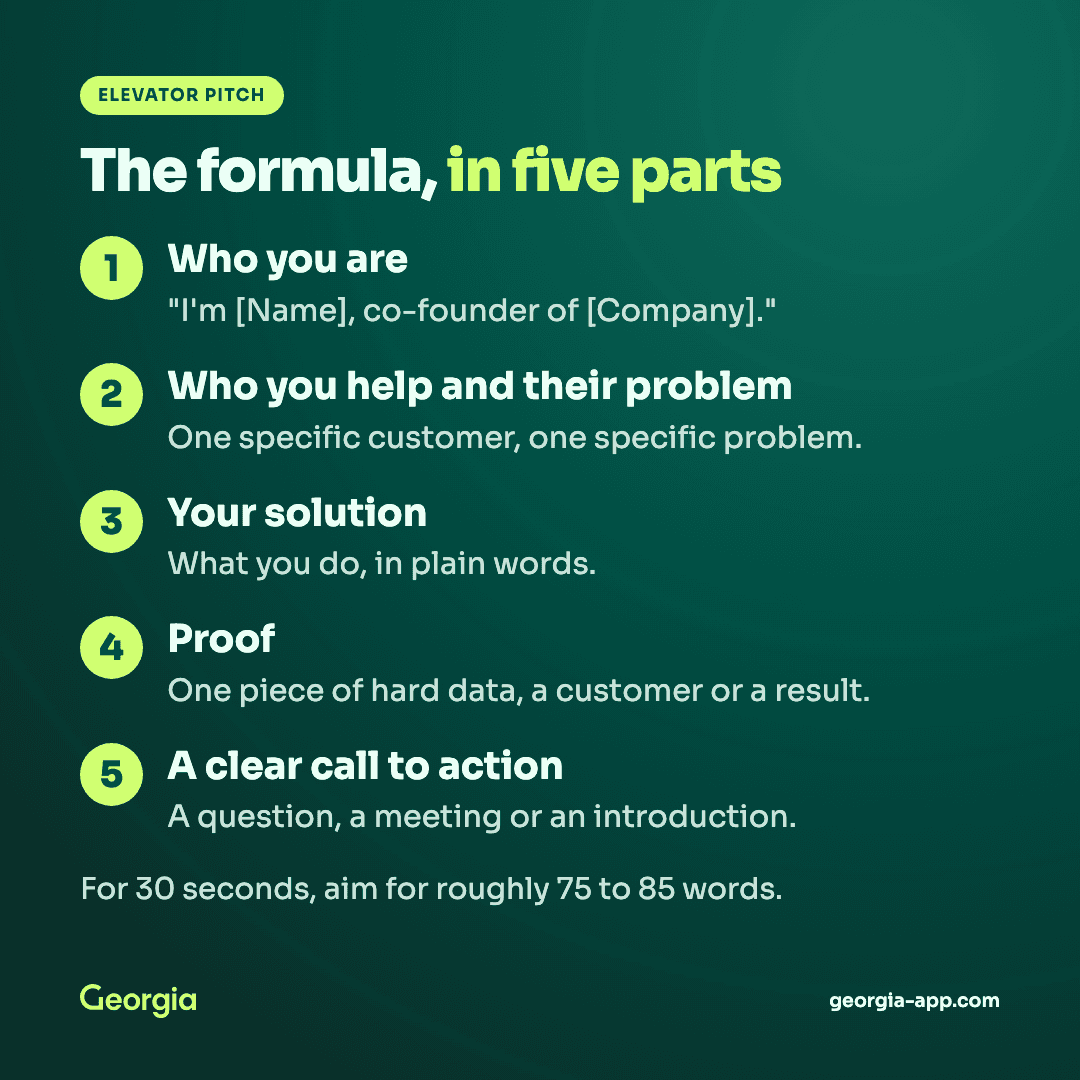
This is what the conventional advice tells you, and it is correct as far as content goes. An effective elevator pitch for a startup usually contains five parts. Antler's guide to the startup elevator pitch also frames a compelling pitch around five key pieces of information. Here is the version we recommend founders know cold:
- Who you are. Your name and role. "I'm [Name], co-founder of [Company]."
- Who you help and their problem. One specific customer, one specific problem. "We work with [customer] who struggle with [problem]."
- Your solution. What you do, in plain words. "We [what the product does]."
- Proof or unique value. Your value proposition in one line: one piece of hard data, a customer result, or why your approach is different from existing alternatives.
- A clear call to action. What you want next. A question, a meeting, an introduction.
Use these key points as a topic map for your own words. Write them as bullet points first, then say each one out loud in a few different ways. A fill-in template to get you started:
"I'm [Name], co-founder of [Company]. We help [specific customer] who [specific problem]. Today they [current workaround and its cost]. We [solution in one sentence]. [Proof point]. [Question or ask]."
Here is the Georgia turn. The template is a map of the five topics you must be able to talk about. It is never a script. In a real exchange, the listener may jump straight to part four, or ask about part two before you have said your name. If you know each part well enough to start from any of them, you can follow the person, wherever they start.
What makes a great elevator pitch: the three C's
The best elevator pitches are clear, concise and compelling. Clear means a stranger could repeat it. Concise means every sentence earns its place. Compelling means it connects to something the listener cares about and holds the listener's attention past the first sentence. Those are the essential qualities. Everything else is detail. If you only remember one rule, avoid jargon. Your listener has no context, and the networking area is loud.
Your Expertise Is the Asset (and the Blind Spot)
Many founders are experts. Fifteen or twenty-five years in an industry, deep technical credibility, a product that genuinely works. That expertise is your biggest asset in an elevator pitch. It is also the reason many expert founders struggle with one.
Julia Georgi (Startup Witch, KB&G) describes it this way: your expertise lights the room and casts the shadow. The deeper you know your field, the more you assume your listener knows it too. So you skip three steps when explaining, and the conversation dies in that gap.
She tells the story of a founder with 28 years in construction and a real product, but no first customer. Contractors with billion-dollar backlogs took his calls. Nothing converted. He thought he needed more features. When asked who his user was, he said "the whole company". In reality, it was one person doing one job, and his 28 years of knowing where projects bleed money was the real asset. The code only delivered it. Two weeks after he reframed his pitch around that one person, the buyer asked when the beta starts. Nothing about the product changed.
The lesson for your elevator pitch: name one person, one job, one problem. Then let your experience show up as proof.
A quick self-check: give your homepage eight seconds, then ask a stranger what you do. Compare what they say with what you say in your pitch. If the two do not match, start rewriting there.
Startup Elevator Pitch Examples
These elevator pitch examples are templates. The companies are invented. Use them to see how the five parts fit together, then replace every bracket and every detail with your own and keep each one under about 85 words. Learn what each sentence is doing, so you can do the same job in different words when the conversation takes a turn.
B2B SaaS elevator pitch example
"I'm [Name], co-founder of [Company]. We work with finance teams at mid-size logistics firms. Every month they spend days matching carrier invoices to shipments in spreadsheets, and they still overpay. Our software reads the invoices, matches them automatically and flags the errors. Our first customers cut their month-end close by several days. We're talking to finance leads who handle more than a thousand invoices a month. Is that a problem anyone on your team deals with?"
Why it works: one buyer, one painful task, one result and a question that keeps the conversation going.
Deep tech elevator pitch example
"I'm [Name], CTO and co-founder of [Company]. Wind farm operators lose money every time a turbine stops unexpectedly. Inspections are slow and mostly manual. We built a sensor and software system that hears early signs of bearing damage, weeks before failure. We're running pilots with two operators in the Nordics. We're raising our seed round to scale from pilots to paid fleets. Do you know anyone in energy who should hear about this?"
Why it works: the technology stays in the background. The listener hears the problem, the result and the ask. Save how the sensor works for the follow-up questions.
Marketplace elevator pitch example
"I'm [Name], founder of [Company]. Small restaurants throw away good food every night, and nearby customers would happily buy it at a discount. We connect the two in a simple app: restaurants list surplus meals in the evening, customers pick them up. We're live in two cities with a growing base of restaurants and repeat buyers. We're now looking for partners to expand. Who do you think I should talk to here?"
Why it works: both sides of the marketplace are clear in one sentence, and the ask invites an introduction.
A good example for a networking event
At a networking event, the goal is human connection first. Shorten the pitch and end with a question about them.
"I'm [Name]. I run a startup that helps clinics cut no-shows with smarter reminders. What brings you to Slush?"
Notice that every example ends by handing the floor back. That last question is where the elevator pitch stops and the conversation starts.
After 30 Seconds: Run It as a Conversation
Here is what most elevator pitch guides skip. The other person answers. They ask "How is that different from X?", or they mention their own company, or they say "Interesting" and wait. If all you prepared was a paragraph, you are now improvising. The trick is to be prepared for all the topics and confident enough to bring them into any discussion between two humans. Yes, investors are humans too.
Georgia's Adaptive Conversation method gives you five moves for this. The listener changes, the method stays the same. Here is how they play out in a short exchange at a Slush side event.
1. Engage: they set the agenda
Find out why they are talking to you. "What brings you to Slush? Had you come across anything like this before?" Whatever they name becomes the agenda. If the investor says "I'm looking at logistics this year", go where they went, even if your next line was about the team.
2. Explore: their story, not their opinion
Ask about a real past episode. "When did you last see a portfolio company struggle with carrier invoices? What happened?" A hypothetical ("Would you use something like this?") gets polite agreement. A real story gives you their words. (Rob Fitzpatrick's The Mom Test makes the same point.) Resist the urge to solve the problem the moment they describe it. Ask one more question.
3. Reflect: play it back until you get "that's right"
Say back what you heard in your own words. "So the problem is less the invoices and more that nobody notices the overpayment until the quarter closes. Have I got that right?" If they say "that's right", you reached their meaning. If they say "you're right", you probably just repeated their words. Reflect again. Chris Voss draws the same line in Never Split the Difference.
4. Evoke and relate: they make the argument
Let them tell you why it matters. "On a scale of one to ten, how much does this cost your teams? Why a six and not a three?" Their answer is the argument for your product, in their vocabulary. Then name the touch point: where their world and your idea meet.
5. Make a claim: permission, one claim, one proof, hand back the floor
Now you pitch, briefly. "Would it help if I told you what our first customers saw?" Then one claim and one proof: "They cut their month-end close by several days." Then hand back the floor: "Does that match what you've seen?" Never end on your own sentence.
When an investor leads with questions, use the same moves in reverse. Reflect the question before you answer it ("You're asking whether this is a feature or a company?"). Ask what is behind it. Answer with one claim and one proof. Then hand the floor back. Your five topics all still appear, in the order the conversation needs.
Adapting Your Pitch to Different Scenarios
A good elevator pitch has one core and several endings. Different audiences are interested in different things, and networking situations vary from a two-minute coffee queue to a 20-minute meeting. Tailor it to the specific audience in front of you. The facts stay the same. The vocabulary, the emphasis and the ask change. One set of five moves covers every audience. Only the vocabulary changes.
| Audience | Emphasise | Clear call to action |
|---|---|---|
| Investor | Market, traction, why now | "Could I send you our deck and book 20 minutes?" |
| Potential client | Their problem and the result | "Would it be worth a short call with your ops lead?" |
| Candidate at a career fair or job fair | Mission, team, what they would build | "What kind of role are you looking for?" |
| Peer founder | What you are learning, what you need | "Who has solved this before?" |
| Journalist | Why this matters now, one striking fact | "Can I send you a short summary?" |
Pitching to candidates at a career fair
Hiring is also pitching. At a career fair, a recent graduate or an experienced engineer is deciding whether your company is worth a job interview. Ask about their career goals and key achievements first, then describe the problem the team solves and what they would build. Point them to the job description or your LinkedIn profile.
Pitching at professional networking events
At professional networking events and side events, lead with a friendly greeting, ask about them, and give your pitch when they ask what you do. A pitch that answers a question lands better than one delivered unasked. Aim for a meaningful connection and a reason to talk again.
How to Say It Out Loud
A written elevator pitch and a spoken one are different things. Written sentences are longer, have more nouns and tolerate jargon. Spoken sentences need air. Most founders write a great paragraph and then deliver it badly because they never said it out loud before the event. The opposite mistake is just as common: they say it so often in the same words that it comes out flat, like a recording.
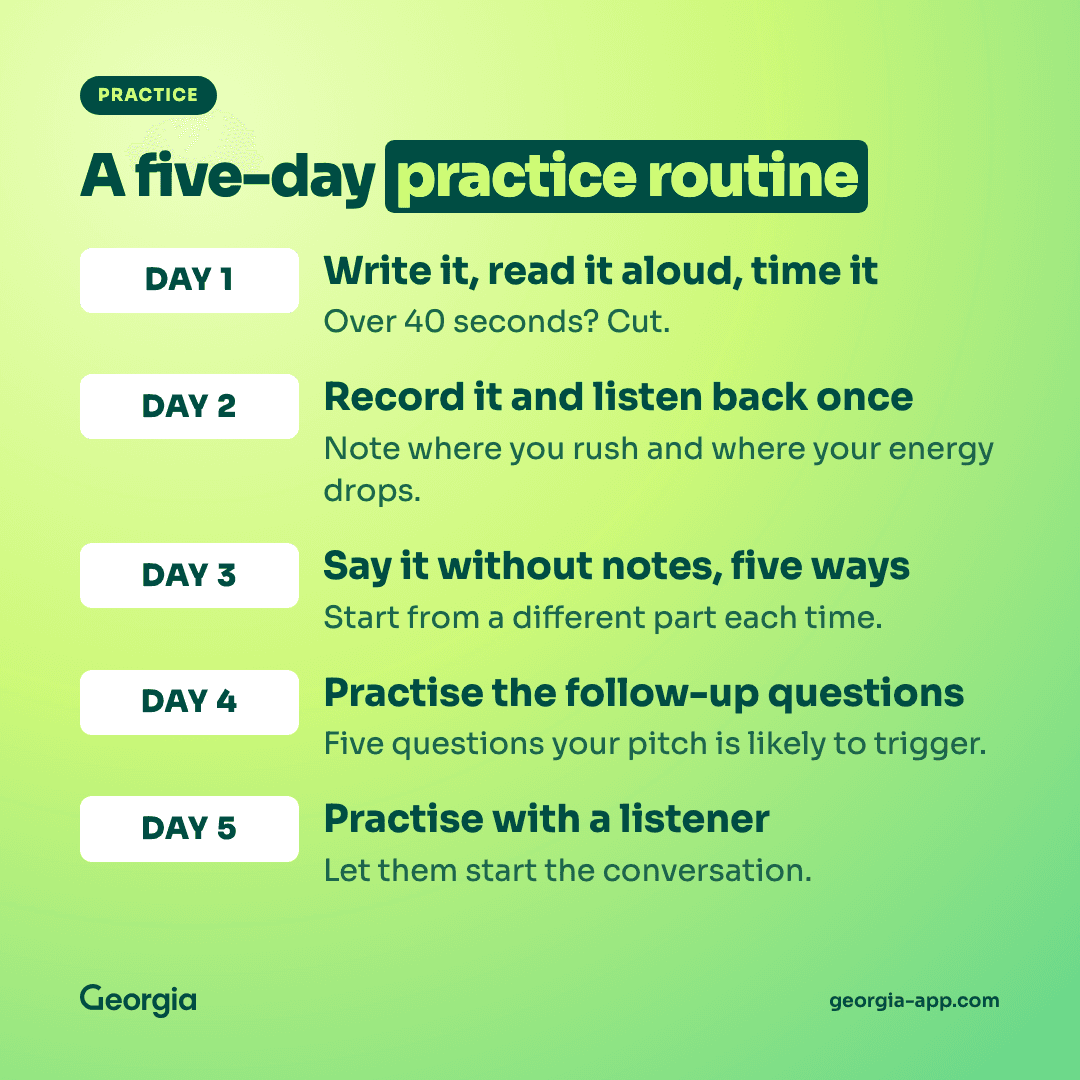
A five-day practice routine
- Day 1: Write it, then read it aloud. Time it. If it runs over 40 seconds, cut. Circle every word you would not use in normal conversation.
- Day 2: Record it. Listen back once. Note where you rush, where your energy drops, and every "um" or "basically".
- Day 3: Say it without notes, five times. Picture a different listener each time: an investor, a customer, your neighbour. Let the words change. The five topics stay.
- Day 4: Practise the follow-up questions. Write the five questions your pitch is likely to trigger ("How is that different from X?", "Who pays?", "How big is this?") and answer each in two sentences.
- Day 5: Practise with a listener. A co-founder, a friend or an AI role-play partner who interrupts and pushes back. Try the investor, client and candidate versions, and let them start the conversation.
The aim is to make talking about your work ordinary: short sessions, often, until you stop bracing for it.
Georgia's Adaptive Conversation module, part of Georgia for founders, is built for exactly this kind of practice. First, an AI coach helps you structure your thinking and write your questions. Then you practise in a live role play with a listener who changes every session: an investor, a prospect, a stranger at a bar, even a grandmother. Georgia scores how relevant your words are for that particular listener. Practise your elevator pitch with a listener who changes every session before you need it at Slush.
Delivery tips
- Body language. Stand still, hands relaxed, and face the person. Make eye contact on the problem and the ask.
- Positive tone. Sound like you enjoy your work. Energy is contagious, and so is boredom.
- Pause after the problem. Give the listener a second to recognise it. A pause can capture attention better than a louder voice.
- Stop after the ask. Silence is fine. Let them answer.
For more on building confidence in high-pressure conversations, read Building Confidence for Difficult Conversations Starts With Practice.
Common Pitfalls to Avoid
- Rambling. Going past 60 seconds loses the audience's attention. If you cannot finish in time, your pitch has too many ideas.
- Jargon. "AI-native orchestration layer" means nothing at a noisy bar. Say what the customer gets.
- Starting with the product. Start with the person and the problem, then introduce the product.
- No unique value. If your pitch could describe three competitors, add what makes you different.
- No call to action. End with a question or an ask, or the conversation drifts.
- Sounding memorised. Know the main points by heart, and let the exact words vary each time. A recited pitch tells the listener you are talking at them.
- Ignoring their answer. If they tell you what they care about and you carry on with your next sentence, you have lost them. Follow what they said.
Founders who struggle with this often say they are "not good at sales". Usually they have simply never practised the conversation. Run your pitch as a conversation with an AI investor in Georgia.
Frequently Asked Questions
What is an elevator pitch in entrepreneurship?
It is a 30 to 60 second spoken introduction to your startup that explains who you help, what problem you solve, how you solve it and what you want next. Its goal is to start a further conversation with an investor, customer, partner or candidate.
How do you structure an elevator pitch?
Who you are, who you help and their problem, your solution, one proof point or unique value, and a clear call to action. Keep each part to one sentence, and know each part well enough to start from it if the listener jumps ahead.
How many words is a 30 second elevator pitch?
Roughly 75 to 85 words. Spoken at a calm pace, that fits into 30 seconds with a short pause after the problem.
What are the three C's for an elevator pitch?
Clear, concise and compelling. A stranger should understand it, it should contain nothing extra, and it should connect to what the listener cares about.
Should I memorise my elevator pitch word for word?
No. Know the five topics cold and practise saying them to different listeners, in different words. A word-for-word pitch breaks the moment someone interrupts, and it sounds recited even when nobody does. Practise being interrupted instead.
What is a good elevator pitch example?
"I'm [Name], co-founder of [Company]. We help finance teams at logistics firms stop overpaying carriers. Today they match invoices by hand. Our software does it automatically and flags errors. Our first customers cut their month-end close by several days. Does your team deal with carrier invoices?" It is specific, short and ends with a question that hands the conversation back.