
Your first morning as a territory manager for a quarry, you stand beside the scale house and watch the trucks roll across. Every load looks the same to you: grey stone, a cloud of dust, a ticket printed and handed through a window. By lunchtime you have a meeting with the purchasing manager of a site-work contractor who has bought from your quarry for years and is now thinking about a pit closer to his next big job.
He gets to the point quickly. "Stone is stone," he says. "Their base meets the same spec as yours, and they are closer to the site. Tell me why I should keep paying for your trucks." You realise that nothing in your product training prepared you to answer that sentence in a way that sounds confident and true.
This post is for aggregates sales reps, quarry and pit sales managers, territory managers at sand and gravel producers and owners of regional operations, in the US and in Europe. It covers what the aggregates market looks like in numbers, why it is so local, how freight shapes the delivered price per ton, how to quote, and how to sell quality and reliability when your product looks identical to the competitor's.
The usual advice on aggregate sales is that it is a commodity business, so you win on price or on relationships. The advisors are right that price and relationships matter, and every experienced seller will tell you so. Advice everyone agrees on is generic, though, and it does nothing for you in that purchasing manager's office. The specific angle here is that aggregates are sold on delivered cost and dependable supply, so the rep who understands haul distance, specification and peak season supply better than the buyer does has something real to say.
Aggregate sales in numbers: crushed stone, sand and gravel
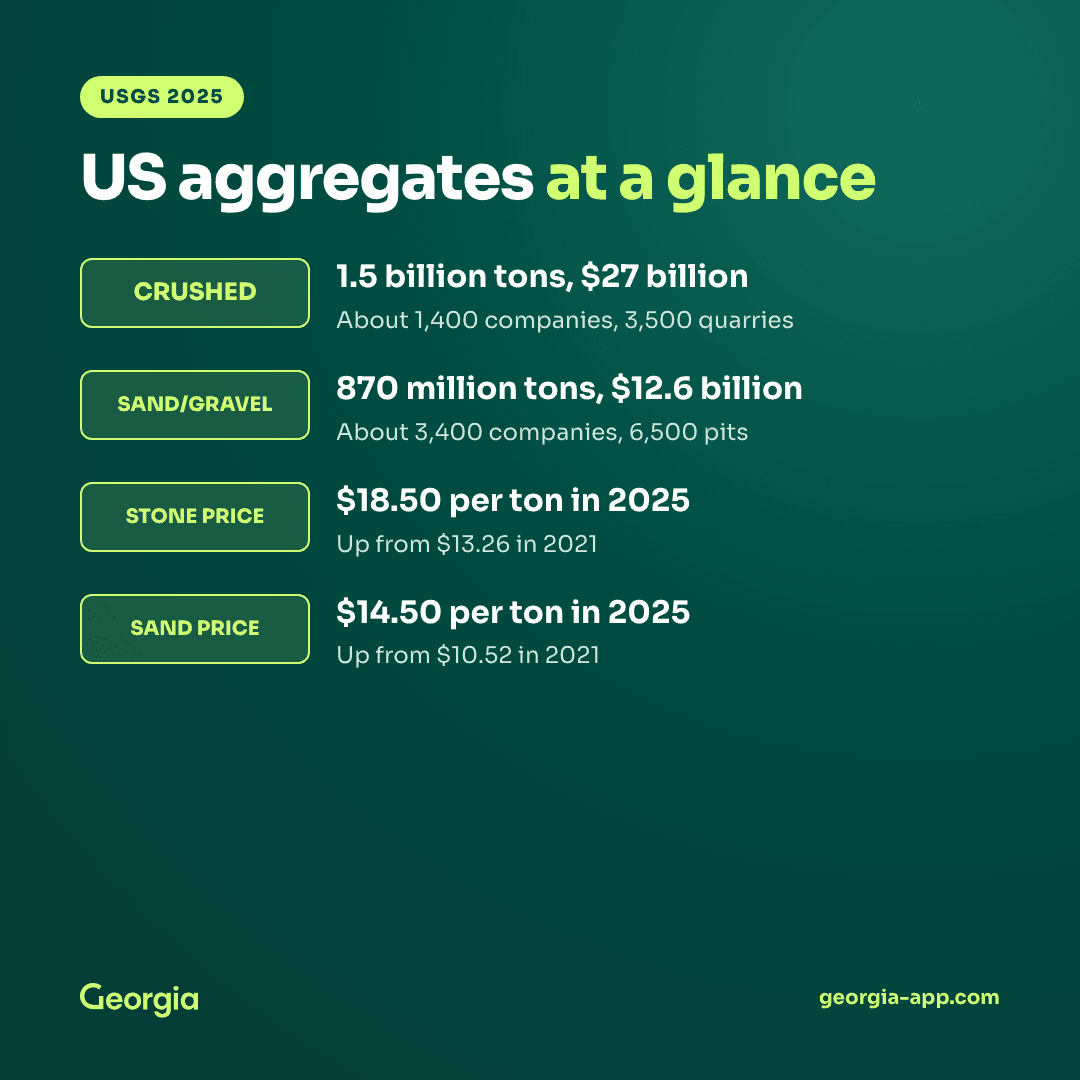
The US Geological Survey publishes the most reliable figures each year. Note that USGS "tons" are metric tons, and the 2025 figures below are estimates from the Mineral Commodity Summaries 2026.
| Measure (USGS, 2025 estimates) | Crushed stone | Construction sand and gravel |
|---|---|---|
| Production | 1.5 billion tons | 870 million tons |
| Value | $27 billion | $12.6 billion |
| Producers | about 1,400 companies | about 3,400 companies |
| Operations | 3,500 quarries | 6,500 pits |
| Average unit value, 2025 | $18.50 per ton | $14.50 per ton |
| Average unit value, 2021 | $13.26 per ton | $10.52 per ton |
| Largest use | 72% construction aggregate | 42% concrete aggregates |
Several things follow for a seller. The value per ton is low, so even small changes in cost per ton decide who wins a job. There are thousands of producers, so every buyer has alternatives. And prices have risen steadily since 2021, which means many of your customers already feel squeezed before you open your mouth.
NSSGA's 2025 scorecard says the US aggregates industry generates nearly $40 billion in sales a year and employs over 100,000 mostly skilled workers. In Europe, Aggregates Europe (UEPG) puts demand across the EU27, UK and EFTA at 3 billion tonnes a year, with an estimated turnover of €15 to 20 billion, about 15,000 companies (mostly SMEs) and almost 6 tonnes per person per year. The European structure looks much like the American one: many small producers, each serving the area its trucks can reach.
Ready-mix producers are among the largest buyers: 42% of US construction sand and gravel goes into concrete aggregates. If you sell to them, it helps to understand how their own business runs, which we cover in ready mix concrete sales. For the wider market picture, see our building materials industry statistics.
Why aggregate markets are local
Aggregates are heavy and cheap per ton, so the truck often matters more than the rock. A USGS study of the Mid-Atlantic region (Robinson and Brown, 2002) found that truck transport costs can double the cost of aggregate to the end user at haul distances of 30 to 50 miles (48 to 80 kilometres). The same report notes that rail, barge and ship transport can offer significant cost advantages along rail and water corridors.
The geography is getting harder too. USGS expects shortages in urban areas because zoning pushes new quarries and pits away from population centres, and warns that regional shortages and higher fuel costs could result in higher-than-average price increases in industrialised and urban areas.
For a rep, this means your real territory is drawn by haul distance from your operation to each job site, whatever the map on the office wall says. Before any important meeting, find out where the job is, which quarries and pits are closer, and whether anyone can reach it by rail or water. A competitor who is closer to one job may be farther from the next, and knowing that lets you pick which work to fight for.
How to quote aggregates per ton: plant price, freight and delivered price
Aggregates are usually quoted per ton, either at the plant (the buyer arranges trucking) or delivered (you arrange it). Buyers compare in different ways, and the most common mistake is letting a buyer compare your delivered price with a competitor's plant price, or the other way round.
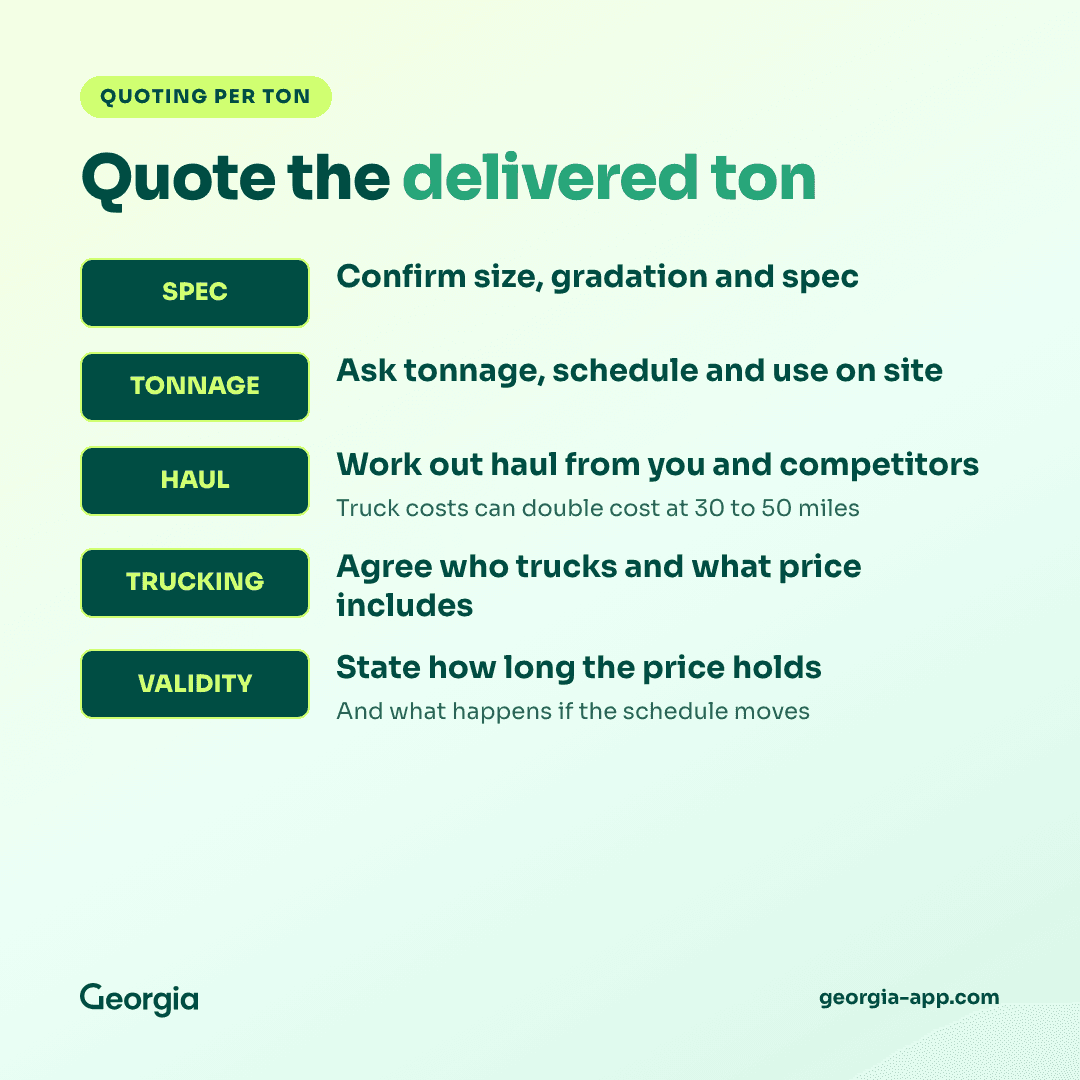
A clear quoting routine:
- Confirm the product and specification: size, gradation and any state or project spec it must meet.
- Ask for the tonnage, the schedule and how the material will be used on site.
- Get the exact job location and work out the haul from your operation and from the nearest competitors.
- Agree who provides trucking and what the delivered price per ton includes.
- State how long the price holds and what happens if the schedule moves.
Then present the number the buyer actually pays on site. If your plant price is higher but your haul is shorter, a delivered comparison often closes the gap, and the buyer may never have done that arithmetic.
There is also research behind pricing this way. Töytäri, Rajala and Brashear Alejandro (2015) found that industrial sellers overcome barriers to value-based pricing by understanding and influencing the customer's perceived value and by strengthening their own bargaining position. In aggregates, perceived value is mostly cost on site and confidence in supply.
Common quoting mistakes:
- Quoting a plant price when the buyer is thinking in delivered price.
- Ignoring the competitor's haul to the same site.
- Leaving out the schedule, so a price is accepted for a job that later moves into peak season.
- Treating a spec question as a formality and sending the wrong gradation.
Selling quality and reliability when the product looks identical
Two piles of base stone can look the same and still behave differently on a job. What the buyer pays for is material that meets spec every time, arrives when the paving or concrete crew needs it, and keeps arriving when the whole region is busy. Those are things you can prove with records.
Buyers are also more open to switching than they used to be. Principia Consulting's Voice of Customer survey found that 40% of contractors agreed they were substituting brands or materials more often in Q4 2024, rising to 61% by Q3 2025, with price increases, lead times and availability given as reasons. Simon-Kucher's 2025 study, on the other hand, reports that 93% of builders and contractors consistently purchase from their preferred suppliers. Put together, buyers stay with a supplier they trust and look around when supply or price lets them down.
Order accuracy matters as well. In the 2026 ASA Voice of Contractor survey, reported by Distribution Strategy Group, order accuracy ranked first within delivery service, followed by consistent on-time delivery windows. That sample was 725 plumbing and mechanical contractors, so it is a neighbouring trade, yet anyone who has sent the wrong gradation to a paving job knows the point carries over.
AGGREGATES
When the stone looks the same
Georgia · georgia-app.com
Davis's 2008 survey of 898 construction managers found that commitment, trust and satisfaction shape construction supply chain relationships. In aggregates, those are built through boring consistency: the right stone, the right tonnage, on the agreed day, again and again. For a wider view of buyers and decision drivers across building products, read how to sell building materials.
A drill for aggregates reps this week
The answer to "stone is stone" improves fastest when you practise it out loud. Set aside a little time each day this week.
- Pick three active jobs and work out the delivered price per ton from your operation and from the nearest competitor.
- Write one sentence for each job that explains your delivered cost and supply record without mentioning a discount.
- Role-play the "their base meets the same spec and they are closer" conversation with a colleague as the purchasing manager.
- Ask your colleague to push on peak season supply and on one past delivery problem, and answer both honestly.
- Write down the question that caught you out and prepare a better answer for the next day.
You can also rehearse these conversations in Georgia with an AI purchasing manager or contractor who compares you with a closer pit and pushes back on price. After each attempt you get feedback and can try again, and teams can build a custom scenario around a real bid follow-up from their own territory. For common pushback lines across the trade, see construction sales objections.
Frequently asked questions
What does an aggregates sales rep sell?
Aggregates reps sell crushed stone, sand and gravel to contractors, ready-mix and asphalt producers, public agencies and other buyers. USGS reports that 72% of US crushed stone went into construction aggregate in 2025, mostly for road construction and maintenance, and 42% of construction sand and gravel went into concrete aggregates.
How are aggregates priced?
Aggregates are priced per ton, either at the plant or delivered to the job. USGS gives average US unit values for 2025 of $18.50 per metric ton for crushed stone and $14.50 for construction sand and gravel. Local prices vary widely because freight and nearby competition differ from site to site.
Why does freight matter so much in aggregate sales?
Because the product is heavy and low in value per ton, transport quickly becomes a large share of what the buyer pays. A USGS study found that truck transport can double the cost to the end user at haul distances of 30 to 50 miles (48 to 80 kilometres). That is why most aggregates are sold close to where they are produced.
How big is the aggregates industry?
USGS estimates 1.5 billion tons of crushed stone and 870 million tons of construction sand and gravel were produced in the US in 2025, valued at $27 billion and $12.6 billion. NSSGA says the industry generates nearly $40 billion in sales a year. In Europe, Aggregates Europe puts demand at 3 billion tonnes a year.
Sell the delivered ton, and the rock speaks for itself
Aggregate sales go to the rep who understands the buyer's cost on site better than the buyer does and who can show a supply record worth paying for. Work out the haul, quote the delivered price, and practise the "stone is stone" conversation until your answer is calm and specific.
If you want your sales team to rehearse those conversations before the next bid, book a demo of Georgia. Teams and programs that qualify as partners get a free custom module built around one of their real sales calls, such as a contractor price call.
Sources
- USGS, Mineral Commodity Summaries 2026: Stone (Crushed), 2026
- USGS, Mineral Commodity Summaries 2026: Sand and Gravel (Construction), 2026
- USGS, Open-File Report 02-350, Sociocultural Dimensions of Supply and Demand for Natural Aggregate, 2002
- NSSGA, Aggregates Industry 2025 Scorecard, 2025
- Aggregates Europe (UEPG), Facts, undated
- Principia Consulting, Are contractors breaking up with their favorite brands?, 2025
- Simon-Kucher, Winning 2025: Construction and Building Materials Study, 2025
- Distribution Strategy Group, Contractors rank delivery ahead of price when choosing distributors, ASA survey finds, 2026
- Töytäri, Rajala and Brashear Alejandro, Industrial Marketing Management, Organizational and institutional barriers to value-based pricing in industrial relationships, 2015
- Davis, Industrial Management & Data Systems, A relationship approach to construction supply chains, 2008