
It is still dark when the phone rings at the plant. The caller is a foreman on a slab job across town, and he skips the greeting. His finishers are standing around, the pump is set up, and the first truck he was promised for the start of the pour has not shown up. He wants to know where it is, and he wants to know who pays for the crew while they wait.
You are a few weeks into an inside sales job at a ready-mix producer. You know the mixes and the price list, and you have never practised staying calm while a contractor with a crew on the clock mentions another plant's number.
This post is for ready-mix sales reps, dispatchers who take customer calls, sales managers at concrete producers and owners of regional plants in the US and Europe. It covers the industry in numbers, why delivery and timing shape almost every sale, how quote and pour scheduling conversations usually go, how to handle the call where the other plant is cheaper, and how to keep contractors once you have won them.
Most advice on ready mix concrete sales says build relationships, be reliable and know your product. The advisors are right, but advice everyone agrees on is generic and gives you no words for the moment a pour starts slipping. Ready-mix is a perishable product delivered against a clock, so the conversations that win and keep accounts are timing conversations, and those can be rehearsed.
Ready mix concrete sales in numbers: what the NRMCA data shows
The National Ready Mixed Concrete Association describes ready-mix as a $64 billion revenue industry across the US. In 2023 producers delivered an estimated 400 million cubic yards at an average selling price of $160 per cubic yard, from about 7,500 plants with roughly 70,000 mixer trucks making around 50 million round trips. Volume is concentrated: Texas (15%), California (9%) and Florida (8%) together account for about one third of it.
The business is cyclical: volume peaked at 458 million cubic yards in 2005 and fell to 257 million in 2010. In a downturn, the contractors who already trust your dispatch are the ones who keep your trucks moving.
In Europe, ERMCO reports EU ready-mix production of 239.0 million cubic metres in 2023 from about 11,462 plants, a business just as local and delivery-driven.
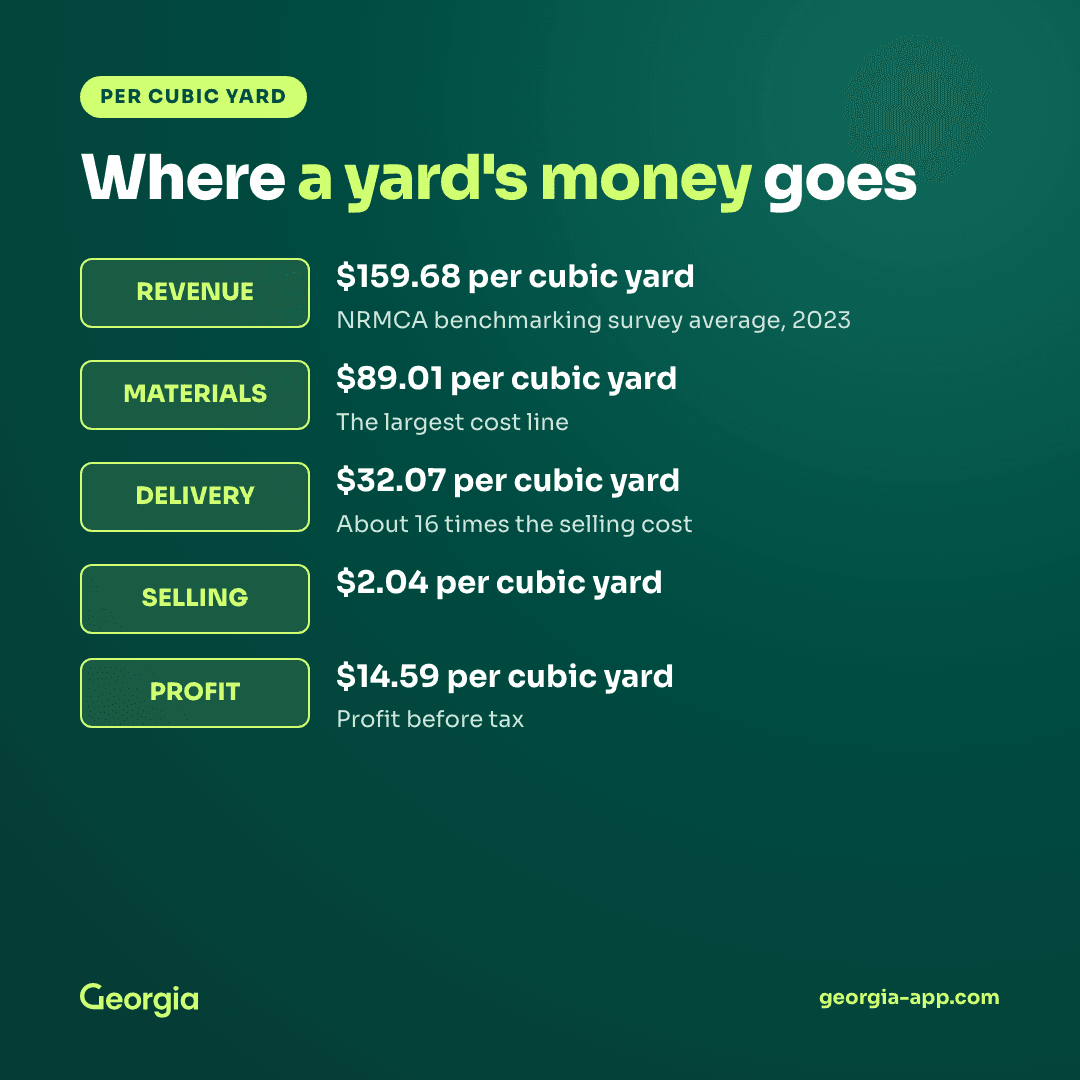
The most useful numbers for a seller sit in NRMCA's per-yard economics. The 2023 benchmarking survey covered 133 million cubic yards, about 33% of the industry, and the averages per cubic yard look like this:
| Item (2023 survey average) | Per cubic yard |
|---|---|
| Revenue | $159.68 |
| Materials | $89.01 |
| Delivery cost | $32.07 |
| Plant cost | $16.52 |
| Selling cost | $2.04 |
| Profit before tax | $14.59 |
Two things stand out. Delivery costs about 16 times as much per yard as selling, which tells you where the product's value and risk really sit. And profit before tax is a thin slice of the price, even in a year when NRMCA says profits per yard nearly doubled. The same deck reports that 50% of companies, representing 49% of the volume, are not economically sustainable at their current return on asset levels.
That is why a discount given away on the phone hurts. McKinsey's "The power of pricing" found that for a typical large company a 1% price rise, with stable volume, would lift operating profit by about 8%, and the logic runs in reverse when a rep gives price away. Materials are the largest cost line, and much of that is sand, gravel and crushed stone, which have their own sales logic covered in our post on selling aggregates and bulk materials.
Why delivery and timing shape every ready-mix sale
Concrete starts changing the moment it is batched, so the sale is really a promise about time. For decades ASTM C94, the standard specification for ready-mixed concrete, included a requirement to complete discharge within 90 minutes from batching. That changed. As ACI's Concrete International explained in August 2024, starting with the 2021 edition the rule was replaced with a time limit to be established between the purchaser and the concrete producer.
Some contractors and older project specifications still treat the 90 minutes as current, and NRMCA's explainer page still describes it. The safe habit is to ask what the project specification says and what your company has agreed with the buyer, and never to quote a time limit from memory.
The trucks themselves set the rhythm of a pour. NRMCA notes that the typical truck mixer is a 9 to 11 cubic yard unit because of weight laws, so any sizable pour is a sequence of loads that has to arrive in step with the placing crew. One late truck can leave finishers, a pump and a foreman waiting, and that waiting is what the contractor remembers.
Survey data points the same way. In the 2026 American Supply Association Voice of Contractor survey, reported by Distribution Strategy Group, delivery service rose from fifth to second among the factors contractors weigh when choosing a supplier, and price slipped from second to third. Within delivery, order accuracy ranked first and consistent on-time delivery windows second. The sample was 725 plumbing and mechanical contractors, so treat it as a signal from a neighbouring trade, one that is likely stronger for a product that cannot wait.
How ready mix quotes and pour scheduling conversations go
There is no published standard for how ready-mix quotes and bids run, and practice varies by producer and region. What is consistent is that a good quote conversation removes surprises before pour day. NRMCA points out that ASTM C94 lists items that should be part of any agreement between producer and purchaser, including the basis of purchase in cubic yards and how those yards are measured.
When a contractor asks for a price, walk through the job before you give a number:
- Confirm the mix or specification the engineer has called for, and who signs off on substitutions.
- Ask for the estimated volume, how it will be measured and how the pour is split across days.
- Ask about site access, placing method (pump, chute or bucket) and the placing rate the crew expects.
- Agree the time limit and any waiting or short-load terms your company uses, in writing.
- Agree who on site can call a hold or change the spacing between trucks.
The scheduling call the day before matters as much as the quote. Confirm start time, volume, spacing between loads and the on-site contact, and say clearly what you will do if weather or a breakdown changes the plan. Contractors forgive a problem that was flagged early far more readily than one they discover when the pump is already running.
Common mistakes in these conversations:
- Quoting a price per yard before you know the placing rate and site access.
- Promising a start time that dispatch has not confirmed.
- Letting the contractor hear about a delay from the driver instead of from you.
Handling the "other plant is cheaper" call in ready-mix sales
Sooner or later every rep hears a version of the line Georgia uses in its concrete scenarios: "The other plant is 10% cheaper. Why should I order from you?" How you answer depends on whether the contractor is shopping or testing you.
The research suggests most are testing. HIRI's Q4 2023 contractor loyalty survey found that one in seven contractors strongly agree they would switch suppliers to get a better price, and Simon-Kucher's 2025 study reports that 93% of builders and contractors consistently purchase from their preferred suppliers. A price challenge is often a request for reassurance that your yards are worth what you charge.
A calm way to handle the call:
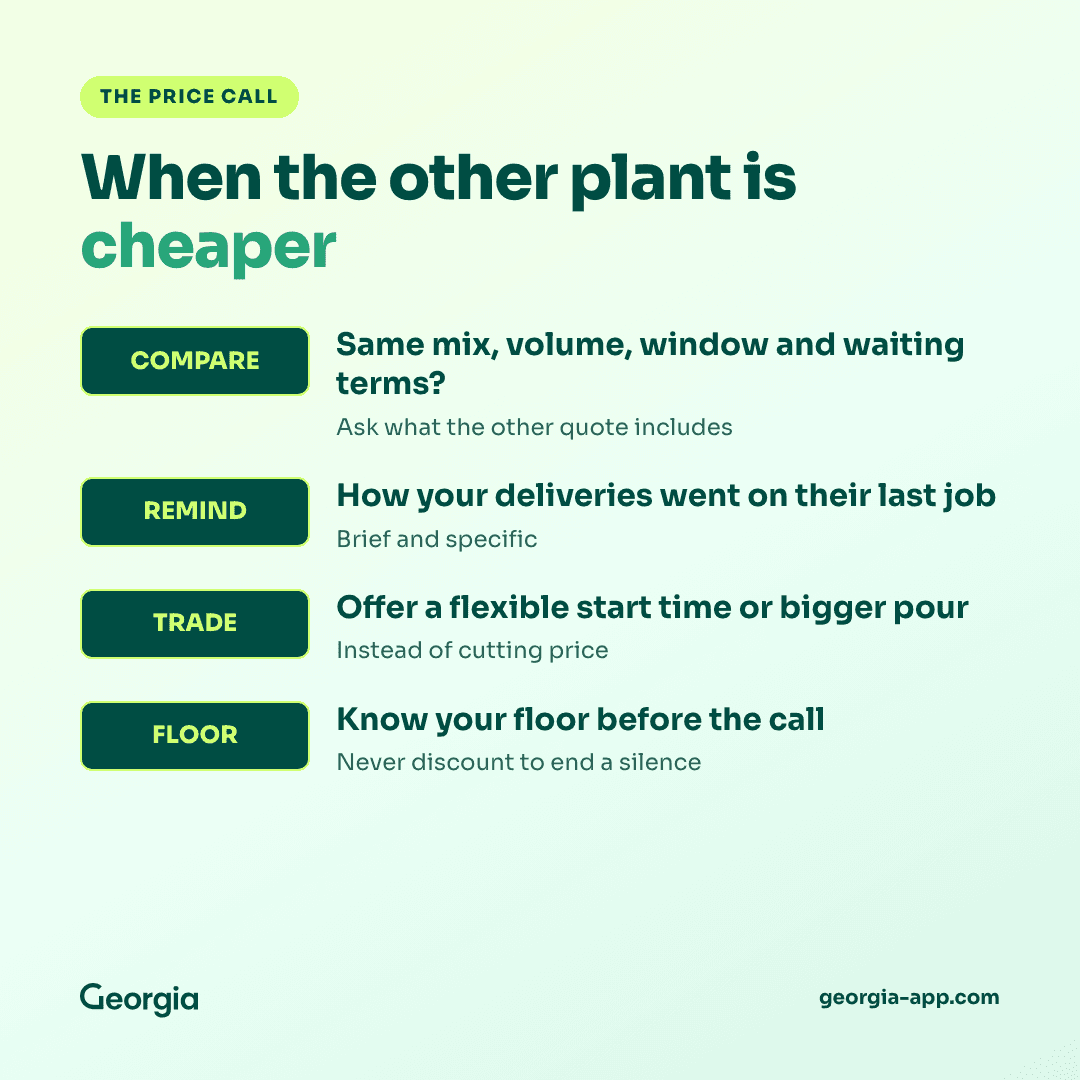
- Ask what the other quote includes: same mix, same volume, same delivery window, same waiting terms.
- Remind the contractor, briefly and with specifics, how your deliveries went on their last job.
- If the gap is real, trade instead of discounting: a flexible start time, a bigger pour on a quieter day, or a longer commitment.
- Know your floor before the call, so you never give away margin to end an awkward silence.
Adaptive selling is the skill that matters here: Franke and Park's 2006 meta-analysis of 155 samples and more than 31,000 salespeople found that it raises manager-rated and objective sales performance. Our post on construction sales objections covers more of these lines, and an earlier article explains how objection handling practice stops revenue leakage in building materials sales.
READY-MIX CALLS
Five calls that decide the account
Georgia · georgia-app.com
Keeping contractors after the first pour
Winning the first order is the easy part. Keeping the account means the contractor keeps calling you first when the next job comes up. Davis's 2008 study of 898 construction managers found that commitment, trust and satisfaction shape supply chain relationships in construction, and in ready-mix those three are built one pour at a time.
Call after every significant pour to ask how the deliveries went, and when something goes wrong, call before the complaint arrives and explain what you are changing. In the ASA survey, 59% of contractors wanted contact with their supplier's outside salesperson at least monthly, rising to 80% of large contractors, so a regular visit cadence is expected rather than intrusive. For more on cadence and preferred supplier status, see our guide to selling to contractors and the broader post on how to sell building materials.
A practice drill for ready-mix reps this week
Saying the right thing while a frustrated foreman talks over you takes practice. This drill works for inside reps, outside reps and dispatchers.
- Write down the three calls you dread most, for example a late truck, a price push and a pour moved at short notice.
- For each, write the first sentence you want to say and the one question you want to ask.
- Role-play each call with a colleague playing the contractor, and ask them to interrupt you at least once.
- Swap roles, so you hear how your own answers sound from the other side.
- Note one phrase that worked and one that did not, and repeat the call the next day.
If you have nobody to practise with before the shift, you can rehearse the same calls in Georgia, where an AI contractor or dispatcher pushes back the way real customers do. You get feedback after each attempt and can try again straight away, and teams can build custom scenarios around their own situations, such as a contractor asking for a lower price per cubic yard or a late delivery complaint.
Frequently asked questions
How much does ready mix concrete cost per cubic yard?
NRMCA puts the US average selling price at $160 per cubic yard in 2023. Prices vary widely by region, mix and delivery conditions, so treat it as a national reference point.
How long can ready mix concrete stay in the truck?
ASTM C94 used to require discharge within 90 minutes of batching. Since the 2021 edition, the time limit is established between the purchaser and the concrete producer, according to ACI's Concrete International. Check the project specification and your agreement with the buyer for each job.
How many cubic yards does a concrete truck hold?
NRMCA states that the typical truck mixer is a 9 to 11 cubic yard unit, a size set largely by weight laws. Larger pours therefore need a planned sequence of loads, which is why the spacing between trucks belongs in every scheduling call.
Is ready-mix concrete a profitable business?
Margins are thin. In NRMCA's 2023 survey, profit before tax averaged $14.59 per cubic yard on revenue of $159.68, and 50% of companies were not economically sustainable at their current return on asset levels.
Win the timing conversations and the price call gets easier
Ready mix concrete sales reward the rep who treats every call as a promise about time and keeps that promise visibly. Learn the numbers behind a cubic yard, ask the scheduling questions before you quote, and practise the hard calls until your first sentence comes out calm.
If you want your team to rehearse those calls before a real contractor is on the line, book a demo of Georgia. Teams and programs that qualify as partners get a free custom module built around one of their real sales calls, such as a contractor price call.
Sources
- NRMCA, Annual Performance Benchmarking Survey and State of the Industry, 2024
- ACI, Concrete International, Concrete Q&A on the time limit for ready mixed concrete, 2024
- NRMCA, About Concrete, undated
- ERMCO, Statistics 2023, 2024
- Distribution Strategy Group, Contractors rank delivery ahead of price when choosing distributors, ASA survey finds, 2026
- HIRI, Changes in contractor loyalty, 2023
- Simon-Kucher, Winning 2025: Construction and Building Materials Study, 2025
- McKinsey, The power of pricing, 2003
- Franke and Park, Journal of Marketing Research, Salesperson adaptive selling behavior and customer orientation: a meta-analysis, 2006
- Davis, Industrial Management & Data Systems, A relationship approach to construction supply chains, 2008