
It is the first Monday in January, and the sales manager of a regional agency is setting out name cards for four new producers. Each of them passed the licensing exam, each has a laptop with a fresh login to the quoting system, and each is a little nervous about the phone sitting on the desk.
She has done this before. She knows that some of the people at the table will still be selling in two years and some will not, and in her experience the difference comes from what they do every week once the training binder is closed.
This post is for new and early-career agents in life, health, P&C and Medicare, and for the agency owners, managers and trainers who hire them. It covers what the career looks like in BLS and LIMRA numbers, what agents who last do differently, the mistakes that cost new producers their first year, and a weekly practice routine you can start now.
How to sell insurance: the career in numbers
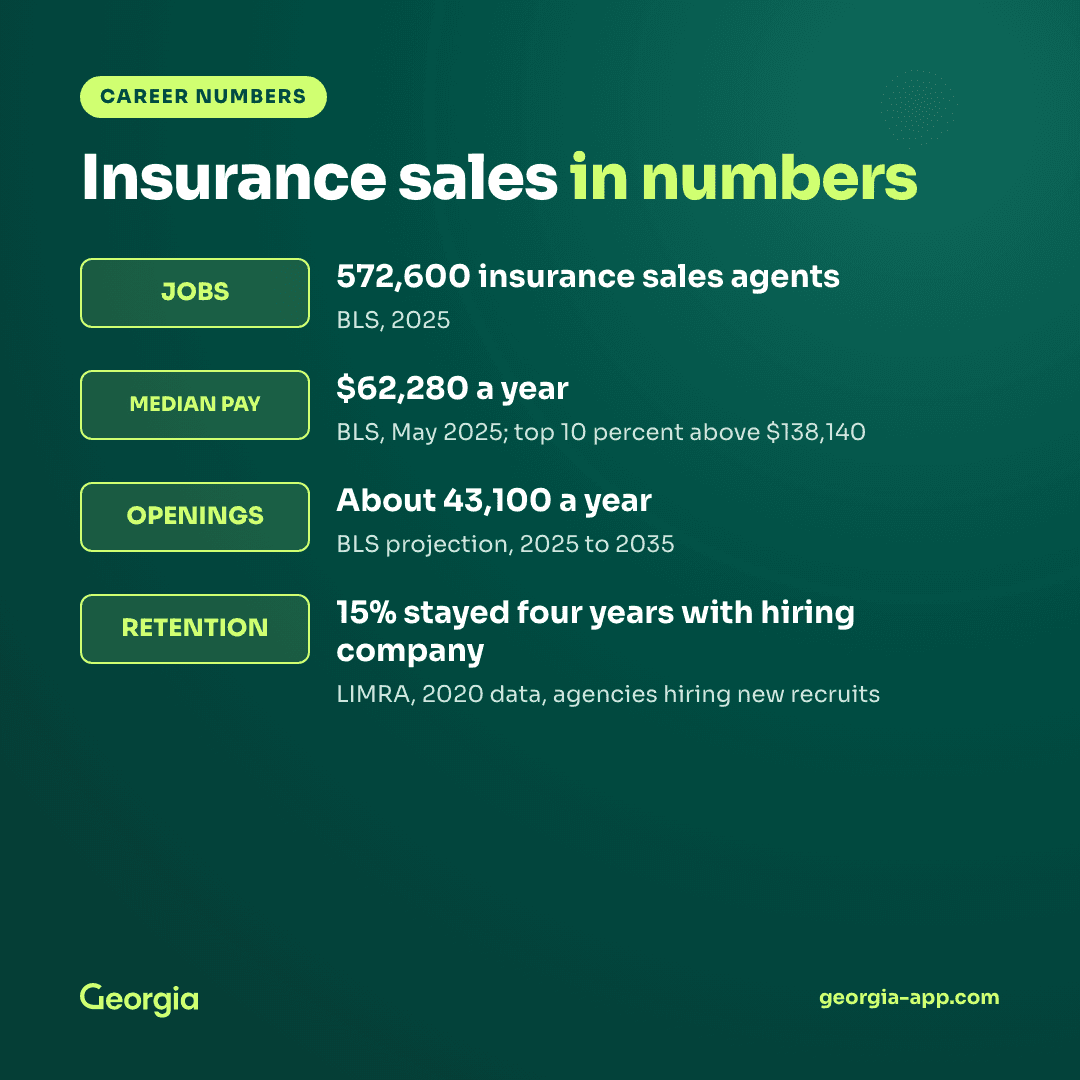
Before learning how to sell insurance, it helps to see the job clearly. The U.S. Bureau of Labor Statistics publishes pay and employment data for insurance sales agents (SOC 41-3021), and the latest figures cover 2025.
| Measure | Figure | Year |
|---|---|---|
| Jobs held by insurance sales agents | 572,600 | 2025 |
| Median annual wage | $62,280 | May 2025 |
| Lowest 10 percent earned less than | $37,330 | May 2025 |
| Highest 10 percent earned more than | $138,140 | May 2025 |
| Projected employment growth | 3 percent | 2025 to 2035 |
| Openings per year, on average | about 43,100 | 2025 to 2035 |
| Share employed by agencies and brokerages | 63% | 2025 |
| Share self-employed | 12% | 2025 |
Source: U.S. Bureau of Labor Statistics, Occupational Outlook Handbook, Insurance Sales Agents, 2025 data.
What the spread means. The gap between the lowest and highest 10 percent is more than $100,000 a year. BLS notes that commissions are the most common form of pay, especially for experienced agents, and that independent agents may be paid by commission only, so income depends heavily on the book of business you build. BLS wage data also exclude the self-employed.
Openings are steady. About 43,100 openings a year, mostly to replace people who change jobs or retire, means agencies hire continually. For a job seeker, getting hired is rarely the hard part.
Staying is the hard part. LIMRA research released in 2022 found that in 2020, only 15% of financial professionals in agency systems that recruit mainly inexperienced people were still with their hiring company after four years, and most who left did so in their first two years. The figure covers career agency systems that hire new recruits, and many managers in other channels will still recognize the pattern.
For managers, the same LIMRA release lists the five factors leaders say most influence retention: early sales activity, a strong selection process before hiring, joint fieldwork, the quality of sales training and mentoring. Every one of them is something the agency controls.
What agents who last do differently
Ask experienced producers how to sell insurance and you will hear the same advice: be consistent, build relationships, ask for referrals. All of it is right, and all of it is so widely agreed that it rarely changes what a new agent does on Tuesday morning. The useful question is narrower: what does each of those habits look like in a specific conversation, and how do you practice it before the conversation happens?
HABITS THAT LAST
Five habits of agents who stay
Georgia · georgia-app.com
Prospecting every day, including the good days
New agents tend to prospect hard when the pipeline is empty and stop when it fills up, which creates a boom and bust pattern in their income. Agents who last keep a fixed daily block for calls, referrals and community contacts, and protect it like a client appointment. If picking up the phone is the hardest part of the day, our post on cold calling anxiety has practical ways to make it easier.
The needs conversation before the quote
A quote given before you understand the client's situation is just a number, and numbers invite comparison. Spend the first part of the meeting on questions: who depends on their income, what they own, what cover they already have and what would worry them most. LIMRA's 2026 workplace fact sheet found that 38% of Americans, about 92 million adults, say they need life insurance or more coverage, so many people you meet already sense a gap and simply have not talked it through with anyone.
People still want that conversation with a person. In the 2025 Insurance Barometer Study, 42% of adults said they would prefer to buy life insurance from a financial professional in person, compared with three in 10 who would prefer to buy directly from a company.
Explaining coverage simply
Clients often do not understand what they already own. J.D. Power's 2026 U.S. Auto Insurance Study found that only 58% of auto customers say they completely understand their policy and what it covers. In Europe, EIOPA's 2024 consumer trends report found that a quarter of Europeans believe insurance-based investment products do not offer value.
Plain explanations are a selling skill and a compliance habit at the same time. Describe what the policy pays, when it pays and what it excludes in everyday words, then ask the client to tell you in their own words what they are buying. If they cannot, you have more explaining to do.
Follow-up that has a date
"I'll get back to you" is how most pipelines leak. End every conversation with a specific next step that both sides agree on, then send a short written summary the same day. When a prospect says they need time, a dated follow-up respects that and keeps the conversation alive. Our guide to insurance sales objections covers how to answer "I need to think about it" and "send me something by email" without pressure.
Retention and referrals
Keeping clients is where a book of business grows. Shopping is common: J.D. Power's 2025 U.S. Insurance Shopping Study found that 57% of auto customers shopped for a new policy year over year, up from 49%. The 2026 study adds that 32% of shoppers used AI tools during their search, and those shoppers were more than 1.3 times as likely to switch.
Agents who last call clients before renewal, review cover when life changes and explain price increases before the bill arrives. The 2025 shopping study also found that bundled customers stay an average of 7.0 years with their insurer, compared with 5.5 years for those who are not bundled, which is a good reason to review home and car cover together. Referrals tend to follow naturally when clients feel looked after.
Common mistakes when you start selling insurance
Selling to everyone you know in month one. Friends and family may buy once, and the list runs out fast. Use them for practice conversations and introductions, and build a prospecting habit that does not depend on them.
Leading with the product. Opening with policy features before you know the client's situation makes every price feel high and every objection harder.
Overpromising to close. Saying a policy covers something it does not, or implying urgency that is not real, may win one sale and cost you the client, the referral and possibly your license. Keep every claim accurate and let the client decide in their own time.
Skipping practice once the training ends. Most onboarding programs include role play in the first weeks and then stop. Conversations get easier with repetition and feedback, so keep a weekly practice slot after onboarding ends.
Going quiet after the sale. A client who hears from you only at renewal is easy for a competitor to win.
A weekly practice routine for insurance agents
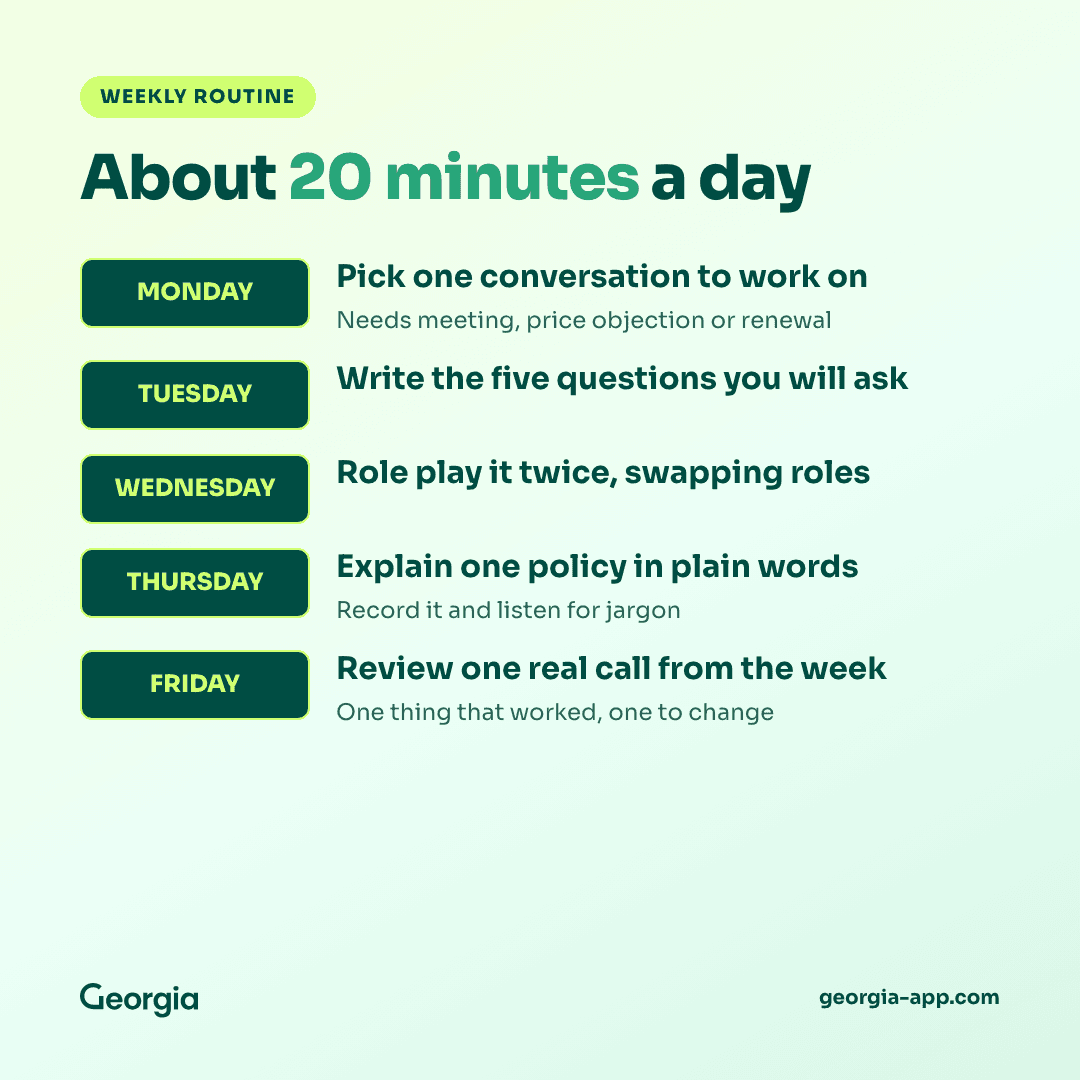
Skills that last are built in short, regular sessions. This routine takes about 20 minutes a day and fits around a full calendar.
- Monday: pick one conversation to work on this week, such as a needs meeting, a price objection or a renewal call.
- Tuesday: write the five questions you want to ask in that conversation, in the words you would really use.
- Wednesday: role play the conversation twice with a colleague or manager, swapping roles the second time.
- Thursday: explain one policy you sell in plain words and record yourself; listen back for jargon.
- Friday: review one real call from the week, note one thing that worked and one thing to change next week.
Managers can run the Wednesday session as joint fieldwork, which matches one of the retention factors LIMRA lists. If finding a practice partner is the bottleneck, Georgia for insurance teams lets agents practice realistic calls with an AI client, such as a prospect who says it is too expensive or a client at renewal, get feedback after each attempt and try again. Agencies can also build custom scenarios around their own real conversations.
Frequently asked questions
Is it hard to sell insurance?
Getting started is accessible, since BLS says a high school diploma is typically required, plus a state license. Staying is harder: LIMRA found that only 15% of new financial professionals in agency systems that recruit mainly inexperienced people stayed four years, based on 2020 data. Steady prospecting, good training and mentoring make the biggest difference.
How much do insurance sales agents make?
BLS reports a median annual wage of $62,280 in May 2025, with the lowest 10 percent earning less than $37,330 and the highest 10 percent more than $138,140. Most agents earn commission, so income grows with the book of business, and these figures exclude self-employed agents.
Do you need a license to sell insurance?
Yes. BLS notes that agents must be licensed in each state where they work, that life and health licenses are separate from property and casualty licenses, and that agents need continuing education. Agents who sell securities also need FINRA licensing. Outside the U.S., check the rules of your national regulator.
How do beginners get clients in insurance?
Start with a daily prospecting block, ask every client for introductions once they are happy with your service, and spend first meetings on the client's needs before any quote. Many new agents also build their skills through regular role play with a manager or practice partner before high-stakes calls.
Build the habits before the calls that count
Agents who last practice the hard conversations until they feel ordinary, and they keep doing it long after onboarding. If you lead or train a team of agents, book a demo of Georgia to see how realistic practice calls fit into onboarding and weekly coaching. Teams and programs that qualify as partners get a free custom module built around one of their real sales calls, such as a renewal call where the client wants to cancel.
Sources
- U.S. Bureau of Labor Statistics, Occupational Outlook Handbook: Insurance Sales Agents, 2025
- LIMRA, Five Ways to Keep Financial Professionals Engaged, 2022
- LIMRA, 2026 Facts About Life Insurance: Workplace Benefits, 2026
- Life Happens and LIMRA, 2025 Insurance Barometer Study press release, 2025
- J.D. Power via InsuranceNewsNet, 2026 U.S. Auto Insurance Study release, 2026
- J.D. Power via InsuranceNewsNet, 2025 U.S. Insurance Shopping Study release, 2025
- EIOPA, Consumer Trends Report 2024 press release, 2025