
A sport management senior in West Haven, Connecticut, has a career fair next week and a spreadsheet with forty team websites on it. Half the rows are in places she has never visited, and she has no idea whether applying to a minor league club in Kentucky makes more sense than waiting for an opening in New York.
Her advisor told her to stay open to moving. Her parents told her to apply close to home. Both pieces of advice sound reasonable, and neither tells her where the jobs in sport business actually sit.
This post is for students and graduates looking for a first job in sports, early-career sellers thinking about a move, and ticket sales managers who recruit across state lines. It uses the latest federal employment data to show where sports jobs are concentrated in 2025, explains what drives each state's numbers, and turns that into a practical search plan.
Sports jobs by state: the 2025 numbers
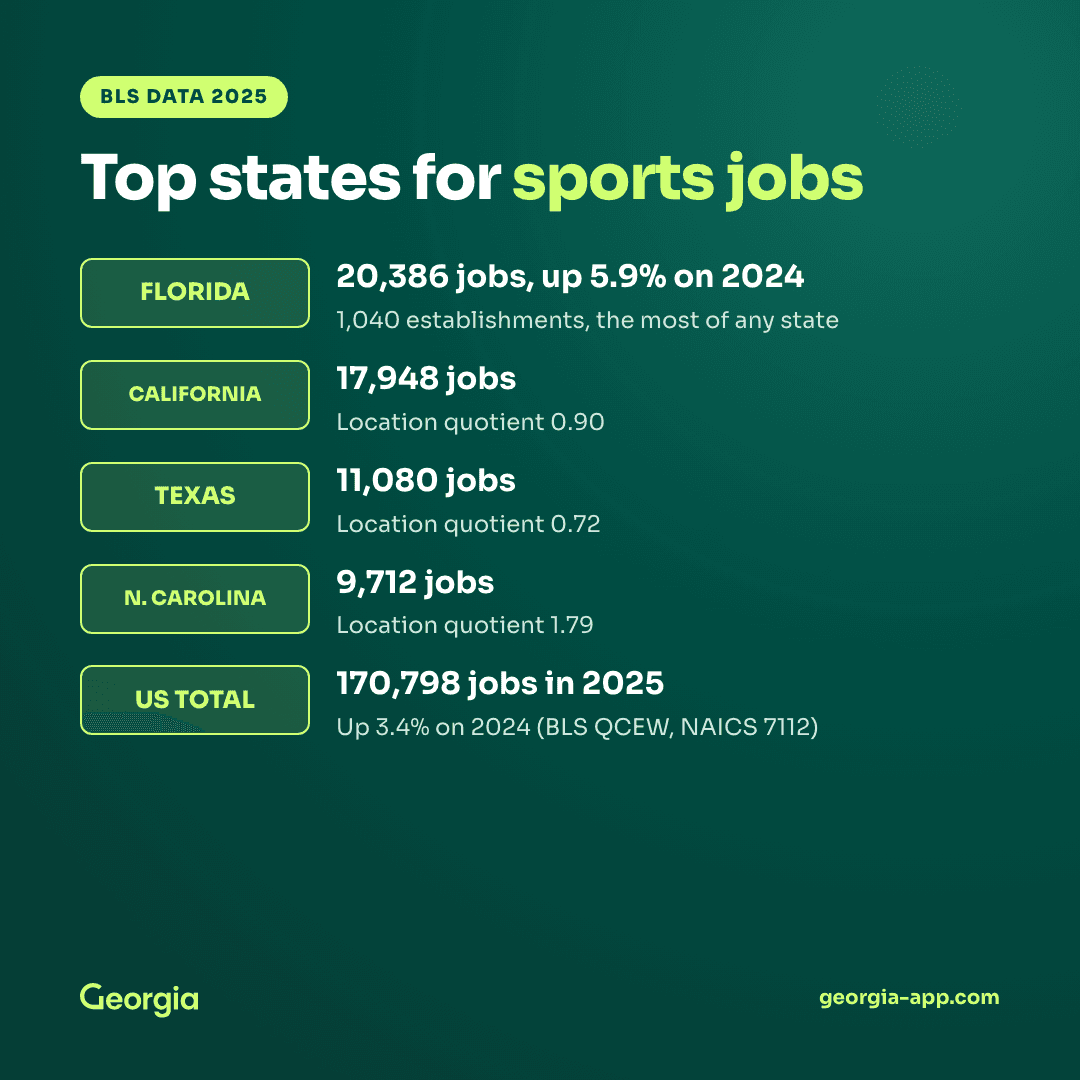
The cleanest count of sports employers by state comes from the Bureau of Labor Statistics Quarterly Census of Employment and Wages (QCEW). It covers NAICS 7112, the spectator sports industry, which includes teams and clubs, racetracks and other spectator sports businesses. In 2025 the US private sector had 170,798 jobs in this industry across 8,976 establishments, up 3.4% on 2024 (BLS QCEW, 2025 annual averages).
Those jobs are far from evenly spread. The five largest states hold about 40% of them, and the top eight hold just over half, which is our own arithmetic from the BLS file.
The table below lists the 15 states with the most spectator sports jobs in 2025. The location quotient compares a state's share of sports jobs with its share of all jobs: 1.00 is the national average, and anything above it means sports is a bigger slice of the local economy than it is nationally. Source: BLS QCEW, NAICS 7112, private, 2025 annual averages, change versus 2024 from the same file.
| Rank | State | Jobs 2025 | Establishments | Change vs 2024 | Location quotient |
|---|---|---|---|---|---|
| 1 | Florida | 20,386 | 1,040 | +5.9% | 1.87 |
| 2 | California | 17,948 | 905 | +0.8% | 0.90 |
| 3 | Texas | 11,080 | 474 | +1.4% | 0.72 |
| 4 | North Carolina | 9,712 | 419 | +3.9% | 1.79 |
| 5 | New York | 9,671 | 392 | -0.1% | 0.90 |
| 6 | Pennsylvania | 8,049 | 278 | -0.6% | 1.21 |
| 7 | Illinois | 6,324 | 328 | +4.2% | 0.95 |
| 8 | Arizona | 5,553 | 212 | +2.9% | 1.57 |
| 9 | Ohio | 5,361 | 195 | +2.2% | 0.88 |
| 10 | Kentucky | 5,148 | 295 | +1.7% | 2.36 |
| 11 | Georgia | 4,944 | 314 | +6.8% | 0.92 |
| 12 | Indiana | 4,845 | 257 | +3.4% | 1.38 |
| 13 | Missouri | 4,384 | 160 | -0.3% | 1.38 |
| 14 | Minnesota | 4,316 | 247 | -0.8% | 1.34 |
| 15 | Maryland | 4,174 | 250 | +2.9% | 1.38 |
The order barely moves from year to year: in 2024 the same five states led, with New York and North Carolina in swapped places (BLS QCEW, 2024 annual averages). The states you target now will very likely still be the big markets when you look for your second job.
One caution before you read the pay column in the BLS file: the industry average annual pay of $216,663 includes professional athletes, so it says very little about what a front office seller earns. For sales pay, look at occupation data instead, which we cover in our guide to sports sales jobs.
Which states have the highest concentration of sports jobs
Raw totals favor big states. Concentration shows where sport is a large part of the local economy, which usually means more employers and events per head.
The highest location quotients in 2025 were Kentucky at 2.36, Florida at 1.87, North Carolina at 1.79, Arizona at 1.57 and Washington, DC at 1.56, followed by Indiana, Maryland and Missouri at 1.38, Minnesota at 1.34, Nevada at 1.32 and Wisconsin at 1.27 (BLS QCEW, 2025).
Kentucky is the clearest example of why the industry definition matters. NAICS 7112 counts racetracks, so horse racing pushes the state to the top of the concentration list, and its average pay of $69,945 is far below the national industry figure, most likely because the state has fewer highly paid athletes in the count. If you want to work in racing, Kentucky is one of the strongest markets in the country. If you want to sell season tickets for a major league club, the number tells you much less.
What drives the big sports job markets
Florida leads on both size and growth, with 20,386 jobs and a 5.9% rise in 2025. It has major league teams in several cities, it hosts MLB spring training, and it has a deep layer of minor league, racing and event businesses with 1,040 establishments in total, the most of any state.
California and Texas are large because they are large states with many teams. A 2022 ranking reported by Metro Atlanta CEO found that California had more Big 4 franchises than any other state, with 15, while just under half of states had none (Metro Atlanta CEO, 2022). Their location quotients sit below 1.00, so the competition for each opening may be stiffer because the sports cluster is a smaller part of a very big job market.
North Carolina and Arizona combine pro teams with a high concentration of other spectator sports. Arizona also hosts MLB spring training, and both states post location quotients well above the average.
Georgia grew fastest among the top 15 at 6.8%, which makes it worth a look for anyone who assumed the Southeast was only about Florida.
Where the sales jobs are posted
The BLS counts all spectator sports jobs, from ushers to coaches. Job ad studies give a closer view of where the sales roles are. In a content analysis of 733 sport sales job ads, over half were in just eight states, led by California at 12.7%, New York at 9.3%, and Texas and Florida at 7.2% each (Pierce et al., Sport, Business and Management, 2012).
Sales is also the largest category in sports hiring overall. On TeamWork Online in 2019, sales made up 35% of all 7,653 job postings, more than double the next category, and teams posted 61% of all jobs, of which 64% came from major pro teams and 36% from minor league teams (IUPUI Sports Innovation Institute, 2019 Sports Industry Jobs Report). That minor league share matters for anyone who rules out smaller markets, because a third of team postings came from clubs outside the major leagues.
The broader point about entry-level work comes from the same data source: sales positions outnumber all other types of entry-level sports jobs by roughly three to one (Pierce, 2018). So when you look at a state list, the realistic question is how many teams in that state run an inside sales or ticket sales program, since that is where most first jobs open.
Connecticut: a small market next to two big ones
Connecticut shows why the state table is only a starting point. In 2025 the state had 607 spectator sports jobs across 79 establishments, up 4.3% on 2024, with a location quotient of 0.33 (BLS QCEW, 2025). On paper that looks thin.
The same file puts New York at 9,671 jobs and Massachusetts at 3,546, both within commuting or relocation range. The University of New Haven makes this point about its own program: its M.S. in Sport Management page describes the school's location near New York City and Boston, and lists internships and part-time roles with organizations such as Yale Athletics, Hartford Athletic, the Hartford Yard Goats and AHL teams in the market, as well as venues like the XL Center and Rentschler Field.
One of its graduates shows how that works in practice. The university reported in 2020 that a sport management senior who had interned with the Hartford Yard Goats and held a ticket sales internship with the New York Yankees was hired as an inside sales representative by the Washington Nationals, choosing from six offers (University of New Haven, 2020).
The scale difference between local and big-market teams is real. One sport sales instructor in Connecticut told us that three lower-league teams in Hartford employ 28 ticket sellers between them, while the New York Yankees alone have more than 60. That is one practitioner's view, but it matches the pattern in the data: a small state can give you the experience, and the big neighboring market gives you the volume of openings.
How to use the state data in your job search
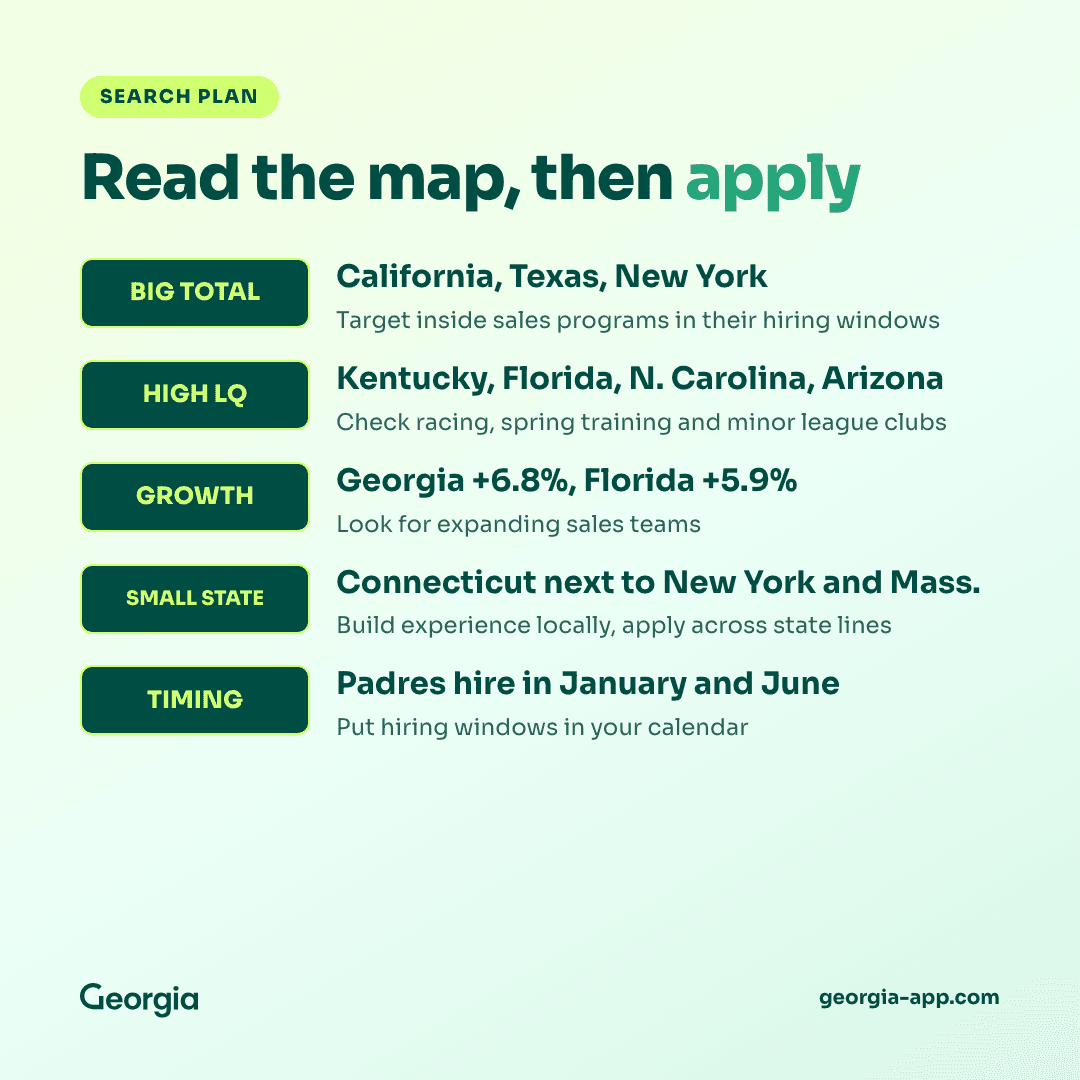
Treat the table as a map of where employers cluster, then narrow it with your own constraints.
JOB SEARCH
Five sports job markets
Georgia · georgia-app.com
The common advice to stay open to relocation is right, and it is also so widely repeated that it gives you nothing to act on. The data gives you something more specific: a short list of states where sports employers cluster, which of them are growing, and which have a concentration of employers that matches the kind of job you want.
Hiring calendars matter as much as geography. The San Diego Padres, for example, say inside sales hires usually start in January and June, and new reps get two weeks of training before their first call (San Diego Padres, Inside Sales). Programs like the MLS National Sales Center place trainees with clubs across the country, with over 300 hires for 24 MLS clubs over 26 sessions (MLS), which means your first job may be in a state you never put on your list. Our guide on how to get into sports business walks through these programs in more detail.
For managers, the same table explains who applies. If you run a sales team in a low-concentration state, most applicants will come from elsewhere, so a clear training plan and a realistic description of the work help you keep the people you move across the country.
Practice the call before you move for it
Moving states for a first job is a big commitment, and the interview for an inside sales role usually includes a mock call. Hiring managers want to hear how you open, how you ask questions and how you respond when a fan says no.
You can rehearse that conversation before the interview. On Georgia you practice a realistic sales call with an AI fan or buyer, get feedback after each attempt and try again. Teams and programs can build custom scenarios around their own situations, such as a season ticket renewal call or a group sales call, so a candidate can practice the call they will actually make in the job.
A five-step state search drill for this week
- Pick three states from the table: one big total, one high concentration and one fast grower.
- List every team in those states that runs an inside sales or ticket sales program, including minor league clubs.
- Note each program's hiring window, such as January and June starts, and put the dates in your calendar.
- Write a 30-second opening for a call to a lapsed season ticket holder, then practice it out loud five times.
- Send one message to a seller at a team in each state and ask what the first 90 days of the job looked like.
Frequently asked questions
Which state has the most sports jobs?
Florida had the most spectator sports jobs in 2025, with 20,386 according to the BLS QCEW. California was second with 17,948 and Texas third with 11,080. Florida also had the most establishments, at 1,040.
Which state has the highest concentration of sports jobs?
Kentucky had the highest location quotient in 2025, at 2.36, which means sports jobs are more than twice as common there as across the US economy. Much of that comes from horse racing, which the BLS includes in spectator sports. Florida, North Carolina and Arizona follow.
Is Connecticut a good state for sports jobs?
Connecticut is small, with 607 spectator sports jobs in 2025 and a location quotient of 0.33. Its value lies in its local teams and its position between New York and Massachusetts, which together had more than 13,000 jobs. A common path for students there is to gain experience with local teams and then apply into the larger markets.
Do I need to move to get a job in sports?
Many people do, because the jobs cluster in a handful of states and the top eight hold just over half of all spectator sports employment. Centralized programs such as the MLS National Sales Center also place trainees with clubs across the country. If you cannot move, focus on every team and venue within reach, including minor league clubs.
Find your market, then practice the call
The state data tells you where to look, and your preparation decides whether you get the offer. Read the post on US sports industry statistics for the national picture, then pick your three states and start practising the calls those teams will ask you to make.
If you run a ticket sales team or teach sport sales, book a demo of Georgia. Teams and programs that qualify as partners get a free custom module built around one of their real sales calls, such as a season ticket renewal.
Sources
- BLS, Quarterly Census of Employment and Wages, NAICS 7112, 2025 annual averages
- BLS, Quarterly Census of Employment and Wages, NAICS 7112, 2024 annual averages
- IUPUI Sports Innovation Institute, 2019 Sports Industry Jobs Report, 2020
- Pierce, Petersen, Clavio and Meadows, Content analysis of sport ticket sales job announcements, 2012
- Pierce, Using Experiential Client-Based Projects in Sport Sales Courses, 2018
- Metro Atlanta CEO, States with the most professional sports franchises, 2022
- University of New Haven, M.S. in Sport Management, 2026
- University of New Haven, Sport Management Major Lands Position with World Series Champion Washington Nationals, 2020
- San Diego Padres, Inside Sales, 2026
- MLS, MLS National Sales Center, 2026