
You are walking along an arena concourse at a career fair with a folder of résumés under your arm. At every team table you say you want to work in sport, and every recruiter answers with a version of the same question: have you thought about ticket sales?
You had pictured marketing, or partnerships, or maybe something in operations. The recruiter is friendly and honest about it, and tells you that the sales program is where they hire most of their new people, that the class starts soon and that the interview will include talking on the phone. You walk away unsure whether that was an offer or a warning.
This post is for students and career changers who want a first job in the business side of sport, and for educators who advise them. It explains why teams hire into sales first, how inside sales programs and academies such as the MLS National Sales Center work, how to get hired, and what the research says about where a ticket sales job leads, including the case for staying in sales.
Ask any advisor how to get into sports business and you will hear the same list: network, get an internship, follow the industry news and be willing to start at the bottom. They are right, and you should do all of it, but advice everyone agrees on is generic and does not tell you what the first job actually is. For most people it is a sales seat, the hiring process is a test of how you sound in a conversation with a stranger, and the people who get through it are the ones who prepared that conversation as carefully as their résumé.
Why teams hire into ticket sales first
Sales is the largest door into a team's front office. Pierce (2018) analyzed entry-level jobs on TeamWork Online in October 2017 and found that sales positions outnumbered every other type of entry-level position by three to one. Ticket sales and service made up 34% of all entry-level jobs, and 41% once sponsorship sales were included.
The reason is partly economic. Popp, Sattler, Pierce and Shreffler (2022) describe ticket sales as the most common entry-level occupation with professional teams, and note that teams attract large applicant pools for sales jobs without needing to invest heavily in pay, benefits or training. The other reason is supply on the candidate side. In interviews with 21 hiring managers, Popp, Harrolle and Wells (2019) found that relatively few aspiring sport managers want to work in sales, so recruiting for those roles is active and continuous.
Put those findings together and you have the most useful fact for a job seeker: sales is where teams are always hiring, and many of your competitors for a first job would rather be somewhere else. If you walk in genuinely interested in selling, you are already ahead of a large part of the line.
Inside sales programs and sales academies
Many teams run a structured entry program instead of hiring one seller at a time, and reading their own descriptions tells you what they expect.
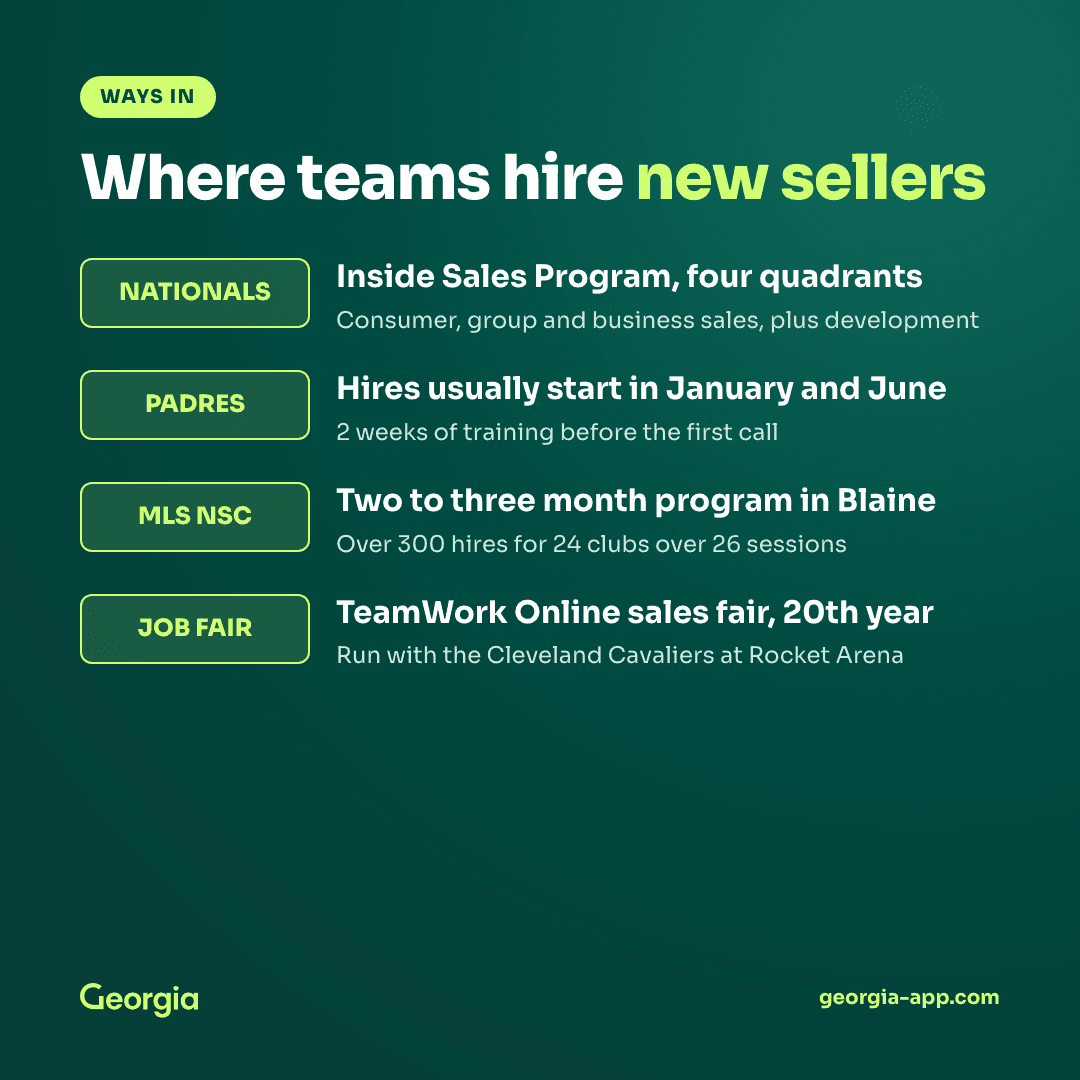
Washington Nationals. The Nationals call their Inside Sales Program an opportunity to break into the sports industry. Training covers four quadrants: business to consumer sales, group sales, business to business sales and professional development, and reps sell season tickets, group and suite events and theme nights.
San Diego Padres. The Padres hire inside sales reps usually in January and June and give them 2 weeks of training before the first call. The program is described as developmental, with next steps into Membership Development, Membership Services, and Group Tickets and Hospitality.
Boston Celtics. The Celtics program combines targeted sales training, development huddles and one to one coaching, with outreach by phone, email and face-to-face appointments.
MLS National Sales Center. Major League Soccer took the idea a step further in 2010 by centralizing it. The center, on the National Sports Center campus in Blaine, Minnesota, runs a two to three month sales training program in which trainees make live calls selling packages for several MLS clubs. The first class graduated in September 2010 with 10 trainees hired by 7 clubs. MLS now says the center has produced over 300 hires for 24 clubs across 26 sessions, and that more than 50 graduates have moved into management.
Job fairs built for sales. The TeamWork Online Sports Sales Workshop and Job Fair, run with the Cleveland Cavaliers at Rocket Arena and now in its 20th year, describes itself as the premier hiring event for entry-level positions in pro sports revenue generation. Students from the University of Iowa have attended it every year for more than a decade.
How to get hired into a sports sales job
Entry-level sales ads emphasize work ethic and cold calling, according to the analysis of 733 job announcements by Pierce, Petersen, Clavio and Meadows (2012), and the Padres state outright that reps must be comfortable making cold calls. Everything you do in the application should show those two things.
GETTING HIRED
The sports sales hiring process
Georgia · georgia-app.com
Take a sales course if you can. Pierce (2018) reported that only 22% of undergraduate sport management programs had a sport sales course, so having one on your transcript sets you apart. Our guide to sports management colleges with sales programs lists programs that teach it.
Compete. The National Collegiate Sports Sales Championship, run by Baylor University, brought 250 students from 50 schools to State Farm Arena in 2026. Competing gives you practice under pressure and a room full of team recruiters.
Avoid the common mistakes. Saying you love the team is the weakest answer you can give, because every candidate says it. Describing sales as a short stop on the way to another department also worries managers who already deal with high turnover. And the biggest mistake is preparing your answers to interview questions while never practising the call itself.
Where a ticket sales job leads: the honest numbers
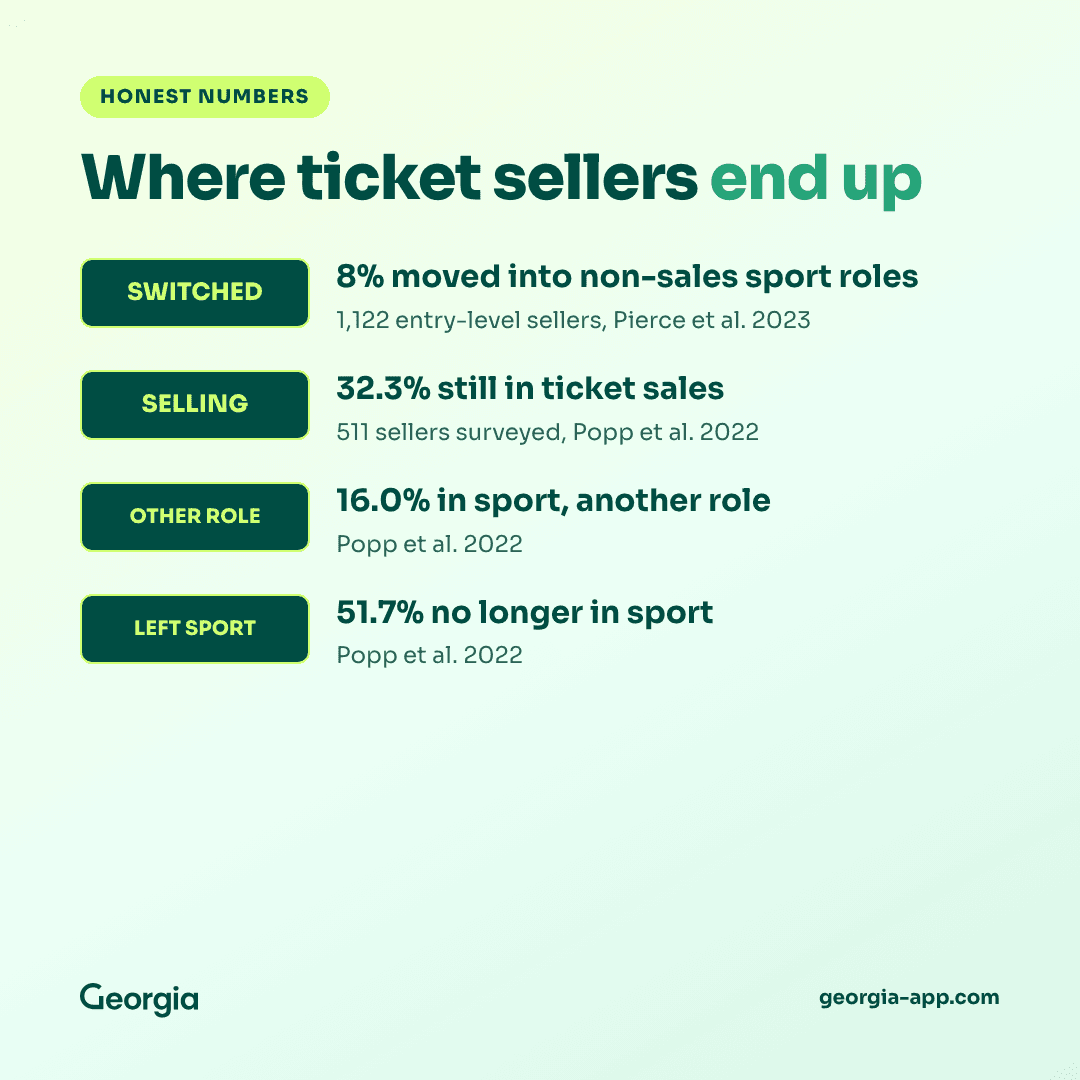
Many people take a sales job planning to move into marketing, partnerships or operations after a year or two. The research says that move is harder than the career fair pitch suggests. Pierce, Wanless, Popp, Sattler and Shreffler (2023) tracked 1,122 entry-level ticket sellers at major league teams and found that only 8% moved from ticket sales into a non-sales role in sport.
A survey of 511 current and former ticket sellers by Popp et al. (2022) shows where the rest ended up.
| Where former and current ticket sellers were (2022 survey, N=511) | Share |
|---|---|
| Still in ticket sales | 32.3% |
| In sport, in a role other than ticket sales | 16.0% |
| No longer in the sport industry | 51.7% |
Source: Popp, Sattler, Pierce and Shreffler, International Journal of Sport Management and Marketing, 2022.
Taken together, the two studies say that a ticket sales job reliably gets you into the industry, while the move from there into a specific non-sales department is much less certain. That is worth knowing before you accept, so you can plan for it instead of hoping. Our post on sports sales jobs covers the pay, the daily work and the reasons people leave in more detail.
The case for staying in sales
The honest numbers above have another side. Sales is where the promotions inside a ticket department happen, from inside sales to account executive, then to group, premium or service roles and eventually to leading a team. The Nationals describe their program as promoting top talent into account executive positions, and MLS says more than 50 of its sales center graduates have moved into management.
The pay supports that path. In May 2025 the Bureau of Labor Statistics counted 1,720 sales managers in spectator sports, with a median annual wage of $96,670. Sponsorship sales is another route that stays in revenue while changing what you sell, from seats to partnerships with companies.
If you find you enjoy the conversations, staying in sales is a real career with a clear ladder. If you still want another department, use your sales years to build a record that marketing or partnership leaders will notice, such as results on campaigns you helped plan, and tell your manager early what you are aiming for.
Practise the conversation before the interview
Hiring managers in the Popp, Harrolle and Wells (2019) study said that assessing candidates is hard, which is one reason so many teams lean on how you handle a call. You can practise with a friend, record yourself, or try a tool built for it. Georgia lets you practise realistic sales calls with an AI fan or buyer, gives you feedback after each attempt and lets you run the same call again, so you can hear your improvement before a recruiter does. Sport management programs can build custom scenarios around a real situation, such as a group sales call or a season ticket renewal, so students arrive at a job fair having already made the call many times.
A one-week plan to get ready for a sports sales hiring process
- Choose three teams with inside sales programs and read their career pages to note when they hire and what they promise.
- Learn one team's season, partial and group plans well enough to explain each in two sentences.
- Write a short introduction about yourself for a phone screen and say it out loud each day.
- Practise a mock sales call every day, asking at least two questions before you mention a price.
- Write down one story from work, sport or school where you kept going after hearing no.
- Message one person who started in a team's sales program and ask what the first six months were like.
Frequently asked questions
Is it hard to get into the sports business?
Many people want a front office job in sport, so most roles are competitive. Sales is the easier door, since sales positions outnumber every other entry-level type by three to one and hiring managers say few candidates want them. Showing genuine interest in selling is one of the fastest ways in.
What is the best entry-level job in sports business?
For most people the most available entry-level job is inside ticket sales with a team. Ticket sales and service made up 34% of entry-level jobs on TeamWork Online in October 2017, and 41% including sponsorship sales. Structured programs at teams such as the Nationals, Padres and Celtics include training and a path to account executive.
Do you need a sports management degree to work in sports business?
A degree in sport management or business helps, but entry-level sales ads emphasize work ethic and cold calling more than a specific major. A program with a sport sales course gives you an edge, since only 22% of undergraduate sport management programs offered one. Practical sales experience from any job counts.
Can you move from ticket sales into another department?
Yes, but fewer people do than the career fair story suggests. Pierce et al. (2023) found only 8% of 1,122 entry-level ticket sellers moved into a non-sales role in sport. Plan for it deliberately, or consider staying in sales, where the path to management is clearer.
Start with the call you will be asked to make
Getting into sports business usually means getting good at one conversation: a call with a stranger who did not expect to hear from you. Teams hire into sales because they always need sellers, and the candidates who stand out are the ones who have practised that call before anyone asks them to make it. If you run a ticket sales team or teach sport management, book a demo of Georgia to see how your people can rehearse real calls with an AI buyer. Teams and programs that qualify as partners get a free custom module built around one of their real sales calls, such as a season ticket renewal. For a wider view of the industry you are joining, see our sports industry statistics.
Sources
- IUPUI ScholarWorks, Pierce, Using Experiential Client-Based Projects in Sport Sales Courses, 2018
- Illinois State University, Popp, Sattler, Pierce and Shreffler, Why sport ticket salespeople leave their jobs, 2022
- Sport Marketing Quarterly, Popp, Harrolle and Wells, How Major League Teams Hire Entry-Level Ticket Sales Representatives, 2019
- Washington Nationals, Sales and Service Job Opportunities, 2026
- San Diego Padres, Inside Sales, 2026
- Boston Celtics, Inside Sales Program, 2026
- MLS, MLS National Sales Center, 2026
- Soccer America, MLS ticket sales school graduates first class, 2010
- University of Iowa, SalesHawks thrive in Cleveland, 2026
- Emerald, Pierce, Petersen, Clavio and Meadows, Content analysis of sport ticket sales job announcements, 2012
- Baylor University, Baylor S3E hosts National Collegiate Sports Sales Championship, 2026
- Emerald, Pierce, Wanless, Popp, Sattler and Shreffler, Attrition in entry-level ticket sales positions: a survival analysis, 2023
- Bureau of Labor Statistics, Occupational Employment and Wages in Spectator Sports, May 2025