
Updated November 2026
By Julia Georgi, founder of Georgia App
It is 5:40 in the morning at a ready-mix plant, and the dispatcher already knows that one of her drivers has been late to the same contractor's pour three times this month. The contractor's foreman has noticed too, yet nobody has said a word to the driver himself.
She tells herself she will bring it up after the morning rush, then after the weekend, then once the schedule calms down. Meanwhile the foreman quietly starts calling a competing plant for his smaller orders, and the driver still has no idea anything is wrong.
When the talk finally happens, it comes out as a heated exchange in the yard, with three weeks of frustration packed into two minutes, and the driver feels ambushed because nobody told him sooner.
So why do we avoid difficult conversations? We avoid them because the mind makes a few predictable forecasting errors: we expect the other person to react far worse than they usually do, we weigh the possible loss more heavily than the possible gain, and every postponement brings a small wave of relief. Research on honesty shows that people react less negatively than we predict, which means the fear is usually bigger than the risk.
This post is for managers and team leads in construction supply, sports ticket sales, insurance and B2B software, and for the HR and L&D people who train them, with the psychology, an example per industry and a drill for this week.
What does the research say about why we avoid difficult conversations?
Most problems at work start as a conversation that came too late, went badly or never happened, and psychologists have studied the "never happened" part for more than fifty years.
The MUM effect: we hold back bad news
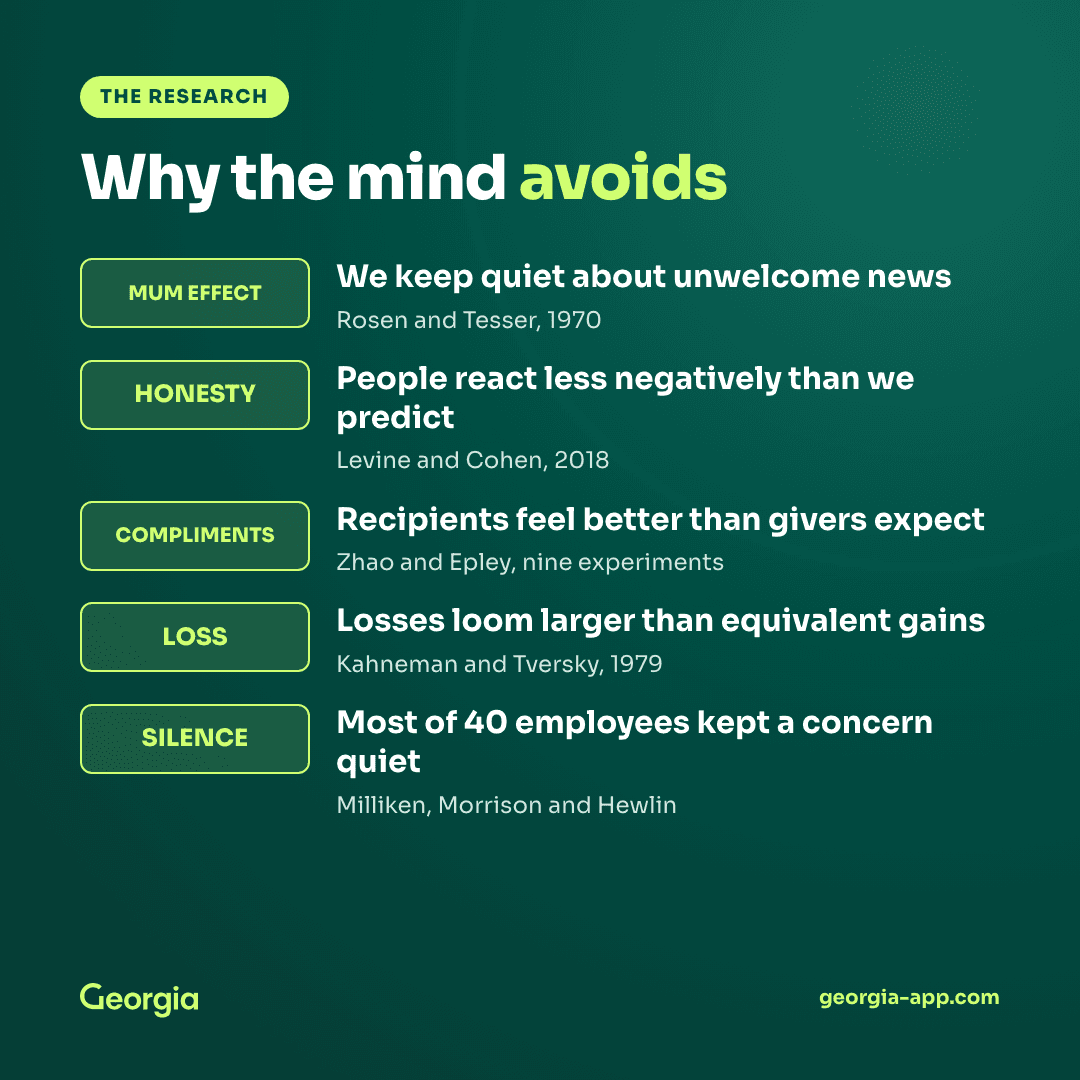
In 1970 the social psychologists Sidney Rosen and Abraham Tesser described what they called the MUM effect, a tendency people have to keep quiet about information that will be unwelcome to the person it concerns. A later study in five European cities dropped "lost" postcards on public transport and found that more of them were returned when the message was good news for the recipient, as long as the news mattered, and the pattern held in four of the five cities. The dispatcher is doing the same thing with her late driver, holding on to the news because delivering it feels worse than carrying it.
We overestimate how badly people will react to honesty
In 2018 Emma Levine and Taya Cohen published experiments in which people were asked to be fully honest with everyone in their lives for three days, or to have specific honest conversations they normally avoid, including sharing negative feedback. Focusing on honesty turned out to be more pleasant and more socially connecting, and it did less harm to relationships, than the participants expected. The authors concluded that communicators overestimate how negatively others will react to their honesty, which is the exact forecast that keeps a manager quiet.
We underestimate how much kind words help
Xuan Zhao and Nicholas Epley ran nine experiments on compliments and found that people who wrote a genuine compliment underestimated how good it would make the recipient feel and overestimated how awkward the moment would be.
This matters for hard conversations because many of them go better when you also say what you value about the person, and managers tend to leave that part out for the same reason they delay the rest: they predict an awkwardness that rarely arrives.
Loss aversion makes the risk feel bigger than the reward
Daniel Kahneman and Amos Tversky showed in their 1979 work on prospect theory that losses loom larger than equivalent gains. When you weigh up a hard talk, a sulking rep or a strained relationship tends to feel heavier than the gain of fixing the problem.
Silence spreads through a team
Elizabeth Morrison and Frances Milliken described organizational silence in 2000 as a collective pattern, in which the beliefs of managers and the way a company is set up make keeping quiet the default. A follow-up study by Milliken, Morrison and Patricia Hewlin interviewed 40 employees and found that most had been concerned about an issue at work and had kept it from their supervisor, most often out of fear of being labeled negatively and damaging relationships they valued. When a manager avoids hard conversations, the team learns that quiet is safer too.
Is fear of confrontation at work a sign of weak leadership?
Ask any leadership coach how to stop avoiding hard talks and you will hear the same sensible list: raise issues early, describe behavior instead of character, listen more than you speak and, of course, prepare. They are right, and you have probably read that list many times, which is exactly why it rarely changes what you do at 5:40 on a busy morning, because advice everyone agrees on is generic enough to fit every situation and none in particular.
The research points to something more specific. Conflict avoidance is mostly a forecasting problem, and forecasts change through experience, so the managers who stop avoiding are usually the ones who have said the hard first sentence out loud often enough to learn that the reaction is survivable. Knowing the steps is recognition, while saying the words under pressure is retrieval, and you only build retrieval with repetitions.
WHY WE AVOID
What you fear and what research found
Georgia · georgia-app.com
What does conflict avoidance look like in your industry?
The ready-mix dispatcher
The dispatcher from the opening avoids talking to the late driver because he is reliable in every other way and she does not want to lose him in a tight labor market. A first sentence that works is short and factual: "You have been late to the same contractor's pour three times this month, and I want to understand what is going on before the contractor stops calling us." See how building materials teams practice talks like this.
The ticket sales manager
A ticket sales manager sees that a second-year rep who carried the team last season has made fewer calls every week since the playoffs ended. The rep is popular, so the talk waits until renewal numbers come in and the season is lost. More on sports sales teams.
The insurance agency owner
An agency owner has a customer service rep with fifteen years of experience who has started sounding short with clients on the phone. The owner fears that raising it will push her to leave and take years of carrier knowledge with her, so he keeps smoothing over complaints himself. More for insurance agencies.
The SaaS team lead
A newly promoted team lead now manages someone who was a peer three months ago, and that person keeps missing sprint commitments and pushing back in standups. The lead avoids the one-to-one because it feels like betraying a friendship, while the rest of the team wonders why the rules apply only to them. More for B2B software teams.
How do you stop avoiding difficult conversations?
You stop avoiding them by making the conversation smaller and more concrete than the version in your head.
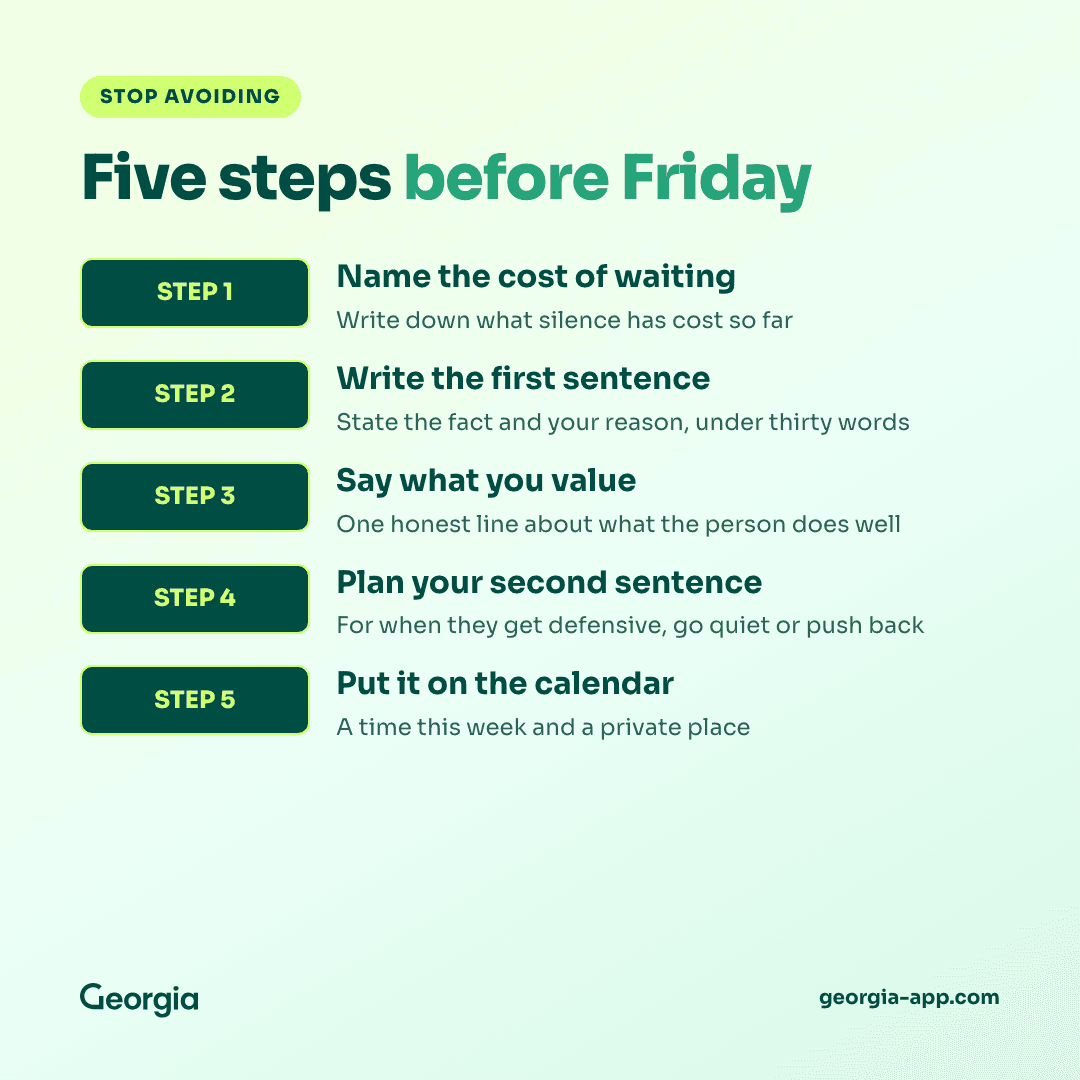
- Name the cost of waiting. Write down what silence has cost so far, so the loss of waiting is as visible as the loss of speaking.
- Write the first sentence. The first sentence is where most people freeze, so write one that states the fact and your reason for raising it, and keep it under thirty words.
- Say what you value. Add one honest line about what the person does well, since the compliment research suggests it will land better than you expect.
- Plan your second sentence. Decide what you will say if the person gets defensive, goes quiet or pushes back.
- Put it on the calendar. Pick a time this week and a private place.
For a deeper look at feedback itself, read our guide on constructive feedback training that changes manager behavior.
What are the most common mistakes?
- Saving the issue for the annual review, where it arrives months late and feels like an ambush.
- Softening the message so much that the other person leaves without knowing anything was wrong.
- Raising it over chat because it feels safer, which removes tone and invites a defensive reply.
How can you practice a difficult conversation before it happens?
Because the fear comes from a forecast, the most direct fix is evidence about how people react, collected before the real conversation. Role-play with a colleague helps, though it is awkward to ask for and hard to repeat often.
This is why we built Georgia for leadership teams, an AI role-play platform where managers rehearse hard conversations. You rehearse the conversation with an AI employee who reacts the way people really do, by pushing back, getting defensive or going quiet, then you get feedback after each attempt and try again, in sessions of 3 to 8 minutes. Scenarios can be built around your team's real situations, in voice or text and in any language, and my co-founder Delphine Voillet has over 25 years of coaching experience.
For more routines, see our leadership role-play exercises and how a difficult conversation simulator for managers works.
What should you practice this week?
- Pick one conversation you have postponed for more than a week.
- Write down what waiting has cost so far and what it will cost by the end of the month.
- Write the first sentence, then rehearse it out loud three times, ideally with someone or something that can push back.
- Predict how the other person will react on a scale from 1 (calm) to 10 (furious), and write the number down.
- Have the conversation before Friday, then compare the real reaction with your number.
Frequently asked questions
Why do I avoid confrontation even when I know I am right?
Being right does little to change the forecast your mind makes about the other person's reaction. Research on honesty shows people expect others to react more negatively than they do, so the fear stays strong even when your case is clear.
What is it called when you avoid difficult conversations?
The general pattern is usually called conflict avoidance. Psychologists call the specific reluctance to deliver bad news the MUM effect, a term Rosen and Tesser introduced in 1970. When a whole team keeps quiet about problems, researchers call it organizational silence.
How long should you wait before having a difficult conversation?
Wait only long enough to get the facts straight and to calm down if you are angry, which is usually a day or two. If you have postponed a talk for more than a week, treat that as a sign the delay is about fear.
What should the first sentence of a difficult conversation be?
A good first sentence names the specific behavior and why you are raising it, without a long warm-up. For example, "You have been late to three pours this month, and I want to understand what is happening."
Can managers learn to stop avoiding hard conversations?
Yes, because the avoidance rests on predictions, and predictions change with experience. Managers who practice the opening and the likely reactions, then have the real talk and compare it with what they expected, usually find the next one easier.
Which conversation have you been putting off?
Every team has at least one conversation that is waiting for a better moment, and the research says that moment is unlikely to arrive on its own. If you want your managers to get comfortable with these talks before they happen, book a demo of Georgia and ask about our free pilot. Teams that qualify as partners also get a free custom module built around one of their real conversations.
Sources
- Sociometry, Rosen and Tesser, On reluctance to communicate undesirable information: The MUM effect, 1970
- Social Behavior and Personality, O'Neal, Levine and Frank, Reluctance to transmit bad news when the recipient is unknown: Experiments in five nations, 1979
- Journal of Experimental Psychology: General, Levine and Cohen, You can handle the truth: Mispredicting the consequences of honest communication, 2018
- Journal of Personality and Social Psychology, Zhao and Epley, Insufficiently complimentary?: Underestimating the positive impact of compliments creates a barrier to expressing them, 2021
- Econometrica, Kahneman and Tversky, Prospect theory: An analysis of decision under risk, 1979
- Academy of Management Review, Morrison and Milliken, Organizational silence: A barrier to change and development in a pluralistic world, 2000
- Journal of Management Studies, Milliken, Morrison and Hewlin, An exploratory study of employee silence: Issues that employees don't communicate upward and why, 2003