

Table of Contents
- Key Takeaways
- Table of Contents
- Rehearse the Sales Conversations Where Margin and Deals Are at Risk
- Separate Live Guidance, Call Analysis, and AI Role-Play Before You Compare Tools
- Compare AI Sales Coaches by the Conversations Your Team Needs to Improve
- Build a Repeatable Practice Routine Around Real Sales Scenarios
- Final Thought: Put AI Sales Practice Into the Team's Operating Rhythm
- Put the Next High-Stakes Conversation on the Practice Plan
- Frequently Asked Questions
An AI coach for sales teams earns its place before the customer answers the phone. When a rep fumbles a price objection, makes an unclear delivery commitment, or fails to address availability, the cost can show up in lost margin or a stalled order. Distributed teams often have limited shared coaching time, so high-stakes conversations can catch reps unprepared.
Choosing the right kind of support starts with identifying when the gap appears. Live assistance guides a conversation as it happens. Call analysis helps managers review what happened afterward. AI role-play gives reps a place to rehearse before the customer is on the line. Each addresses a different need, so compare tools against the moment you want to improve.
This article explains how to distinguish those approaches and build coaching around conversations that put deals and margin at risk. You’ll see how to prioritize realistic practice for price, delivery, and availability objections, then connect rehearsal to observable changes in what reps say on calls. Georgia’s personalized, self-paced simulations offer a way to extend communication practice across sales teams.
Key Takeaways
- Match the coaching approach to the gap: in-call guidance, review of completed calls, or rehearsal before the conversation.
- Evaluate an AI coach for sales teams by testing whether its scenarios reflect the pressure your reps face with customers.
- Start with one recurring conversation problem, then establish a repeatable practice and manager-review routine around it.
- Track whether rehearsal changes what reps say and do in customer conversations, not simply how often they complete practice.
Rehearse the Sales Conversations Where Margin and Deals Are at Risk
Inconsistent customer conversations create operational drag. An unplanned discount can weaken margin, while a vague response about delivery or availability can leave a customer uncertain about what happens next.
Managers have limited time to coach a distributed team. Without a routine for practice, reps may encounter difficult conversations with customers before they have rehearsed a clear response.
The video below offers one perspective on AI and sales coaching. As you watch, consider which conversations your reps need to practise before a call.
Identify the moments that put a sale under pressure
A price objection tests whether a rep can understand the buyer’s concern and explain value before discussing a concession. A delivery change or availability constraint calls for a clear explanation of what has changed and what the customer needs to decide next.
An AI coach for sales teams helps reps practise customer conversations that can put margin, delivery expectations, and relationships at risk. Artificial intelligence can support focused communication practice without making the commercial decision for the rep.
Treat communication practice as operational preparation
Rehearsal gives reps a chance to practise questions and responses before pressure builds. It can support more consistent communication, but it does not guarantee revenue or close-rate gains. Look for observable behaviours: does the rep clarify the request, explain a constraint, and avoid offering a concession before understanding the issue?
Georgia’s personalized AI role-play practice uses self-paced simulations to help people practise communication under pressure. Connect that preparation to your soft-skills training programs and the customer conversations that repeatedly test the team.
Separate Live Guidance, Call Analysis, and AI Role-Play Before You Compare Tools
“AI coach” can describe tools designed for different points in the sales process. Identify the coaching gap first, or you may compare features that address a different problem.
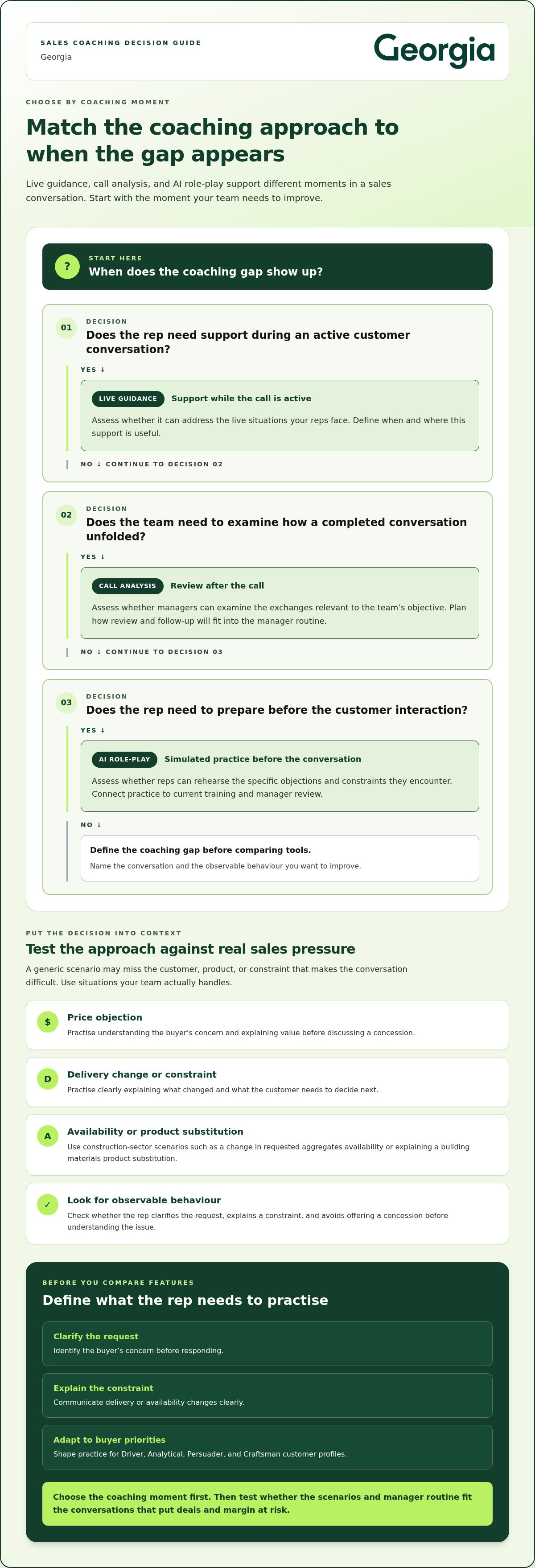
Live guidance supports a rep during an active customer conversation. Call analysis helps managers review completed conversations. AI role-play gives reps a chance to practise before customer interactions. Each approach addresses a distinct coaching moment.
Match the coaching moment to the team’s gap
If reps need help while speaking with a customer, assess live guidance. If managers need to examine how a completed exchange unfolded, assess call analysis. If reps need to prepare for an upcoming conversation, assess rehearsal.
For example, a manager might use rehearsal to prepare a rep for a negotiation with a contractor, then use a separate review process to discuss a completed customer call. The timing and objective determine which approach fits.
Keep the tool category separate from the coaching objective
Before comparing features, define the behaviour you want reps to practise. It might be asking a clarifying question, explaining a constraint, or adapting a response to a buyer’s priorities. A Driver may prefer a concise response, while an Analytical buyer may want the reasoning behind a recommendation. Include the Persuader and Craftsman profiles when shaping practice for different customer styles.
Different approaches can serve different roles in a team’s coaching routine. Georgia’s AI role-play simulations support personalized, self-paced communication practice before customer conversations.
Compare AI Sales Coaches by the Conversations Your Team Needs to Improve
Compare tools against the conversations your reps handle, not a feature checklist. A generic subscription renewal may tell you little about a contractor challenging a quote, a ready-mix customer facing a delivery change, or an aggregates buyer asking about product availability.
Use the framework below to test fit. Treat manager effort as a practical question about how each approach could fit your team’s routines, rather than assuming that a tool will handle the coaching process for you.
| Approach | Practice format | Coaching timing | Scenario relevance | Manager effort to assess |
|---|---|---|---|---|
| Live guidance | Support during a customer conversation | While the call is active | Can it address the live situations your reps face? | How will managers define when and where this support is useful? |
| Call analysis | Review of completed conversations | After the call | Can managers examine the exchanges relevant to the team’s objective? | How will managers make review and follow-up part of their routine? |
| AI role-play | Simulated conversation practice | Before a customer interaction | Can reps rehearse the specific objections and constraints they encounter? | How will practice connect to current training and manager review? |
Evaluate scenario relevance for construction-sector sales
Read or run scenarios with your field context in mind. A building materials rep may need to explain a product substitution. A concrete sales rep may need to communicate a delivery constraint clearly. An aggregates rep may need to respond when requested material availability changes. Customer relationships can add pressure across construction sales: a familiar buyer may expect flexibility, while the rep still needs to set clear expectations.
Generic prompts can miss details practitioners recognize, such as the customer’s schedule, the product under discussion, or the effect of a changed commitment. Assess whether a scenario lets the rep clarify the customer’s priority, explain the situation, and respond professionally. These criteria help you compare an AI coach for sales teams, especially when the training objective includes negotiation conversations.
Test whether the format fits the team’s workflow
Self-paced rehearsal gives reps a chance to practise before calls. Live support belongs inside active conversations. Post-call review gives managers a basis for examining what happened. Consider who will assign practice, review what reps learn, and connect it to current sales meetings or follow-up.
Track practice activity separately from commercial outcomes. Completion and behaviours such as asking a clarifying question or explaining a constraint without making an early concession can be observed during training. Revenue and close rates require independent measurement and depend on factors beyond a practice tool. Connect scenario selection to your sales negotiation training priorities, then assess whether the format supports the behaviour you want to improve.
Build a Repeatable Practice Routine Around Real Sales Scenarios
A practice routine loses focus when it starts with a large scenario library and no clear priority. Choose one recurring conversation problem, define what the rep should do differently, then establish a simple cycle for rehearsal and review.
For example, if reps concede too quickly under price pressure, focus practice on clarifying the customer’s needs before responding. Ground the scenario in your team’s actual sales environment, including the buyer, product, and constraints involved.
- Select one recurring friction point. Use a pattern managers hear in customer conversations, such as a price objection, a delivery change, or a stock constraint.
- Set one observable objective. Ask reps to clarify the customer’s concern before explaining a price, proposing an option, or discussing a revised delivery plan.
- Rehearse the exchange. Use a realistic scenario that gives the rep room to listen, respond, and practise the target behaviour under pressure.
- Review and adjust. Compare the practice with your communication expectations, then decide whether to repeat the scenario or address a different gap.
Choose a scenario and define the target behaviour
Make the scenario specific enough to feel familiar to a building materials, concrete, or aggregates team. A customer might challenge a quote while comparing supply options, question a delivery change against a job schedule, or ask about a stock constraint after planning around an expected product. The purpose is to practise communication, not to invent operational facts or promise a particular resolution.
Give the rep a clear action to practise: ask a clarifying question, acknowledge the concern, explain the known constraint, or confirm the customer’s priority before proposing a next step. A focused objective is easier to review than a broad instruction to “handle objections better.”
Review practice without turning it into a one-off event
Set a cadence that fits the team’s operating rhythm, then keep the focus on the chosen behaviour. Managers can review practice against shared expectations for clarity, listening, and response. Personalized, self-paced simulations, such as those offered through Georgia, give reps a way to practise communication under pressure. Managers set the standard and connect rehearsal to real conversations.
Connect practice to the team’s operating measures
Separate participation from performance. Record practice completion as a training measure, then observe whether the target behaviour appears in customer conversations. If you already review call notes, customer feedback, or sales execution measures, establish a baseline before looking for a change. Revenue and close rates can be affected by factors beyond training, so avoid attributing commercial movement to practice without evidence.
Use the AI coach for sales teams as part of a measured routine: practise, review, observe, and adjust.
Final Thought: Put AI Sales Practice Into the Team's Operating Rhythm
Choose one recurring, high-pressure conversation and make rehearsal part of your team’s development routine. Review practice against clear communication expectations, then observe whether reps apply those behaviours with customers. An AI coach for sales teams can support preparation while managers set priorities and connect practice to the work. Georgia provides personalized, self-paced AI role-play simulations for communication practice under pressure. Book a demo to see how the platform could fit your team’s training needs.
Put the Next High-Stakes Conversation on the Practice Plan
Choose one customer conversation your team needs to handle more consistently, then make it a defined part of sales development. Give reps a clear behaviour to practise and managers a practical standard to reinforce. A specific coaching objective gives the team a stronger starting point than adding a tool without deciding what needs to change.
An AI coach for sales teams should support the practice your operation needs. Georgia’s personalized, self-paced simulations focus on soft-skills conversations, alongside sales and commercial training modules. Book a demo to explore how that practice could fit your team’s customer scenarios and training rhythm.
Build the routine around the work, keep expectations clear, and give reps a chance to prepare before the conversation matters.
Frequently Asked Questions
Can an AI coach help sales reps prepare for price objections?
Yes. An AI coach for sales teams can give reps a place to practise responding to price pressure before a customer conversation. Build the scenario around whether they identify what is driving the objection, such as scope, specification, or timing, before discussing concessions. After practice, review whether the rep explains the relevant trade-off clearly and confirms the customer’s priority.
Does an AI sales coach work during a live call?
Some products focus on support during an active call, while others help managers review completed conversations or let reps rehearse beforehand. Assess when the coaching happens. If your goal is to help a rep prepare for a scheduled negotiation, a tool centered on post-call review addresses a different moment in the sales process.
Can AI role-play replace a sales manager's coaching?
No. Role-play can give reps additional practice, while managers remain responsible for setting expectations and applying judgment to customer situations. For example, a manager can align the team on what a clear commitment sounds like when an order changes, then use practice to discuss how a rep communicates the next step. Simulation extends preparation; it does not remove manager accountability.
How should a sales team measure AI coaching?
Track training activity, observed behaviour, and commercial outcomes as separate measures. Record whether reps complete assigned practice, then review customer conversations for behaviours such as clarifying a request before proposing an option. Establish a baseline using existing records before comparing results over time. Changes in orders or revenue can have several causes, so avoid attributing them to coaching without evidence.
What scenarios should construction sales teams practise with an AI coach?
Choose situations tied to decisions your reps handle, such as a customer requesting a substitute, asking whether material can be held, or seeking a revised plan after supply details change. A useful scenario gives the rep a chance to clarify what the customer needs and communicate only what they know. This keeps rehearsal relevant to building materials, concrete, aggregates, and construction sales.
Is self-paced AI sales practice useful for experienced reps?
Yes, when practice targets a real conversation challenge rather than repeating material a rep already handles well. An experienced rep might rehearse a negotiation with a long-standing account where a pricing request carries relationship pressure, or prepare for a changed customer requirement. Focus practice on a specific communication choice, then let the manager connect it to the account context.
What should a team pilot before adopting an AI sales coach?
Pick one recurring conversation, define the behaviour reps will practise, and agree on how managers will review it. Use a consistent scenario and shared criteria to assess whether the practice fits the team’s work. Before the pilot, record a baseline from relevant existing measures. Review training participation and observed behaviour separately, then consider commercial results alongside other factors that may influence them.